
Prep time
24 hours
Cook time
6 hours
Course
Main
Skill level
Intermediate
Season
Fall, Winter
Serves
6
Duck confit is a classic among classics. It’s a cooking method that has withstood the test of time, largely in part because of its simplicity: duck legs, slowly cooked in duck fat. It’s simple yet decadent, hearty, and deeply satisfying. If you like duck, tender braised meat, and duck fat, you’re in luck—this dish has plenty of all three.
If you’ve never made confit before, the premise is simple: brine the meat, cover it in fat, and cook it low and slow. For a full description of the technique, check out this article.
Once you make this confit, you’ll start thinking about all the other things you can slowly simmer in fat to get that unctuous taste that confit is famous for. Small game, upland birds, and venison can all be cooked with amazing results.
This recipe uses wild shot duck legs. Wild goose legs can be used with an increase in cook time. Domestic birds will generally, depending on size, take less time than their wild game equivalent. The fowl legs should be plucked—you want the skin and fat intact.
I use an equilibrium brine for this recipe. This accomplishes two things: it prevents the meat from becoming overly salty if I leave it in the refrigerator for a few extra days, and it ensures that the meat is properly seasoned while concentrating the flavor of the meat.
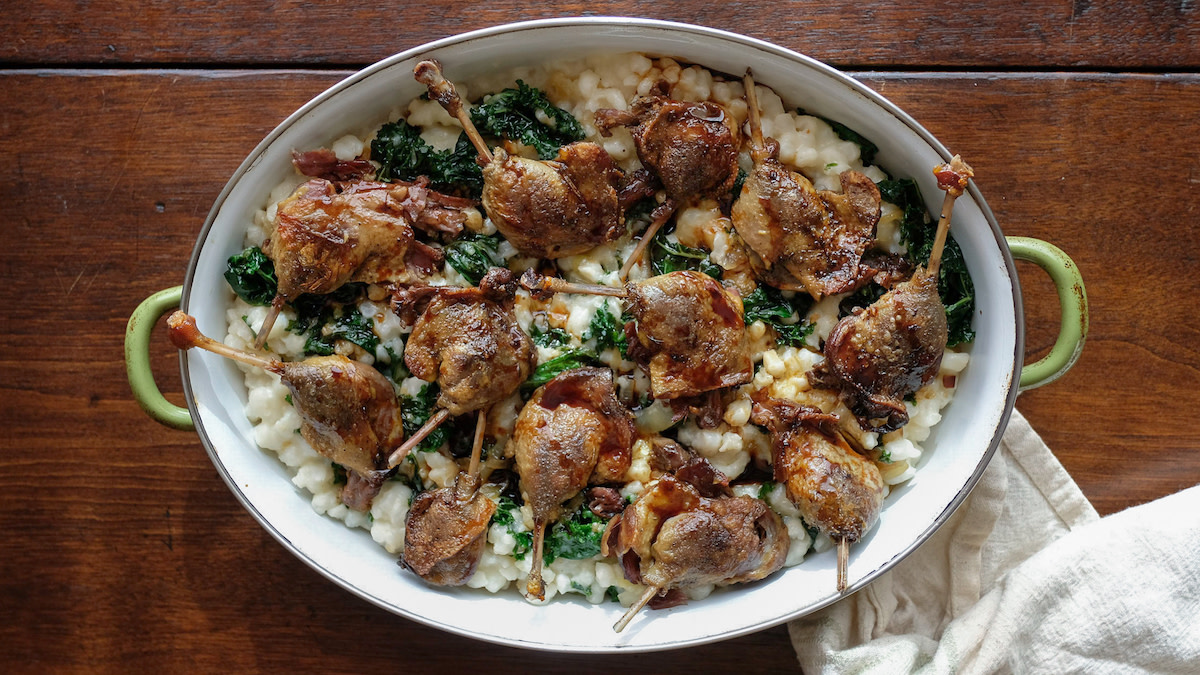
Once the duck legs are finished cooking, be sure to allow them to cool down in the fat. This is the key step to having super moist, ultra rich confit. To finish this dish, I use some of the fat and roasted garlic to wilt winter greens, warm up some hominy, sear the legs, and serve with a bit of demi glace for a southern take on a classic cassoulet.
Ingredients
- 12 duck legs, skin on, weighed
- 1.75% salt (e.g. for 1000g duck legs, use 17g salt)
- 1-2 cups duck fat
- 1 head garlic, cut crosswise
- 2 sprigs rosemary
- 6 sprigs thyme
- Zest, one lemon
- 1 tsp. fresh black pepper
Also works with
Preparation
- Weigh the duck legs and calculate the amount of salt you will be using (1.75% by weight). Season both sides of duck legs with the salt. Season with black pepper.
- Place in a non-reactive pan with herbs, lemon zest, and garlic. Cover and refrigerate for 24 hours or more. Do not brush off any excess salt before cooking.
- When ready to cook, preheat the oven to 200°F, and place a rack in the center of the oven.
- Place duck legs, lemon zest, garlic and herbs in a dutch oven or a heavy roasting pan, and add enough duck fat to submerge. Cover with a lid or foil. Place in the preheated oven.
- Cook for 4 to 6 hours, or until fork tender. Remove from the oven, partially remove lid or foil and be sure to allow it to cool completely to room temperature. Remove the duck legs from the fat. Strain the garlic and aromatics from the confit fat and save that garlic for other dishes. The fat will keep for a few weeks or months at room temperature and adds wonderful flavor to other dishes, as well.
- The finished confit is endlessly versatile—shred it from the bone and add to anything you like, use it to make rillettes, or sear each leg in a hot pan and serve over hominy, like we did.
Shop
Sign In or Create a Free Account
Related

Recipes
Duck Chilaquiles
(1)
Recipes
Duck Reuben Sandwich
(2)
Recipes
Duck and Avocado Tartare
(0)The comments section requires Functionality cookies. Please enable Functionality cookies in Cookie Settings to view this content.
Duck Confit
Prep time
24 hours
Cook time
6 hours
Course
Main
Skill level
Intermediate
Season
Fall, Winter
Serves
6
Duck confit is a classic among classics. It’s a cooking method that has withstood the test of time, largely in part because of its simplicity: duck legs, slowly cooked in duck fat. It’s simple yet decadent, hearty, and deeply satisfying. If you like duck, tender braised meat, and duck fat, you’re in luck—this dish has plenty of all three.
If you’ve never made confit before, the premise is simple: brine the meat, cover it in fat, and cook it low and slow. For a full description of the technique, check out this article.
Once you make this confit, you’ll start thinking about all the other things you can slowly simmer in fat to get that unctuous taste that confit is famous for. Small game, upland birds, and venison can all be cooked with amazing results.
This recipe uses wild shot duck legs. Wild goose legs can be used with an increase in cook time. Domestic birds will generally, depending on size, take less time than their wild game equivalent. The fowl legs should be plucked—you want the skin and fat intact.
I use an equilibrium brine for this recipe. This accomplishes two things: it prevents the meat from becoming overly salty if I leave it in the refrigerator for a few extra days, and it ensures that the meat is properly seasoned while concentrating the flavor of the meat.
Once the duck legs are finished cooking, be sure to allow them to cool down in the fat. This is the key step to having super moist, ultra rich confit. To finish this dish, I use some of the fat and roasted garlic to wilt winter greens, warm up some hominy, sear the legs, and serve with a bit of demi glace for a southern take on a classic cassoulet.
Ingredients
- 12 duck legs, skin on, weighed
- 1.75% salt (e.g. for 1000g duck legs, use 17g salt)
- 1-2 cups duck fat
- 1 head garlic, cut crosswise
- 2 sprigs rosemary
- 6 sprigs thyme
- Zest, one lemon
- 1 tsp. fresh black pepper
Also works with
Preparation
- Weigh the duck legs and calculate the amount of salt you will be using (1.75% by weight). Season both sides of duck legs with the salt. Season with black pepper.
- Place in a non-reactive pan with herbs, lemon zest, and garlic. Cover and refrigerate for 24 hours or more. Do not brush off any excess salt before cooking.
- When ready to cook, preheat the oven to 200°F, and place a rack in the center of the oven.
- Place duck legs, lemon zest, garlic and herbs in a dutch oven or a heavy roasting pan, and add enough duck fat to submerge. Cover with a lid or foil. Place in the preheated oven.
- Cook for 4 to 6 hours, or until fork tender. Remove from the oven, partially remove lid or foil and be sure to allow it to cool completely to room temperature. Remove the duck legs from the fat. Strain the garlic and aromatics from the confit fat and save that garlic for other dishes. The fat will keep for a few weeks or months at room temperature and adds wonderful flavor to other dishes, as well.
- The finished confit is endlessly versatile—shred it from the bone and add to anything you like, use it to make rillettes, or sear each leg in a hot pan and serve over hominy, like we did.