

Myths, lies and old wives’ tales loom large in the outdoor pursuits. Here at MeatEater, we’re dedicated to separating facts from bull, so we created this series to examine suspect yarns. If there’s a belief, rumor, or long-held assumption you’d like us to fact check, drop us a note at factchecker@themeateater.com.
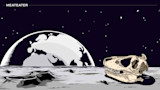
Claim The asteroid that killed the dinosaurs had such an intense impact with Earth that it launched dinosaur shrapnel into orbit. Thus, in theory, there could be perfectly preserved bones on the moon.
Origin Scientists have been speculating about this since Apollo 14 astronauts found Earth rocks on the moon in 1971. It’s believed the 4-billion-year-old piece of granite got there via an asteroid’s collision with our planet. Since then, it’s been a popular bit of bar room wisdom among amateur paleontologists and astronomers.
Most recently, scientist Hank Green went viral on TikTok explaining this lunar-dinosaur hypothesis. His minute-long video from June 12 has nearly 2 million views.
Facts The asteroid that flung a rock to the moon isn’t the same asteroid that doomed the dinosaurs, but the physics are unchanged. In Peter Brannen’s 2017 book “The Ends of the World,” he stunningly describes how it could happen:
“As the asteroid collided with the earth, in the sky above it where there should have been air, the rock had punched a hole of outer space vacuum in the atmosphere,” Brannen wrote. “As the heavens rushed in to close this hole, enormous volumes of earth were expelled into orbit and beyond—all within a second or two of impact.”
Later in the book, Brannen directly asks geophysicist Mario Rebolledo if that means there’s pieces of dinosaur bone on the moon. “Yeah, probably,” Rebolledo answers.
Takeaway Anything is possible when an asteroid the size of Mount Everest moving 20 times faster than a .30-06 bullet hits earth. While no dino DNA has been discovered in space, it’s likely they beat us to the moon by about 66 million years.
Feature graphic via Hunter Spencer.
Stay in the loop with The MeatEater Newsletter
Shop
Related
Anthropology
Fact Checker: Are There Dinosaur Fossils on the Moon?

Natural History
Fact Checker: Were Whales Released in the Great Salt Lake?

Wildlife Management
Study: The Future of Moose in the Adirondacks

The comments section requires Functionality cookies. Please enable Functionality cookies in Cookie Settings to view this content.