5 Of the Weirdest Things People Catch Through the Ice

One of the biggest things we like about ice fishing is the mystery. Unlike open-water fishing, where we can see down into the clear blue depths, ice fishing blocks the aquatic world from view, adding a layer of secrecy as to what may be lurking beneath our feet. When we drill a hole in the ice, there’s a sense of piercing the veil where we’re staring down through a window into a dark and unseen and never really know what may be staring back.
For the most part, whenever we go ice fishing we’re targeting a particular fish species or even multiple species and have a general idea of what we’re going to catch. However, there are plenty of times when we end up with a surprise. Some anglers hook into the occasional walleye when jigging for perch, or end up landing a bass on a tip-up they set for pike. Others catch a smattering of trout when they’re going for panfish, or they’ll hook into a giant muskie on a burbot or lake trout line.
These surprise catches are usually viewed as a pleasant and often welcome bi-catch that spices up a cold day. Yet, on occasion, the hidden world beneath the ice yields something that’s not only surprising—but downright weird.
Mudpuppies
Everyone remembers their early years catching salamanders. During the summer, you’d go down to a pond or stream with a bucket and pluck the tiny wriggling amphibians from the water with your hands or a small net. Occasionally, it was because you were catching them for bait or to keep them as pets, but usually, it was just for the fun of watching them wriggle around for a few minutes before you let them go. However, the fun of catching a salamander is entirely different during the cold of winter when you suddenly pull a large, teeth-snapping dragon out of a hole in the ice, but that’s how it feels to land a mudpuppy.
Mudpuppies are a common bi-catch in Mid-Western and Eastern North America. One of the largest species of salamander, mudpuppies usually range between 8 to 15 inches long and are a far cry from the almost adorable salamanders you may have caught as a child. Not only are they large, but because their skin and lung respiration is not sufficient for gas exchange, mudpuppies also have a set of flaring external gills along the sides of their necks and heads, giving them a very alien-like appearance. As voracious predators with a row of sharp teeth that help them eat a variety of small fish, insect nymphs, minnows, and crayfish, they’re capable of delivering a nasty bite to a fingertip.
Mudpuppies are active winter feeders and are actually caught quite frequently through the ice. So, while it’s not uncommon to hear the sudden exclamation of ice anglers encountering a mudpuppy when they think they’re pulling out a perch or panfish, the appearance of one coming out of the darkness of an ice hole gets weirder every single time it happens.
Catfish
Catfish are a weird fish in general. With whiskered faces and spines on their fins, along with their indiscriminate diets and ability to live in otherwise uninhabitable waterways, wanting to catch catfish during the summer is bizarre enough on its own. However, when you’re pulling a catfish through a hole in the ice during the dead of winter, the oddness of the whole experience increases tenfold.
Ice fishing for catfish is something that 99.9% of ice anglers completely overlook, which is what makes it so unusual. The fish are almost strictly associated with warm summer nights and hot, muddy lakes and rivers, and so catching one in a frozen, bitterly cold world just feels out of place. Yet, some anglers not only catch catfish through the ice but actually target them as a regular and reliable ice fishing quarry.
While it is possible to catch blue and flathead catfish through the ice on occasion, the species that is most frequently caught and usually targeted through the ice is the channel cat. These warm-water catfish have a winter activity level similar to bass, where they’re fairly active during both early and late ice and can be caught in fairly shallow water.
Most of the time, ice anglers targeting catfish do so by jigging with large lures tipped with chunks of worms, maggots, or live and dead minnows or by setting tip-ups for them baited with chunks of cut bait. When the fish are biting, the action can be surprisingly fast and furious, so if you’re an angler craving a meal of fried catfish during the middle of winter, you may want to go out and try your hand at catching some winter kitties through the ice because you could be pleasantly surprised.
Sturgeon
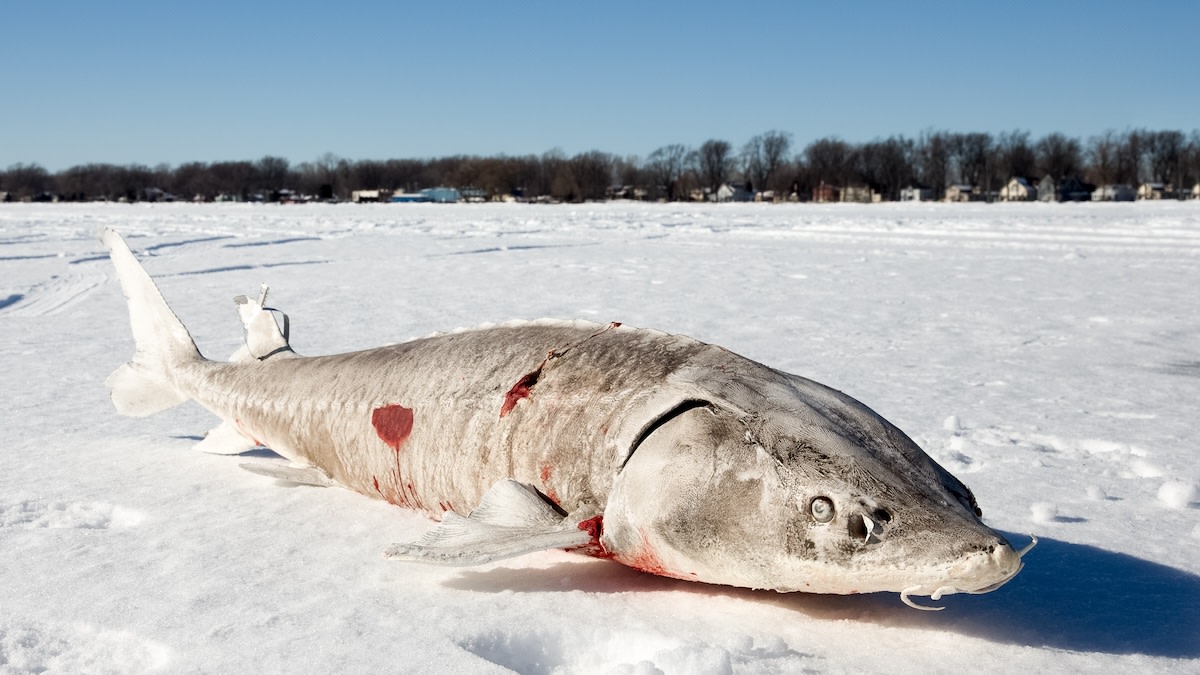
Imagine setting the hook on your jigging rod, thinking you’ve snagged a nice walleye or lake trout, only to suddenly realize you’ve hooked into a dinosaur. You fight the creature to the surface and then look down to see a massive prehistoric beast with an elongated body covered in smooth skin and armored with rows of bony plates so large, it barely fits through the ice hole. It may seem bizarre, like catching a stegosaurus with a lasso, but that’s the reality of ice fishing for sturgeon.
While a popular winter spearing target on Lake Winnebago in Wisconsin, many anglers don’t realize that you can actually catch sturgeon through the ice on regular gear. However, it remains a niche practice and is mostly isolated to lakes and rivers around northern Midwest states such as Minnesota and Wisconsin which have high enough sturgeon populations that ice anglers can actually target them. Generally, it’s done by anglers using heavy-duty jigging rods and heavy braided lines baited with large spoons designed for salmon and lake trout trolling or with large bait hooks tied to the line about 6-inches away from a heavy egg sinker. They’ll bait both rigs with either gobs of nightcrawlers or chunks of cut bait and dead minnows and then either jig them a few inches off the bottom or let them sit in the mud and wait for a sturgeon to come along.
Though it’s not a common practice, ice fishing for sturgeon is actually done frequently enough that it’s become highly regulated, with both Minnesota and Wisconsin declaring the practice to be catch and release only for most of the year. Still, even if you can’t bring a fish home, it may be worth making a trip out that way to try your hand at ice fishing for sturgeon for the strangeness of dinosaur ice fishing alone.
Lamprey
When it comes to the strange, unusual, and downright creepy creatures of the world, the lamprey probably tops the list. Also known as the “vampire fish” these parasitic, eel-like creatures are some of the weirdest and most terrifying fish on the planet. With their jawless, round mouths that are often as wide or wider than the head and lined with sharp teeth arranged in many concentric circular rows, which are used to cut holes in fish to suck their blood—lampreys are about as close to a monster from an alien movie as you can get. Yet there are still people out there who are crazy enough to ice fish for them.
Though not a common practice by any means, some Native people in Alaska have relied on migrating lampreys as a food source for generations. Like salmon and steelhead, lampreys are anadromous and will make their way up rivers from the ocean to spawn. This usually occurs in the late fall and early winter when rivers connecting to the ocean, like the Yukon, are frozen, allowing lamprey anglers to walk out on the ice and capitalize on this blood-sucking bounty.
Though it’s not done with a traditional hook and line, people chasing lampreys still ice fish for them by chainsawing large holes into the ice and then using dip nets to scoop lampreys out onto the ice. While the runs are often short, lasting for mere hours at a time, savvy lamprey ice anglers can catch as many as 1,000 lampreys in a single day, giving them plenty of lamprey meat to use for fishing bait, to feed to their dogs, and even eat themselves. It’s got to be said that while there are a lot of ice anglers out there with pretty adventurous palettes, most of us probably draw the line at eating a vampire fish—it’s just a little too weird.
Sharks
Jaws may be the greatest movie ever made. Now, this has nothing to do with the goofy robot shark, the silly Stephen King-esq plot of there being a man-eating monster in Maine, or the fact that Jaws is ultimately killed with an exploding scuba tank (spoiler alert!). No, what makes Jaws such a fantastic film all comes down to one character—Captain Quint. This surly, shanty-singing, shark-hunting badass, played flawlessly by the late Robert Shaw, has become an icon in predator fishing culture as the ultimate tough-guy angler. However, try and imagine Quint delivering one of his infamous shark fishing powerlines—"A shark’s got lifeless eyes, black eyes, like a doll's eyes"—and then zipping up a parka, putting on a pair of mittens and then walking out to drill a hole in the ice. Because as strange as that may seem, ice fishing for sharks is actually a thing.
Though not a common practice by any means, scientists studying Greenland sharks in the North Atlantic and Arctic Ocean actually catch and tag the monstrous fish for their studies almost exclusively by ice fishing. It’s done by first cutting a hole in the sea ice that’s roughly large enough to sink a small car. Then scientists feed a long, heavy rope with a weight and massive hooks tied along its entire length down through the ice to the bottom of the sea, essentially creating a shark-catching trot-line.
As Greenland sharks are opportunistic predators and scavengers, each hook is baited with a chunk of meat or a whole dead fish, then it’s left to sit along the bottom to wait for a shark to come along. Greenland sharks are among the largest sharks on the planet, growing to more than 20 feet long and weighing more than 2,000 pounds. Needless to say, when one is hooked, it takes a long time to land, even on an electric winch or with the aid of a snowmobile. Additionally, these sharks are even occasionally and accidentally hooked by ice anglers pursuing other species like wolffish, cod, and skate, making for a shockingly strange and almost terrifying addition to an angler's day.
Believe it or Not
When you really think about it, ice fishing is kind of a weird sport. I mean, you walk out onto a frozen block of ice in the dead of winter, facing brutal winds and blasting snow, and then you drill a hole and try to catch a fish. I feel like if an alien race landed on Earth and saw your average ice angler sitting on a bucket with a jigging rod or chasing after waving tip-up flags, they’d promptly turn around and leave, thinking we were too strange to abduct or even probe.
Yet, the weirdness of ice fishing is part of its appeal. You’re heading out into an alien world, so far from the warmth and comfort of home, to explore the unknown and fish for the unseen. When you look at it that way, everything you manage to catch on an ice fishing trip, from a tiny panfish to a monstrous lake trout, it all has its own mystique. So even when you end up landing something unexpected or surprising, it fits with the bizarre aspect of the sport, and in the end, the stranger it is, the better.
Stay in the loop with The MeatEater Newsletter
Shop
Shop AllRelated

Ice Fishing
The 5 Hardest Fish to Catch Through the Ice
Ice Fishing
The Best Techniques for Catching Trophy Fish Through the Ice
Ice Fishing
3 Tip-Up Setups to Catch More Fish Through the Ice
The comments section requires Functionality cookies. Please enable Functionality cookies in Cookie Settings to view this content.