Gyotaku: Edible Fish Taxidermy


As Americans and Europeans know, traditional fish taxidermy involves harsh chemicals to preserve the skins, which are later mounted on wood or plastic molds. And if you've ever spent time in a dusty barroom overlooking a lake or river, you know they don't age well. The modern version of fish taxidermy relies on the honesty of fishermen. Fiberglass replicas are crafted from "detailed" measurements, photographs, and descriptions provided by the angler.
However, while Westerners were huffing formaldehyde over workbenches and embellishing the size of their catch, the Japanese were perfecting a taxidermy method that was not only authentic but impossible to counterfeit—and the best part? You could still eat the fish.
Gyotaku is a Japanese art form that involves painting a fish with non-toxic sumi ink and pressing it onto rice paper. Gaining popularity in the mid-1800s, these prints served as a record of the catch, providing bragging rights for fishermen when they returned to port—all while still allowing them to sell their haul at the market.
Early gyotaku prints were blotchy and far from being wall hangers, but the practice quickly evolved into an art form. Much like petroglyphs paving the way for Picasso, modern gyotaku pieces are impressive, blending traditional techniques with contemporary artistry. Artists now create prints in grayscale and vivid colors, with their subject matter expanding beyond fish to include other animals and plants.
The technique has even found practical applications outside of art. Marine biologists have used gyotaku to document fish species, preserving anatomical details that might otherwise be lost. Some of these early prints have been preserved in museums, offering a glimpse into the marine life of the past.

Modern Printing Materials
Contemporary gyotaku has evolved to include materials different from the original sumi ink and rice paper. Artists now use water-based paints and acrylics. Not all modern inks and paints are considered non-toxic, so buyers beware.
Traditional Japanese rice paper, renowned for its durability and ability to capture fine details, has been substituted for alternative materials in modern fish printing. Cotton fabrics, such as an old pair of Carhartts, work well as a recycled canvas. Mulberry paper is another popular choice due to its strength. Additionally, modern canvas materials offer a versatile surface for printing.
The Process
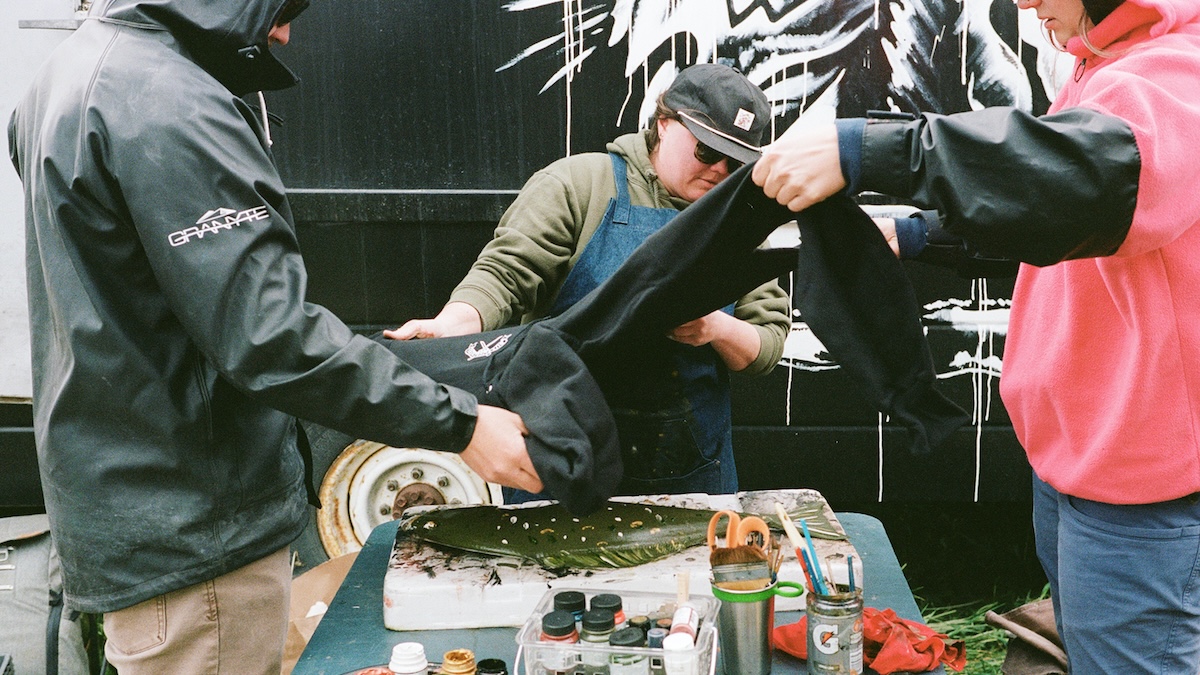
Alaskan fisherman and self-taught gyotaku artist Lindsey Kenton has been professionally printing fish for three years. In that time, she's tackled a myriad of species found in the North Pacific—going as far as printing a crab cut out of a halibut's belly. Kenton graciously shared a rough overview of her process with us.
Begin by washing and wiping down the skin. Excess slime or water will interfere with a proper print. Measure the length of your fish from bow to stern, then measure from the tip of the dorsal fin to the belly. Ensure an adequately cut canvas, giving your fish at least 4 inches on all sides.
Place your catch on a solid structure, like a piece of foam, and pin the fins down. They tend to retract and stick to the body.
While the creators of gyotaku lathered their fish in ink, the modern technique is a bit more meticulous. Begin by applying the ink or paint to the body with a brush or sponge. If the fish is naturally darker toward the dorsal fin, apply more; use less if it is lighter toward the belly. Once the basic shading is done, it's time to add detail. Following the pattern of the fish, paint along notable features, including the lip, eye, lateral line, and fins. This gives definition to your fish art. Remember, it's a race against time—you don't want the ink to dry, so be sure to work quickly.
When painted, take your canvas material and carefully place it over the fish. Kenton suggests folding your canvas and placing it over the center of the fish, then unrolling it like you would a sticker.
Firmly but carefully apply pressure with your hand, remembering to hit the fins, too. Slowly peel the canvas material away once you have covered and pressed the entire fish. Hang your print for a minimum of one hour to be sure your hard-earned artwork doesn't smudge. If an area doesn't appear as you had hoped, the angler/artist can apply more ink directly to the canvas. According to Kenton, eyes tend to be tricky, and artists often place a piece of paper over them to deliberately hand-paint them at the end.
Once your print is complete, wash the fish thoroughly to rid your protein of ink. Fillet or gut your fish and refer to the extensive collection of recipes compiled on our website on how to cook it!
Images via Tauri Vincent and Ryland Hormel.
Stay in the loop with The MeatEater Newsletter
Shop
Shop AllRelated

Foraging
The 12 Best Edible Wild Mushrooms


Fishing
Gyotaku: Edible Fish Taxidermy