Cal Of The Wild
Ep. 128: Bears, Fire, Moose, and Jail Time

Play Episode
24m
This week, Cal talks about getting hit by a bird while driving, how many days you get in jail for getting too close to. grizzly bears, moose, and so much more.
00:00:02 Speaker 1: From Mediator's World News headquarters in Bozeman, Montana. This is Cal's weekend review, presented by Steel. Steel products are available only at authorized dealers. For more, go to Steel Dealers dot com. Now here's your host, Ryan cal callahan. After pleading guilty to willfully remaining, approaching and photographing wildlife, a twenty five year old Illinois woman, Samantha Daring, will be spending four days in jail. If you recall, Yellowstone National Park officials have been publicly on the hunt for this particular offender since May of two thousand and twenty one, after a YouTube video of the woman being bluff charged by a salgrizz to within an estimated fifteen feet of her surfaced. In addition to four days in the WHOSCAL, she was also sentenced with one year unsupervised probation, too thousand dollars in fines, and is banned from Yellowstone National Park for one year. Charges were dismissed against her for feeding, touching, teasing, frightening, or intentionally disturbing wildlife. The ultimate punishment was much lower than the one year in jail and ten thousand dollars in fines she could have received. That's according to the Cody Enterprise. What do you think of that sentence? Does it fit the crime? Keep in mind our national park systems, even the states bordering Yellowstone National Park down to hotel billboards, bars, and every tourist trap along the route. Heck, even the tail of some airplanes market intentionally or not being close to wild animals. Here's a quote. Wildlife in Yellowstone National Park are indeed wild. The park is not a zoo where animals can be viewed within the safety of a fenced and closure. They roam freely in their natural habitat end when threatened will react accordingly, said Acting United States Attorney Bob Murray. Quote. Approaching a soal grizzly with cubs is absolutely foolish. Here, pure luck is why Daring is a criminal defendant and not a mald tourist. It is pure luck, Bob. We have set up the road systems in national parks to be so similar to theme parks that any sort of wildlife education gets lost in the all two familiar lines of people. Lines are where folks like you and me turn our brains off, not on. We are conditioned to just follow the tail lights in front of us. Everyone going through the gates of Yellowstone National Park has basically been told they will get or this is their chance to be close to super wildlife stars such as bison, wolves, elk, and grizzly bears. So when Samantha Daring is ending four days in the clank and she's forked over two thousand dollars and fines plus court fees and maybe we get one more follow up story out of this, does anyone think another bad tourist video is going to pop up next year? Will that video be the one that stops bad tourist behavior? Come on, this lady is getting more seriously reprimanded than most people out there illegally killing wildlife. For the record, I think our park rangers should just have the free range to gently tap any visitor young old infirmed on the forehead with the two by four whenever they break park rules and say this time, look and that not on your forehead is the only thing that saved you from a mawling. This week, we've got goats, fire bear, and nuts. But first I'm gonna tell you about my week. And my week was fantastic. Buddy of mine and I headed out to find him a moose, which we did find moose ultimately, but not the right one. Conditions were tough, save for one small storm that hit in the high country with wet snow and reasonably cold temps. It was hot, not much for moose moving around. I hauled the can am over there. We put more miles on that than I ever thought I would. I quickly became a convert to the reasons why folks buy them. They're very comfortable, especially on old logging roads and pothole infested dirt. I do not have defrost in my machine, so we'd get bundled up and head out pred Onto account for the wind chill. The front windscreen fully opens, you know, just like a pick up topper window. One morning, I watched a bird fly from its ground nest on the side of the road and barely miss us, I thought, but my buddy said, I just got hit in the chest. I was driving. He was looking around. Then he opens his armpit and the bird flew straight back out the round window where it came from. All I could think of was that bird telling its friends I got hit by a car today, and it was a totally different experience than you would expect. We took horses and mules the stock up really old trails that existed on maps but not so much on the ground. We did a lot of path finding and cut and chopped alongside the axe and saw marks of those folks that have been there before us. I like to bring the steel m s a two d C with a fourteen inch bar. I can put two batteries in my saddle bags, which leaves the saw almost weightless, so you can pack it anywhere on a mannied load or like we used on this trip Paniers. I was completely astonished at how much cutting we got done on one battery, and unfortunately, on one outing we did a lot more cutting than hunting. We should have stopped going up the trail hours earlier. But as I am sure some of you can relate, Sometimes your brain and says, the next corner, a little further it's gonna open up. Right where you're standing looks moosey as all hell, but a little further is going to be better. And eventually you have to throw your head lamps on, turn the string around, and bob and duck and weave the javelin like deadfall, hoping not to get skewered. Somewhere too soft. All the way home and the dark, we got a lot of hiking in. We burned our legs, we burned our lungs, we burned our foreheads. It was a great trip all around. Looking forward to doing it again. Moving on to the prehistory desk. First up in Morocco, researchers at the London National History Museum have discovered a new species of dinosaur related to the Stegosaurus. This specimen is a kind of ankleosaur, which literally means stiff lizard, which, if you think about it, it's like they gave the job of naming dinosaurs to the Intern that day. I mean, all fossils kind of fit the diff description, right, That's like naming a specimen dead dinosaur or really really old dinosaur. All ankleiosaurs have a heavily armored skull, defensive spikes down the back, and a bulb shaped tail used as a club. It's more famous relation. The stegosaur has those two distinctive rows of spade shaped fins down its back and the barbed tail. I had to throw that description in in case you're getting confused and don't have a ten year old around that can set you straight. What made this new find so unusual was the way this ankleiosaur spikes were connected to its body. Previously discovered examples of the species had spikes anchored into the flesh, sort of like how our hair is rooted into our skin. But the spikes of this new find refused directly to its ribs, a feature that paleontologists believe has never before been observed in any living thing, or, as they put at, an unprecedented more followed among extinct and extant vertebrates. That makes you sound smart. Having the spike fused directly to bone would mean either that these spikes were covered in flesh, which seems very painful and impractical, or that they somehow protruded through the skin like a permanent compound fracture. Regardless, we can be sure this was not an easy critter to eat. The researchers found this attribute so unusual they originally thought the find might be a fake. They even use the word bizarre in the title of the published paper, Interesting Dinosaur Fact for You. The cartoonist Gary Larson ended up making an important contribution to the study of stegosaurs. A panel of his cartoon The Fire Side shows a caveman teacher standing in front of a classroom pointing at a picture of a stegosaurs tail. The cartoon depicts the caveman teacher pointing to the spikes and saying, now, this end is called the thago miser, after the late Thag Simmons, you know, implying that the poor old Thag was the first to get whacked by the stegosaur spiky tail. Almost unbelievably, paleontologists hadn't had an official name for the Steaga source tail before this, so they started referring to it informally as the Thago miser, and after time it became the standard term, and that is now just what a Stago source tail is called. Since the word thag miser has been used by organizations as august as the Smithsonian, the National Park Service, and the BBC, as well as several authoritative dinosaur books. Gary Larson is, in fact so beloved by all kinds of scientists that in biologist Dale Clayton gave the name string of Phyllis Gary larsoni to a previously unknown species of chewing lause found only on owls. Now, how's that for a legacy mom In other news slightly less ancient, but still earlier than we thought. A series of footprints uncovered in White Sands National Park in New Mexico make a compelling case that human beings were in North America at least twenty three thousand years ago, ten thousand years earlier than the previous consensus, and just so you know, that still doesn't make people old enough to ride dinosaurs. To determine the age of the White Sands footprints, the scientists dug shallow trenches alongside them and analyze preserved grass seeds trapped in each layer of ancient dirt. By carbon dating seeds just above one set of footprints and finding that they were twenty two thousand, eight hundred years old, the authors concluded that the prints must have been at least that old, and possibly older. We've talked before on the show about carbon dating and how in order to do it you need you know something made of carbon. For example, even though the pigment red ochre was used extremely widely by ancient painters, it contains no carbon, and so researchers have to rely on other techniques to date those paintings. In the case of these footprints, though the seeds that provide the carbon can be dated, and so they provide a kind of time stamp. Similarly, when researchers were analyzing the Chovette Cave in France, which has some of the world's most beautiful prehistoric paintings, I'll be honest with you, as a once considered a tattoo that would be you know, of cave paintings, and uh, you know it was shamed for that idea and never followed through with it. Anyway, they discovered very few signs of ancient people actually coming into the caves to look at the paintings, except for a single set of footprints made by what appeared to be a girl of about ten. Scientists figured out that she had been carrying a torch to light her way, touching it to the wall to knock the ash off the end of it so it would burn cleaner the way a small grew knocks the ash off a cigarette. By carbon dating the ash on the wall and where it had fallen into the footprints both on the girl's way in and out of the cave, scientists determined that she had been there twenty seven thousand years ago, but the last painting in Chauvette was made around thirty two thousand years ago, So this girl seems to have been the only person who had seen the paintings in five thousand years and the last person to see them until they were rediscovered, which could imply that she was so unimpressed that she told no one about them, or that people just didn't care about art. If that doesn't give you chills, it should. That whole story is like history repeating itself, type of you know what I'm saying, or maybe uh, when you hear some old duffers say, you know, nobody pays attention to their kids anymore in my day. Anyway, back to New Mexico and our twenty three thousand year old footprints. If the White Sands prints are twenty three thousand years old, then they were made when an enormous glacier called the Cordillarian Ice Sheet completely covered western North America down to about present day Oregon. And that means that either people got here from Asia over the glacier, which seems very difficult, or came here by boat along the coast, something we've covered many times, which also seems very tough. Or possibly we're already here even before glaciers closed the route. This last hypothesis could mean that human beings were in North America a long, long, long time ago. The anthropologist Paul Atte Steve's, a member of the Cree and Mattis People's, recently published a book from University of Nebraska arguing that human beings have been on this continent for more than one hundred and thirty thousand years. Moving on to the wildfire desk, goats, fire and bears, the Bureau of Land Management has enlisted a new kind of soldier in the fight against wildfires, goats that's right. According to Colorado Public Radio, BLM biologists have released hundreds of goats in key areas to help control the invasive overgrown plant species that become tinder for wildfires. In the process, goat manure helps the soil hold water and enriches the ground for native plants to thrive. At Stutty Ranch in western Colorado, eight hundred goats were dispatched earlier this year to beat down a type of wheat grass that deer and elk don't eat. After they're finished, they'll move to another BLM area to clear oak brush near last year's grizzly Creek fire. Hillary Boyd, a BLM biologist, told Colorado Public Radio, quote, our hope is if we can kick back some of these grasses, improve the soil, and make room for some other more desire bowl plants to grow, the fields are going to be even more valuable for wildlife. Believe it or not, goats have been fighting fires in the United States for a long time. In two thousand one, Smithsonian Magazine found a couple in California who had been using the technique since the Golden State has for many years conscripted goats as environmentally friendly allies and the wildfire fight, and the idea may be starting to catch on in other states. Goat grazing is only one of many fire suppression techniques, but goats can be deployed in areas where prescribed burning is impossible or impractical. Landscapes prone to human cause fires are also areas where folks don't like a bunch of smoke. Biologists might consider using goats around campgrounds, trailheads, and private land cut back on underbrush without using fire. In addition, as I mentioned in our last wildfire round up, some fire conditions promote plant growth, even bad plants. There's no sense burning a bunch of in base of weeds only to have them rebound even stronger the next year. Goats can clear an area of these plants without making the original problem worse. Goats aren't the perfect solution, of course, remember the manure I mentioned earlier. If gos a release too late in the season, fell, munch down invasive plant seeds and deposit them out the other end. Like all things, goats must be used responsibly. There's a lot of reasons for getting the wildfire problem under control. Loss of human life, property damage, harmed wildlife. Environmentalist groups have raised concerns about how aerial fire retard affects animals, especially fish species. You've probably seen videos of tanker plans dumping thousands of gallons of the red water chemical mixture in a brave effort to control the spread of a blaze. Between two thousand twelve and two thousand nineteen, the Forest Service used more than one and two million gallons of fire retardant. Fire retardant is mostly water, but companies also include chemicals like ammonium phosphate to stick to plants and inhibit combustion. The mixture hasn't been shown to harm humans. Birds are large wildlife because typically humans, birds and wildlife are gone by the time they're flying over. The retardant isn't good to ingest, but it's usually washed away and deluded by streams or rain runoff. Amphibians, rodents, insects, and other creatures that hunker down to wait out ablaze may have more trouble, according to a two thousand eleven four AT Service Environmental Impact Report. Water quality can also be affected, especially in small ponds and vernal pools where water can't flow to dilute the ammonium phosphate. A vernal pool is kind of like the prairie potholes I talk about with some frequency. They are typically very shallow, intermittently dry areas where water collects. Think of that elk wal oh, you know that is often dry. Vernal itself means of the spring, which is a fun thing to keep in mind the next time you run into someone named burn. Fire retardant has been linked to fish kills in Oregon, New Mexico, and California, but a two thousand nineteen biological opinion by the National Marine Fishery Service concluded that the chemicals do not destroy critical habitat or jeopardize the existence of threatened salmon, chum, and steelhead trout. In other words, fire retardant might kill some fish, but it's unlikely to have population level impacts. In their never ending quest to ban hunting in the United States, animal rights lobbyists have hit another excuse to definitely postponed hunting seasons. Earlier this month, the Center for Biological Diversity called on the Nevada Department of Wildlife to shut down bear hunting units due to wildfires in the state. CBDs Nevada state directors said we should give bears a break. Climate fueled catastrophic fire isn't just hard on us. Bears are struggling to survive and recover from the most difficult summer of their lives. As you can imagine, if this flies in Nevada, it may very well fly in other Western states. If wildlife agencies shut down hunting for every wildfire, you can kiss those early season hunts goodbye. Small localized fires can be good for the landscape and for the animals that live on it, but many of the raging blazes we've seen out west can be harmful, not only due to the flames and the heat, but also due to the methods we used to control the fire and the ways fire can be manipulated by those who want to end outdoor recreation. If you like to think of yourself as a hunter or a conservationist, or as a hunter conservationist, or just someone that enjoys knowing that the natural world is out there so that video game programmers are building off the real deal, this is just another reason to be involved year round. Active management can mean science based climate change mitigation, prescribed burns, which means dealing with a little smoke in your neighborhood for a short period of time to offset an entire summer or longer of smoke inhalation, Selective logging, which can even mean a clearcutter cut block here and there, and maybe even goats moving on to the inconvenient squirrel desk. A man in Fargo, North Dakota, returned from a four day business trip last month to find his Chevy Avalanche filled to the brim with black walnuts. When I say filled, I mean filled. In photos posted online, Bill Fisher explained how an American red squirrel had packed his truck's engine, bay, side panels, and frame with lemon sized walnuts in total, Fisher retrieved forty two gallons of black walnuts from his truck. He told me the total hall wade about eighty pounds, and he estimates the squirrel had stashed well over one thousand nuts in just ninety six hours. I can't really do this justice over the airways, so I encourage you to google red squirrel Chevy and check out the photos for yourself. Fish says he can still hear walnuts rolling around in the frame of his truck, but he's had a good attitude about the whole thing. He offered the all natural pop picked black walnuts on his Facebook page and said that the furry tree dweller may be retiring soon due to health reasons. The squirrel is dealing with a caustic work environment due to a relentless micromanaging supervisor of the canine type, referring to his dog. Believe it or not, this isn't the first time Fisher has dealt with this problem. His neighbor's walnut tree produces mature nuts every two years, and every two years he finds walnuts in his truck. This year, he thought he'd be safe doing a full clean up in the middle of September before his business trip. He was wrong. He told us, this is definitely a red squirrel with attitude to match against other squirrels. According to forestry professor Georgia Peterson, red squirrels frequently engaged in what's called larger hoarding. They'll store large caches or middens of their favor at foods. The squirrel prefers Fisher's black wallnuts, but red squirrels often go for fungi, fruits, and especially tree seeds from coniferous species. The other type of hoarding is called scatter hoarding. Eastern gray squirrels more frequently stashed their food in this way by hiding or burying small amounts of food in various locations throughout their territory. Both types of squirrels engage in both types of hoarding, but reds tend to larder while grays tend to spread. As meat eaters Clay Nucom pointed out recently in an article on the meat eater dot Com, finding a squirrel's cache of food, or at least finding the area where they've been storing food, is the first step in a successful squirrel hunt. If Fisher wanted to do any squirrel hunting, he might try parking his Chevy on the nearest patch of public land. Squirrels might think that cars and trucks make great food larders, but it can be dangerous to drive with a cash of pine cones, nuts, or tree bark. Your engine can overheat due to a lack of air flow, and combustible materials can catch fire if they're pressed against an exhaust pipe. If you live in an area with lots of red squirrels, be sure to check your engine bay regularly for squirrel food during the fall months. Parking your car in a garage is the best way to avoid being chosen as a pantry. But I've also heard that mothballs, hot peppers, and other animal repellents can do the trick. If you want to know a personal favorite of mine, downy dryer sheets. Get a box of downey dryer sheets. Poke those dryer sheets and any little hole that you think a squirrel can get through, or a mouse or whatever. There's something about those things that just to irritate the crap out of them, they won't go near him. Hopefully you'll have better luck than Fisher did. He's tried placing a mixture of Tabasco sauce and cayenne pepper under the hood and parking his truck as far away from the tree as possible, but so far nothing has been able to dissuade his furry intruder. That's all I've got for you this week. Remember, if the squirrels are putting away that much food, it's going to be a hard winter, So go to steal Dealers dot com and find your local steel dealer to get prepared to cut and buck some firewood. As always, thank you so much for listening, but right in to ask Cal that's a s k C A L at the Meat Eater dot com and let me know what's going on in your neck of the woods. Thank you so much for listening. I'll talk to you next week.
Presented By
Featured Gear
While you're listening

Policy & Legislation
Deer Farmer Defies CWD Law, Faces Potential Jail Time

A Minnesota deer farmer defied a statewide quarantine in January by trucking three captive bucks to a hunting show in St. Paul. He will try on March 23 to convince a judge that the Department of Natural Resources lacked authority to impose the travel ban on privately-owned whitetails. The case...
Patrick DurkinMar 18, 2020
Read MorePlay Now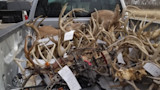
Wildlife Management
Kansas Man Faces Jail Time for Poaching 60 Deer

John Blick Jr. of Sharon, Kansas, has been sentenced to 14 months in prison and ordered to pay $327,641 in restitution for poaching 60 whitetail and mule deer. The bust is the result of a multi-year investigation leading to a 139-count indictment. Additionally, the 28-year-old will lose hunting...
Spencer NeuharthJan 14, 2021
Read MorePlay Now
Wildlife Management
Man Receives Jail Time After Failing to Meet Wyoming’s Residency Requirements

Last fall, Rodney Gilstrap took a plea deal and was sentenced following a multi-year investigation by Wyoming Department of Game & Fish (WDFG) wardens. Gilstrap’s charges stemmed from his residency—or lack thereof. According to a press release, WDFG warden James Hobbs initially received an anonymous...
Sage MarshallJan 28, 2026
Read MorePlay NowConversation
Save this episode