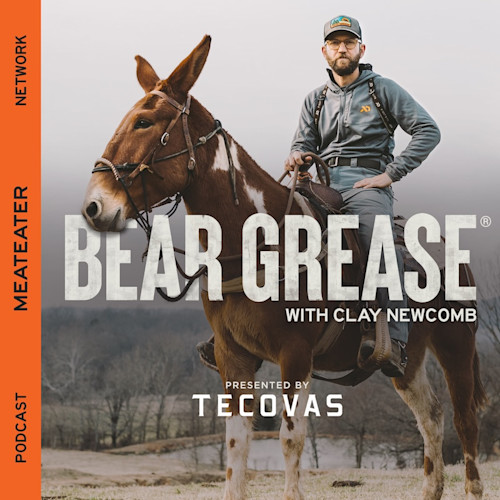
00:00:14 Speaker 1: My name is Clay Nukeleman. 00:00:16 Speaker 2: This is a production of the bear Grease podcast called The bear Grease Render, where we render down, dive deeper, and look behind the scenes of the actual bear Grease podcast presented by f HF Gear, American Maid, purpose built hunting and fishing gear that's designed to be as rugged as the place. 00:00:38 Speaker 1: As we explore. Welcome to the bear Grease Podcast. 00:00:45 Speaker 3: Everyone, take one great. 00:00:47 Speaker 2: We have a great group of people here today. The bear Grease The Bear Grease Render Podcast is what this is where we talk about discuss the past, documentary style bear Grease podcast. I was asked recently why I would need to tell people that. I told the people that people come in by the droves. 00:01:10 Speaker 3: Yes, they do by the droves. 00:01:12 Speaker 2: They come in by the droves, and so we have to continue to tell people what they're listening to and even more complicated now in the Beargrease Feed we have Brent Reeves this country life podcast. 00:01:24 Speaker 3: Living Large Man. That's so much fun. Yeah. Man gets some good feedback too, it's really cool. Yeah. 00:01:30 Speaker 2: So you've done three Yeah, you've done three episodes. So what were the what were the episodes about? 00:01:35 Speaker 4: Well, the first one was just an introduction to me and just kind of like who I am. They would people would have been a little more in depth in what they would have got just listening to me ramble on on here. And the second one, I think it was about man, you tell. 00:01:51 Speaker 3: Me, yeah, oh yeah. 00:01:53 Speaker 4: The second one was also a little bit about more about me, about the stuff that I've told my buckets and why maybe why I do that. And the last one, the most recent one that's out right now, is about turkey hunting mentors, mentors that influenced me that growing up in some lessons I learned from those folks and been really good, but a lot of fun good. 00:02:17 Speaker 2: So a lot of you probably would have heard this Country Life with Brent Reeves, but it's usually about twenty minutes long. It's a monologue, it's a little bit of comedy, a little bit of instruction, a lot of fun. 00:02:30 Speaker 1: It's lighthearted, a tear every now and then, a tear will stream down your cheek every now and then. 00:02:35 Speaker 2: And the way that I have described it, and maybe i've described it on this podcast before, if anybody had fault with the Bear Grease podcast, they could say that it's like a heavy listen like you have to work at it. 00:02:46 Speaker 1: I remember when we first did Bear Grease. 00:02:49 Speaker 5: It's exhausting one. 00:02:51 Speaker 2: Of the things. 00:02:53 Speaker 1: Yeah. 00:02:54 Speaker 2: One of my one of the guys, my dear friends that media was like, I mean, it's like a pretty heavy listen, like you actually have to like it's not just easy listening music, you know, quote unquote. 00:03:06 Speaker 6: No kny here. 00:03:07 Speaker 2: Yeah, And I would say this country life is easy listening. Not that it's light. 00:03:15 Speaker 3: You're here some whal and jail there maybe, but no. 00:03:19 Speaker 6: I think if if Steve Vanilla is the Julia Child. 00:03:23 Speaker 1: The campfire, the campfire per CBS. 00:03:26 Speaker 6: Britton Reeves is the Garrison Keller oh of the Wilderness podcast, Garrison Keller is Okay. 00:03:33 Speaker 3: Keeler, Garrison Keeler. There's some pronunciation in the family. He did a spoiler alert. He did a radio ship. He did a radio show called. 00:03:48 Speaker 1: Very Yeah. 00:03:49 Speaker 6: We're all the the Lake Wobegone. 00:03:51 Speaker 3: Yeah. 00:03:52 Speaker 1: Yeah, And so that's that's all. 00:03:54 Speaker 7: The women are strong, all the man are good looking, and all the children. 00:03:56 Speaker 3: Are above average. 00:03:59 Speaker 2: Yes, well, this country life has been really great. So Brent, thanks buddy, good job man. What did you tell the guy that asked you what the next week's podcast was going? 00:04:10 Speaker 1: To be about. 00:04:10 Speaker 4: I told him it was a two parter. The first part was none and the second part. 00:04:15 Speaker 3: Was bizz. 00:04:18 Speaker 4: He was he was trying to get some inside information. 00:04:21 Speaker 3: Mm hmm. 00:04:22 Speaker 7: You can go to prison for that. 00:04:23 Speaker 3: Absolutely. 00:04:24 Speaker 2: So we don't know what the next episode is. I know what it's about. It's gonna be good. 00:04:28 Speaker 3: Yeah. 00:04:28 Speaker 2: So the guests we have today, we have Ben Lagron, who has been here several times, longtime friend of mine. Uh, former history teacher h yeah, current childbirth. 00:04:47 Speaker 3: I mean. 00:04:49 Speaker 2: That would be like if I said I'm a podcaster and all y'all went. 00:04:55 Speaker 1: Sometimes I just. 00:04:56 Speaker 5: Tell people I work for the internet. 00:04:58 Speaker 2: Yeah, yeah, yeah, yeah, balanced families, yeah great. And to to your left is my wife, doctor mister Nukelem, And I think. 00:05:11 Speaker 6: We need to clarify and nothing I care, and not that you ever need to call me doctor mister Nukelem again. But there's a lot of people on the internet right now that think that Clay. 00:05:21 Speaker 5: Good Job got the PhD. 00:05:26 Speaker 2: So Misty made a post the other day and what threw it off was the picture we were at her defense of her dissertation, and we were there with our whole family, and I took like a just like a selfie I was. I was the one holding the camera out and so I'm up close in the family's back a little bit. And that was the only picture we had, and so Misty posted that and said I got my I got my pH D. 00:05:52 Speaker 1: I finished it, and the internet lit up. 00:05:56 Speaker 2: My bone lit up people like, man, it's so great, Clay. 00:06:01 Speaker 1: No idea that you were even working. 00:06:03 Speaker 3: There's a prime example of how people look at that. Well, I was. 00:06:06 Speaker 4: I can't remember what Grady was in, but probably all of them. But at least once a year a teacher would give you a test that said, okay, follow these directions. Start at the beginning, read them all the way through. You probably did this, Ben, and then do what the directions say. Well, like fifteen to twenty minutes in, I'm working. I read about half the directions and I'm working my behind off, but I try to look and three cours that everybody's sitting there staring at the ceiling and looking. 00:06:33 Speaker 6: At the are getting up and walking out of the room. 00:06:36 Speaker 3: I'm like, golly, I got to hurry up. 00:06:38 Speaker 4: And if I just read the last line was like, do the first three problems then you can go. 00:06:45 Speaker 3: But I did. 00:06:47 Speaker 6: Yeah, So I always I think it was a punishment for people who were, you know, motivated and driven like those that I always felt like the teacher was trying to trick us, like to just say, read all the directions first, and then it was a mistake to do all the work. 00:07:00 Speaker 4: That's the reason I can't go to that Kia store. I'm not reading those directions, buddy, he can get lost. 00:07:07 Speaker 2: Well, we'll come back to this. I just need to get through introductions here. I want to talk to you about your your PhD and what it's in. But to your left, we have coming back from He's it's been a while since he's doctor Mali. 00:07:25 Speaker 3: People. Yeah, it's good to be doctors. 00:07:30 Speaker 2: Malaka like his people only let him come here like like twice a year and you have to get on the schedule to get him here. 00:07:38 Speaker 8: But it's good to have you talk about August when we when we end. 00:07:41 Speaker 2: Yeah, yeah, And I'm still interested in uh a boat partner. 00:07:51 Speaker 8: Hey, my boys are getting older that I would I would consider it more than my son is like in love with outdoors and so let's talk in November twenty twenty six. 00:08:10 Speaker 2: November, all right, that's cool, that's cool, And Josh Landbridge spilmmaker who is now a boat owner and the captain. 00:08:18 Speaker 7: That's right, Captain land Bridge of the essay game. It is a trout fishing boat specially designed for our white river tail waters. Twenty one foot long, forty eight inch bottom, seventy two inch wide beam with a jet motor on the back. 00:08:38 Speaker 3: Speed. 00:08:38 Speaker 1: Pretty wet brand of boat. 00:08:40 Speaker 3: Is it? 00:08:40 Speaker 7: It is an AAF so af was a was a brand of boats was made in Mountain Home back in the early two late nineties, early two thousand. 00:08:50 Speaker 1: Is your cool trout boat? Come with that flat bill hat? 00:08:53 Speaker 3: Nope? 00:08:55 Speaker 1: Yeah, you just got that hat sold separately. Josh always has the coolest hat. 00:08:59 Speaker 2: It does if you're jealous, it's true. 00:09:02 Speaker 3: I gotta do something. 00:09:03 Speaker 7: I wear a beard because what's under the beard is not that great looking, and I wear a hat just to cover as much as possible. 00:09:09 Speaker 2: There you go. Well, hey, very nice Josh about taking his boat down to the big rivers of the South for us to go catfishing. 00:09:18 Speaker 3: Sure, and he said, he said, of course. Really heck, yes, Oh we're in Man. 00:09:24 Speaker 6: Hey, someone else got a boat, and that's Bear John. 00:09:26 Speaker 1: Yeah, our son got a boat. 00:09:28 Speaker 6: We sometimes talk about how Bear uses my Facebook account to purchase and sell items, and all my friends think that my because he doesn't have and he's constantly like selling machine parts. And it's kind of funny because the boat I don't think has gone out into the water yet, but it's been the focal point of a lot of activity at the new con farm, including with your son Josh. Almost every other night there's a group of five or six boys here, our young men who are working on something on that boat. And we really thought it was going out on the water this week and we came home and they were supposed to have taken it out and the boat's just hanging out there. 00:10:05 Speaker 3: That the battery was dead. 00:10:06 Speaker 6: Yeah, there's always a reason, and I think that they enjoy working on I mean, it was a boat that came without a motor. Then they had to fix the motor that he got on Facebook marketplace. Now they've got to charge the motor. I don't know, it's kind of kind. 00:10:18 Speaker 7: Of it's a trolling motor. 00:10:20 Speaker 3: It's just got a trolling motor. 00:10:21 Speaker 5: Yeah, yeah, yeah, yeah. 00:10:23 Speaker 2: It's a big a lot of a lot of boat activity. Male, Like, how you better get in well again, it's good buddy. 00:10:27 Speaker 1: By twenty. 00:10:27 Speaker 2: By twenty six, you'll be You'll be maybe you bought applestock back. 00:10:32 Speaker 3: In Like. 00:10:36 Speaker 1: It's like where you go the podcast. 00:10:40 Speaker 2: It's like that, buddy, you better watch out because because hey, I want to go ahead and make this public declaration. Brent Reeves and I planned to become commercial fishermen. 00:10:51 Speaker 3: Oh really really, Oh it's coming. 00:10:53 Speaker 2: Yeah, that's happening, huh, or at least expert cat fishermen. I am an expert catfisher I'm not saying that I'm not, but I've kind of been delayed in my development for the last twenty years because I've been pursuing other activities. 00:11:09 Speaker 4: You mean, like there's a cat, a professional cat fisherman trapped inside your body. 00:11:13 Speaker 3: Yes, that hadn't been let out yet. 00:11:15 Speaker 2: Well, he was out when I was in high school, but he got put back in when I moved to the mountains, kind of out of a big just when I moved up here. 00:11:24 Speaker 3: I don't know. 00:11:25 Speaker 2: There's no cat fishing up here is not as good, but big plans for me and Brent to become professional cat fishermen. And on our maiden voyage a couple of weeks ago, we caught a giant. 00:11:36 Speaker 3: Jack gantor Yeah he was huge. Yeah, that's a twenty pound feet probably was well you said. 00:11:42 Speaker 1: Said, you said twenty pounds. 00:11:44 Speaker 4: Twenty maybe well, and I tell you very. 00:11:49 Speaker 3: And you are a doctor, could have been closer to. 00:11:53 Speaker 2: Hey, you somewhere between when you have a fishing buddy. I think I think there's a lot of character in what people. The world is just witnessed that I underestimated the way to that fish. Trying to be honest. 00:12:05 Speaker 3: Yeah, you always say I overestimate bears about thirty percent. 00:12:08 Speaker 1: Well that's the truth. But we're talking catfish catfish. 00:12:17 Speaker 2: So anyway, we're big into the boat world and are going to continue to get bigger. 00:12:22 Speaker 1: We Uh, what were the other things on your on your list? 00:12:25 Speaker 6: Well, I get a lot of questions on my Instagram about Banjo and whether or not we ever sold them, Okay, right, and I just mule. Yeah, I felt like it'd be good to update everyone. Much like I predicted, Clay did not sell him, despite his strong commitments to do so. Instead, Banjo went to boarding school. 00:12:47 Speaker 2: Yeah, so, so first of all, to give people a little bit of history back, Okay, is he the best mule I've got? I trained her she's seven years old. I got her when she was eighteen months old. I trained her in the six six week period, and I trained her myself, and she's a finished, really nice mule worth a lot. Had a guy come to my house a few days ago and asked me what I would sell her for, and he was a mule. 00:13:17 Speaker 7: Trainer, and he said no amount of money. 00:13:19 Speaker 2: I told him, I said, I said, you don't have enough money to buy that mule. And I was being serious. So I'm telling you that because this is in connection. So Banjo is Izzy's full brother, and I got him with the intent of training him myself. My life was quite a bit different when I got Banjo in terms of the amount of time that I could spend with a mule, and so I kind of slow trained him. Okay, what I did with Izzy in six weeks, I did in like a year with him, which is not good. 00:13:47 Speaker 1: It's not good practice, you know. 00:13:49 Speaker 2: There was just rather than riding him five days a week, I wrote him once every ten days, or maybe once every ten days, I'd ride him three days in a row. And I might go for a month without messing with him, and then coming back and messed with him and so last summer I. 00:14:04 Speaker 1: Started riding him and got bucked off twice. 00:14:06 Speaker 2: Okay, so he scared me, and it was my fault, one hundred percent of my fault. And I really felt like this mule had a lot of potential. He was really level headed. He was a flashy mule. And I'm going to tell you why. It's for sure a bona fide like stamped and approved flashy mule. 00:14:24 Speaker 1: A man that I'm gonna tell you about in a minute. Told me this, Brent, And so I. 00:14:33 Speaker 2: Asked my dad asked, all, y'all, you know, I think I'm just gonna sell him, because I you know, pretty much a bucking mule can be like a biting dog. Like if your dog bites you, you don't really ask many questions. You get rid of the dog. A mule can be that way with certain people. I asked an old muleman, Lloyd Holly, over here in Prairie Grove, and I said, man, I got a mule. He's bucked me off twice. I think it's my fault. I think he's a good mule. And he said, get rid of that sucker, And but I just couldn't quite do it. And so my friend, Michael Lanier. He's he was my squirrel hunting mentor and a good mule man. He introduced me to a guy in another part of Arkansas that is an Amish guy mule trainer. And in the mule world the Amisher legendary, the Amisher legendary for being mule trainers. And so for a for a very good price, I took Banjo over to this guy's place. And the idea was he would keep him for thirty days for a certain price, and he would ride him thirty times, or you know, train him, train him for thirty days every day, every day. And uh. And so me and my uncle go over there, and it was fascinating to me. We pull up to this place and I thought maybe the guy might have like two or three animals he was riding for people. This is like a this is like a business man. That he had probably twenty to twenty five horses and mules in stalls, just one after the other. And he and his son and his son in law and I think another son. I think there are four of them. That I mean rode and trained those mules and horses every day. It's just what they wake up and do and while we're there. These people are very nice people then like this, not big conversationalists necessarily, but I'm trying to sap everything i can out of this small interaction. When I'm dropping Banjo off at training camp, you know, and while I'm sitting there, we I tie Banjo up, and there's all these mules and horses, and Banjo's kind of excited and he's never been in an environment like this. He's kind of pulling up the lead rope and amped up. And I see two things that happen just while we're standing there in like ten minutes that would be like if that had happened to me, they had been a big deal. I watched him put a I'm kind of I'm probably boring everybody. 00:17:07 Speaker 3: Uh. 00:17:08 Speaker 2: I watched him put a horse on a treadmill. One of the one of the boy the young guys brought this horse over that you could tell had never been ridden and was just bug eyed. And and they're trying to get it up on this horse treadmill and that's there. 00:17:22 Speaker 1: They're pulling on it. They're pulling on it and trying to get it up in there. 00:17:25 Speaker 2: And and I'm talking to the dad and he while in conversation to me, just walks over like never takes eye contact off of me, and gets right behind this horse and puts a lariat rope on one side of the treadmill. Runs the lariot rope around the back of this horse that's freaking out, and he's still talking to. 00:17:43 Speaker 1: Me, just like, oh yeah, we got all this stuff do. 00:17:45 Speaker 2: Da runs it around the back of the horse, and through another back back of the horse, through on a back through the treadmill, and pulls the rope so that the rope cinches down and pushes the horse onto the treadmill, and he takes the tail that lariot rope and just pop pops that horse and it just jumps on that treadmill, just. 00:18:06 Speaker 1: Like it was born to do it. 00:18:07 Speaker 3: Yeah. 00:18:10 Speaker 2: Yeah, it was a beautiful trick. I mean, this horse training is all about confidence, and I mean that horse knew that this guy wasn't gonna take anything. And and and then directly after that, we're still in the same conversation, one of the young boys walks up and he's got a little a young colt saddled up. And this colt, you can tell it's just hardly ever had a saddle on him, and he puts the saddle on him and ties him up to a to a stall right there, and the horse starts pulling against the lead, pulling against it like he's he's he's not used to being tied up, and he starts bucking and kicking and flips over on the ground, feet in the air, just rolling. 00:18:53 Speaker 1: On the ground. I mean, it's like chaos. 00:18:56 Speaker 2: And that that boy never batted an eye and just sat there within about two feet of that horse. The man never breaks conversation, like I'm like, and he lets that horse do its thing. It flops for a minute, stands up. The boy never I mean, I'm serious. He didn't smile, he didn't grin, he's a blood pressure didn't go up. And then he takes the horse off of the off of the unties it and walks it out. And he didn't ride the horse, but he just starts training. I mean, just like every day they says, that's where Banjo's up. 00:19:32 Speaker 1: So and when I when I. 00:19:34 Speaker 2: Was leaving, the man said to me, he said, Banjo be on that treadmill by the time you guys leave. I didn't see him put him on, but he was just like it starts well, he's there for a month. And I talked to him and he said he's really happy with what Banjo's doing. He says he's not bucked, he's not kicked. He said he really wants to do what they want him to do. He thinks he's got a lot of potential. He thinks that. He told me he needs another thirty days, so I'm going to leave him there another thirty chiropractor. 00:20:11 Speaker 1: And I went through the. 00:20:12 Speaker 2: Whole thing with him about, you know, well what if I took him? And he said, well, how much time will you have to ride him? And I said, well, I don't know, probably not that much. And he said, well you need to leave him here, and I said deal. And then I said, Misty, I said, what will this animal be worth when he comes back from you after being under saddle for sixty days? And he said, Clay, he said, that's a pretty flashy mule. He's got white feet. Whoa And he literally said that. He literally said that. And he told me that they took a mule like ban Joe to a big sale the other day and sold him for fifty five hundred dollars. And he said, if I rode him for a year after I get him back from them, he said it might be worth ten grand. 00:20:54 Speaker 5: Ten thousand dollars like. 00:20:55 Speaker 4: That, I should have sent the bucking horse of mine. 00:21:03 Speaker 2: Got his own PhDs, getting the PhD for those boys. 00:21:08 Speaker 1: Okay, that was a big story. 00:21:09 Speaker 6: That's a good one. That's a good one. I'm glad to hear that. Banjo's and such. You know, I think I envisioned it as a little bit. I envisioned it a little differently. I feel like, yeah, it feels it feels a little Yeah, It's like I didn't realize Banjo was in this much trouble. You know that he goes to a place like that. But it helps me. 00:21:33 Speaker 1: Yeah, saying about sending some of the kids. 00:21:36 Speaker 6: I've got a couple of names. 00:21:40 Speaker 9: My question is, did the treadmill have one of those screens with a trainer's face on it and. 00:21:44 Speaker 5: Talking to you know what they do? 00:21:46 Speaker 1: You know what they do? 00:21:48 Speaker 2: The horse is running on the treadmill and it's got big sides on it, and they throw tarps over the mule. They get up on the treadmill and sit on the mule while it's running on the treadmill like a mule that's never been written. 00:22:01 Speaker 1: Just because it can't get away, can't fight it. It can't fight it's gotten up. 00:22:06 Speaker 6: An electric treadmill. 00:22:08 Speaker 1: Yeah. 00:22:09 Speaker 5: Wow, yeah, it's like, what do they call that? 00:22:11 Speaker 1: I mean, it's a. 00:22:14 Speaker 2: And I mean and by the time they're done, I mean, the meal like doesn't care. 00:22:18 Speaker 1: He's just like, well, I guess people can get on my back now. 00:22:21 Speaker 2: So we had a a interesting two episodes of the Bear Grease podcast that just came out about we called our Condown series. 00:22:31 Speaker 1: It was this all started. 00:22:34 Speaker 2: Steve Varnella was actually the one who told me about the book The Education of Little Tree. 00:22:38 Speaker 3: Have you ever heard of it before? 00:22:40 Speaker 6: You anyone? 00:22:41 Speaker 9: Jenica read it in junior high because she's wow, yeah, that's just really your wife, just like independently. 00:22:47 Speaker 5: It wasn't like that class. It was either junior high school. 00:22:50 Speaker 6: She's a literature major, but she did it in high school. 00:22:53 Speaker 5: Huh yeah, and that. 00:22:54 Speaker 9: But then she didn't know the backstory because she's like, yeah, I didn't really care for that book. But when I told her about the author, she's like, that's really fascinating. 00:23:03 Speaker 3: So she read it. 00:23:04 Speaker 1: Had you ever heard of it? 00:23:05 Speaker 8: Malaccho never? 00:23:06 Speaker 2: Yeah, yeah, I had never heard of it, And I think that it was on its way to becoming a book like Where the Red Fern Grows, kind of an American classic adolescent book. And then all this stuff with Asa came out and it kind of it put a put a damper on that. It wasn't until two thousand and seven that Oprah Winfrey took off the book off her book list. Really yeah, it was on her booklist for years and years. Wow, originally when it first came out and was people liked it even after the New York Times article came out. It was a period of time when people just didn't know it just just the internet was hardly there in the mid nineties, It wasn't It took a while for the world to kind of catch up to the book, and that's when Oprah Winfrey took it off. I tried to get Oprah here today. 00:24:03 Speaker 6: She didn't respond to the Bear Grease invite. 00:24:05 Speaker 1: Well, no, she didn't. 00:24:07 Speaker 6: Oh, sometimes these invites come out last minute, So maybe next time. 00:24:10 Speaker 3: I'm a little. 00:24:14 Speaker 5: Got the phone hung up. 00:24:23 Speaker 1: Where to start with this one? 00:24:25 Speaker 2: So we have already talked about the first episode, but the second episode with Asa Carter, who would like to start? 00:24:32 Speaker 1: Who would like to start. 00:24:34 Speaker 6: Would it be too early to jump in with some of the just clarifying? 00:24:39 Speaker 1: Yeah, go ahead, all right. 00:24:40 Speaker 6: I don't want to be mean to Clay, but but uh I actually, after after. 00:24:47 Speaker 3: I got my head one exactly, did any. 00:24:50 Speaker 6: Of you find the pronunciation of the kkk? I think that's where we need to start. How would you say, Brent, don't say kkk, say the full? Say the full? 00:25:03 Speaker 3: So each one of them ku klux klan? 00:25:07 Speaker 5: Right? 00:25:07 Speaker 6: Anyone else say it differently? 00:25:09 Speaker 8: I asked, what are you saying the clue klueklu to doctor Malka Nichols klux clue kluks it is. 00:25:17 Speaker 5: It's ku klux. 00:25:18 Speaker 6: Close definitely ku klux klan. Yeah, it's a and once once you listen to the podcast, Clay said, he said after record the podcast, he said, hey, say, he basically did the same thing I just did to you. And he said, say say with that, how would you say kkk? And I said ku klux clan and goes, oh, Josh, you say it clue. 00:25:40 Speaker 7: I don't say it that way. But I grew up in my mind hearing it that way. And I think I was a teenager before I realized. I think I saw it in print, I was like, Oh, it's actually ku Klux Klan, not klu. 00:25:51 Speaker 6: Klux klu Clux clans has like something from a doctor sus but. 00:25:56 Speaker 9: It makes sense on your tie's almost like they made a mistake later like. 00:26:00 Speaker 5: Oh, I've got so. 00:26:06 Speaker 6: That, we've got that other. I thought this was fascinating, Like on so many levels. I thought this, this, this podcast was fascinating as someone, you know, I think one of the most fascinating parts of it is that the book is blacklisted and I haven't heard of it and none of my students have read it. That that to me when I just listening, yeah, listening to the to the podcast, I hadn't heard of the book, So I I like to put this kind of stuff and and here in like when I when I heard the different excerpts from the book and what they described it would be the type of book that we would love to read at the school. But it's it's never on any of the list, Like when you when you. 00:26:44 Speaker 5: Know you look when you google blacklisted books. 00:26:46 Speaker 6: No, well, I mean I don't google blacklisted books. That's not what I'm going for. But but it's just interesting. It's never on a recommended list and No, none of our over the years, none of our literature teachers have ever brought this up as a good book to read, a good conversation to have. I think it's fascinating that Jessica Reddit and they didn't have a broader conversation. 00:27:04 Speaker 2: About Quite a few people reached out to me and said they had read the book and didn't know the background. 00:27:11 Speaker 6: And didn't know that, And to me, that's that's wild. That would be a fascinating background to discuss with high school kids, especially, I mean, I think or college studio. 00:27:20 Speaker 2: But that brings up the biggest question in the whole thing is it doesn't matter. Does it matter Malachi? Doesn't matter that he wrote a great book and that he was this guy. 00:27:32 Speaker 8: I mean, yes and no. But I was rooting for him in a sense of like to hope that he changed at the end, you know, because I think just looking at people would like it's hard to change when you get older, right, And to see a guy potentially, see a guy who was so distraught with the world and so you know, racist that potentially he would change and you would see you were you were thinking it was you know, he changed, and so yeah, and he like produced this great work that was always in him, right, So from that perspective, I think I was rooting for him. 00:28:13 Speaker 5: I mean, I think it. It doesn't take. 00:28:15 Speaker 8: Away the fact that it's a great book, but I do think you have to I do think it requires a read and then a discussion right about the author because I can't remember if it was in the first or second episode. You the first or second episode you kind of asked like, would you read this to your kids? 00:28:36 Speaker 3: Right? 00:28:37 Speaker 8: And I think to me, I think I would when they're older, to have that conversation about like, can people who do bad stuff produce good things? 00:28:47 Speaker 3: Right? 00:28:47 Speaker 8: That's a I mean, that's a deep question, especially regarding race, that you yourself have to be resolved in to have. I think it's a great conversation to have with kids who will be faced with, you know, people whose values are or the way they live their life is different than you. They that they might produce something that's good, and do you value that or do you shun it away just because or their history. I don't have the right answer right now, but I mean I think it's a great it's a great exercise to have, and it puts you in an uncomfortable position right, I think at. 00:29:23 Speaker 3: The end of God was crazy. 00:29:25 Speaker 2: Yeah, well the the hard part or not the hard part. But the question then becomes to what level of scrutiny do we scrutinize everything? Because it's like, I can pick up this book right here, Well, pick up a book and name the author. 00:29:45 Speaker 1: Is that author perfect? 00:29:47 Speaker 3: You know? 00:29:48 Speaker 1: Did the author the Bible? 00:29:50 Speaker 3: Then yes? 00:29:53 Speaker 2: I mean so, then then that means there's a gradient scale because ASA's life was so radical and. 00:30:02 Speaker 1: The the. 00:30:02 Speaker 2: The sentiment so egregious that we can say, well, for sure it matters with this guy because of how egregious it was. But then the guy that you know cheated on his wife. You know, maybe it's not that big a deal. I mean, and I guess it's all And that's just an example of something scandal. 00:30:23 Speaker 6: I think what makes this a little bit different is that he stated it was semi autobiographical. He lied love, Yeah, he just I mean, but it's it is an important one when you I think, it wouldn't matter to me if he just said this was a nonfiction book, all right, this is a fiction book. Like if he just said this is the novel that kind of I made up, then that wouldn't be very important. But the fact that he said this was like his life story, that makes it that that is puzzling, and it makes you have to kind of jump to Okay, this guy was crazy. Yeah, And maybe that doesn't matter, maybe that doesn't make the book less good. But poor guy, he was really great. 00:31:00 Speaker 3: Yeah. 00:31:01 Speaker 4: Yeah, I think the value of it starts at page one and ends at the last page in that book, and you don't take it any further than that. 00:31:10 Speaker 1: He So you're a big death of the author guy. 00:31:12 Speaker 4: If the end of that is the end of his I'm trying to think out of how to phrase it. His participation in that to me stopped when at the last period, in the last page of that book. And I if I I owe that guy, if I read that book and enjoy it, thank you for writing a book. Nothing else matters to me as far as he's concerned, long as he's not affected me or my friends or my family or something like that, which brings up another question. Does that, you know, if that book is successful like it was, does that adversely affect me or my family or my friends. You know, I don't. It'd be hard to correlate all that together. But as far as him as a human being, Would I sit down have a cup of coffee with him? 00:32:05 Speaker 3: Now? 00:32:06 Speaker 4: Would Could I read his book and enjoy it and end it with just that participation in that piece of his life that he wrote down on a piece of paper. Yeah, I can enjoy that, But the rest of it is immaterial to me the way I. 00:32:22 Speaker 3: Look at it. 00:32:24 Speaker 6: Yeah, I don't want to be real chatty Kathy here at the same time, though, does it? You know he his life's message was a massive injustice to a lot of people. 00:32:34 Speaker 3: Well was for sure? 00:32:36 Speaker 1: Yeah, yeah, Carter was. 00:32:38 Speaker 6: We're just kind of acknowledging this guy was like two different people, and. 00:32:42 Speaker 3: I think he was skitzo. 00:32:43 Speaker 6: Yeah, that's what at the end, I thought that of the theories, that was probably the best. This guy is crazy, he's not, he's not well because it. 00:32:51 Speaker 1: Wasn't just it wasn't. 00:32:53 Speaker 8: I was just gonna say, it wasn't just a pen name, right, I think that's what I can Yeah, it wasn't just a pen name. Like he picked up and moved as life. Yeah, like talk to Barbara Walters. I mean that's like some magician type of stuff, you know, like to live that type of life. You know, you gotta be drinking something in your tea. 00:33:14 Speaker 2: You know, there's no I tried to get the audio from his interview with Barbara Walters and it couldn't find it. 00:33:19 Speaker 1: It doesn't exist. 00:33:20 Speaker 6: She I didn't hear you say this on the recording, But didn't she say? 00:33:24 Speaker 3: That was. 00:33:26 Speaker 1: So so Dan T. 00:33:27 Speaker 2: Carter, he he told me that back in the seventies, the Today Show was so it was one of the best shows, the most watched shows in America. 00:33:37 Speaker 1: But they were still using. 00:33:39 Speaker 2: Tape tape and literally would tape over the stuff they did, oh a week before, just like saving tape, you know, saving money, And so there were no there's no archival footage of that interview, but they said that that he he wore his cowboy hat and he like had his head down all the time, and he was kind of like when you look back at it now, an expert would be like, yeah, that guy's probably lying, But at the time, it just wasn't It wasn't seen. 00:34:11 Speaker 6: Didn't she say? She regretted that. 00:34:12 Speaker 2: I want to say that She said that was one of the bigger regrets of her her professional career, because perhaps she wasn't ever duped like that. Before everybody she sat down with. You know, they may have lied to her, but at least they were who they said they were. And so, yeah, the guy was That's what was interesting to me, just for no good reason. But the guy was was just he was super smart and was an actor and could tie stories together. I mean, he was kind of and I don't want to use the word brilliant because it sounds like you're like you liked the guy, but he was. 00:34:56 Speaker 3: He was cunning and crafty. 00:34:58 Speaker 1: Yeah, goly he was he ever, Ben, what were you gonna say? 00:35:01 Speaker 9: Well, a couple of times. The first almost like a technicality. And this is kind of hinted in the podcast that him having some apparently subconscious things that he respected about Cherokee culture stuff like that, that's not as like contradictory to his like worldview as people might think. Because he didn't write a book about a slave narrative and pretend that he was African American, like I don't think he was. He could consciously do that, consciously do that, but says it's a technicality. It's like sometimes people view like racists as just like this black or white thing, and and and actually I think that's actually one of the fact that people are more complex than that, to me is actually the danger and how you might how you interact with people that do have some pretty messed up worldview. For instance, like people that I look at in my my childhood that I kind of respected and knew, and I look back, like, it's not like I just reject wholesale everything about their their character, because but I look back and I see how messed up their views were on race, and I learned from that. And my point is like people are complex, and you can, I think you can, in one hand like condemn something, on the other hand be like. 00:36:25 Speaker 5: Wow, that's interesting. 00:36:27 Speaker 9: But I think after studying history for so many years, I still baffled why we we as in like society want to like venerate people or just like condemn every part of them. Or why why do people get so infatuated with talented writers and musicians, Like who said anybody has to like this guy just because he's a good writer, because obviously's a good writer. Same thing with musicians, Like I'll start watching a documentary about some musician that I like their music, and I'm halfway into I'm. 00:36:57 Speaker 5: Like, I kind of can't stand this. 00:37:00 Speaker 9: I would not hang out with them, Like I like their music, but I don't like anything about them as a person. 00:37:06 Speaker 5: But it's just weird in. 00:37:07 Speaker 9: Us how we try to put people on a pedestal just because they're talented. And you see that in history, starting with George Washington, who was as human as all of us. He's got like this godlike status in our culture because people don't really know about his entire life. And when you study history, there's so much to take in. You kind of are taught to categorize things pretty quickly so you can just understand it quicker. And it's like, these are the social causes, these are the political causes, these are the economic causes, and these were the good guys. These were the bad guys, and that's just who they were. But when you really dive into history, read biographies and stuff, you learn how complex people are. And sometimes you find people are actually pretty crazy at the end of it, and that might have been part of the driver of their just like massive output of productivity or whatever they were, and whether it's politics or art or whatever. 00:38:02 Speaker 5: But people are complex. 00:38:03 Speaker 3: M that's good. 00:38:05 Speaker 2: I think the what you said about musicians like if We and Malaca, I'm not arguing with you. I'm the same way. I think I agree with what you said at the beginning, Like it does matter what the author believed and did with his life. 00:38:19 Speaker 1: It's important, it's not irrelevant. 00:38:21 Speaker 2: But at the same time, yeah, how many musicians do I like their music but would really be deeply, deeply opposed to the values and lifestyle that they live, Like, yeah, a lot. 00:38:36 Speaker 1: But I still would listen to their music and enjoy it. 00:38:39 Speaker 6: And I think about that. You could apply it to like politics. There's a lot of politicians whose lifestyles do not match their voting patterns, and so a lot of people would vote for them because they like the way they vote, but then they find out how they live and it's like, oh, yuh, that's different. Actually the opposite of what you say, and which one matters how they've vote, you know, and how much that aligns to how you would want to be represented in your government, in a representative government for the exactly These are complex, difficult questions Langbridge. 00:39:12 Speaker 7: You know, it's interesting I actually had some of the same thoughts about about musicians and celebrities. I mean, I struggle sometimes, like with professional athletes, It's like that are venerated. 00:39:25 Speaker 5: Yeah, but really they're just absolutely dirt balls. 00:39:28 Speaker 7: You know, and because they have a skill, and at the same time, you can enjoy watching them play or you can enjoy listening to their music. 00:39:37 Speaker 2: When there's a sports game on, I only watch the good guys. Anyone that doesn't have my exact value system. I blank them out in my mind as they play football. 00:39:50 Speaker 7: But I think I would lean more towards the death of the author philosophy that I think that that you you know, I think you can. I think it also depends on your your worldview and perspective, because I think there there is there are people who are very critical of everything that they see and hear, and you know, I remember when I was a kid, we boycotted everything because you know, and until I got older and realized, like, there there is stuff in the world that that is not going to align with my values. However, you know, Scripture talks about being in the world and not of the world, and so we have the opportunity to maneuver those things and still maintain the standards that we have. I can read this book and not violate my conscience, or I can and enjoy it. However, do I agree with with Asa Carter. Absolutely not, you know what I mean. The man was a kook. But I think I think if you're if your perspective is right, you can read that book and you can identify things inside of it that are a beautiful because I think you know the pros that you read in in the in the I've never read the book, but that you read the excerpts of on the podcas Has it was so beautifully written and then paints a picture in your mind. But at the same time, you know, we can we can also, you know, I think we have the ability to, you know, if you have a critical mind and ability to read that stuff. You know, can someone who has such a strong philosophy about certain things right in right like that and not they're not be subversive or or seditious things going on behind there even consciously or subconsciously that they put in there. 00:41:31 Speaker 5: Who knows. 00:41:32 Speaker 7: But I do appreciate it, and I think you can read it, you know what I mean. I think probably thousands of people when Oprah put it on our list, I'm sure thousands and thousands of people read it and liked it and you know, didn't become racist. 00:41:45 Speaker 3: This guy must be a right. 00:41:47 Speaker 6: I think I'm one of those people that, like when you're watching a movie and if it, if it really impacts me, I go and research like the people who wrote it and who made it. And so, first of all, I think I would not have been due just had I known this book existed. I think I would researched this guy. I think I was. It's true, Yeah, it's true, But I think, you know, for me, like I do get really connected to who and I don't abstain from watching them in sports, but I actually care a lot about that the people behind the behind all these things, and that matters a whole lot to me, mainly just because I'm I'm curious, you know, and I'm interested in the person behind such a brilliant story. So I think for someone like me, this is like what this guy just totally lied and is completely different than. 00:42:35 Speaker 4: I meant you beyond. Would it affected you so much that you wouldn't have enjoyed the story? 00:42:42 Speaker 6: Well, I don't know that if I wouldn't have enjoyed the story, but it certainly changes when you when you read it. I thought it was really interesting when he actually interviewed the Native American people and they say, well, this is accurate, but this part over here is yeah, we would have never And it was like, okay, so he's kind of just writing like a Southern guy who has observe. 00:43:01 Speaker 2: I kind of thought that was a little nitpicky, though, really well, kind of like Steve said, he said, nobody had problems with this book at all until we found out who the author was. You know, Steve said, go back to the seventies and see if any anybody was saying that it was bad. 00:43:20 Speaker 6: Did they have any Native Americans interviewed in this episode about what they thought about it? 00:43:23 Speaker 2: That I don't really know, but I know that the world and this wasn't coming from the Native American community. Perhaps they had a response and I'm unaware of it, but you know, the world was venerating him as one of the greatest Native American writers in history. 00:43:40 Speaker 1: Pretty crazy, and so I mean, you know they weren't. 00:43:46 Speaker 2: I don't and I don't know have they ever heard of takumsaaaa. I had a guy stop me the other day and say, Clay's thought, Oh. 00:44:11 Speaker 3: What do you got? 00:44:11 Speaker 2: This is a this is a technical media question. What do you guys think about me reading excerpts from books? 00:44:17 Speaker 1: Like when you're listening to that. 00:44:19 Speaker 9: Like do you go, oh gosh, I feel more connected to it, Okay, And I can say i've kind of I can say I haven't read the book, but I listen to an audio book because I. 00:44:28 Speaker 1: Did a little snippet just on yeah with just Meet. 00:44:31 Speaker 5: People say you ever read that, Like, yeah, audiobook? 00:44:34 Speaker 3: You know. 00:44:35 Speaker 2: Sometimes I just you know, when I'm making these podcasts, I'm just trying to find a way to tell the story. And part of this was convincing people who hadn't read the book that it was a good book. I mean, that was what I was trying to do, because I believed it was a good book. 00:44:49 Speaker 9: What I found interesting was it was the whole thing about making money. It was almost like, I mean, he obviously never admitted that he thought he was wrong, but he eventually kind of gave up his almost like lost the lost this war that I've devoted my life to. 00:45:03 Speaker 5: I'm just gonna go make some money. 00:45:04 Speaker 9: I didn't find that very shocking, Like it's like that kind of makes sense. I think the most shocking thing is the extent he went to to sell a book to like literally con America, and it was it's It's pretty twisted, but also kind of hilarious. When Elon Musk took over Twitter and they're like this, everybody thought he was going to fire everybody. And these two random young guys got boxes and they started walking down the street near the office and fold all these journalists and just saying they got fired. They started tweeting and writing about all these firings, and they were just totally made it up. Something's entertaining about somebody that cons others like that, you know. 00:45:42 Speaker 5: What I have to say, And. 00:45:45 Speaker 7: Maybe this is a character flaw, but I assumed that that if I pick up a book and it says based on a true story or something like that, that's a lie. That if I see a movie is based on a true story, they they made that crap up, you. 00:46:01 Speaker 1: Know, based on Oh man, you should see. 00:46:03 Speaker 6: I mean, when I went to a movie based on a true story, I basically have checking everything. 00:46:09 Speaker 7: I mean, who's to say that an autobiography is completely true? 00:46:13 Speaker 3: I mean, it's my story. 00:46:15 Speaker 2: I tell like, I won't exactly that's this country life, New York City. 00:46:25 Speaker 6: You know, something this made me think about is mine. And there's been several stories like this have come out in the news in the last like five or ten years. But at our daughter's school, there was a woman who was like named to all these Latin Latin like community service leadership positions and really worked for the on the for the welfare of Latino people. And she of course claimed to have been raised in a Latin community in like you know, some some urban area. And it turned out she is not at all Latin. There's none of that that and she got fund out, she got fired, and they wrote a letter, an apology letter to all the students and to me as a parent, I got this letter. You know, you're disturbed by this, and it was like, this woman's been working for decades inside of this this community under and some I don't even know how they they figured it out, but it's kind of the same, the same thing, except for in her case she was actually she's doing good for that community. 00:47:23 Speaker 3: Wow. 00:47:24 Speaker 6: And it's it's like that's pretty messed up though, I mean, living living a total lie and iron. 00:47:30 Speaker 3: Azed Cody, what's the het? 00:47:32 Speaker 4: Remember that guy the Native American and Eric quotes they're standing on the side of the road and somebody drives behind and throws with McDonald's sack out in his feet, and he's dressed in full Native American regalia, and he turns and looks towards the Cameron. 00:47:50 Speaker 3: Was from sicily. 00:47:55 Speaker 6: Being rocked right now. 00:47:56 Speaker 2: I told you, are you going to start lettering now? He yes, because you've been fooled. Hey, what did you guys think about the Were you surprised Malaca? 00:48:10 Speaker 1: Let me ask you. 00:48:10 Speaker 2: Were you surprised when you heard the innered the inner workings of how the white supremacists were saying that the civil rights movement was the communists being fed by the Jews? 00:48:25 Speaker 1: Did you know that really? 00:48:27 Speaker 3: Yeah? That in school? Okay, Yeah. 00:48:30 Speaker 8: I think it goes back to what Ben said. It's I mean, this stuff is complex, you know the issues of race and south. It's really complex. And there's no there's no black and white. I think human beings wanted to be black and white, yes or no, and it's it's just not It's just not so. And I think also one thing that I was just thinking about Aesa and just his life. I think everybody comes to a position of like making a choice. I think he probably had a choice of of like wanting things deeper, or like turning his life around or trying to produce books and just like letting the KKK life go. And I think he just made a choice to not do it. I think towards the end of his life he probably looked back, he was got to mix in he's crazy and stuff like that. Looked back and thought, man, like I wasted my time, right, did this radio show and got kicked out right. I supported, you know, Governor Wallace, and then ran against him and lost. Right, Like his life is just a bunch of trying and trying and trying and failing. And then he just thought, man, maybe I should put my life towards something and he produced this like great book. So, I don't know, very interesting. 00:49:46 Speaker 10: Man. 00:49:46 Speaker 4: It was cool that he told that story. Somebody it was in the navy with him. He said they'd heard that story when he was young. Yeah, before he did all that other shit. 00:49:55 Speaker 1: He was eighteen years old. Yeah, he told that story. 00:49:58 Speaker 3: He told so that's been an him for a while. 00:50:00 Speaker 4: And it goes back to that thing I said on the last render, I think people are inherently good, because that's the only place a story like that comes from. 00:50:09 Speaker 3: And he just chose to be terrible person. 00:50:13 Speaker 1: Mm hmmm. 00:50:13 Speaker 3: I think that was I think everybody. 00:50:16 Speaker 4: I mean obviously that I say, obviously I'm not a doctor like most of the folks in here. 00:50:21 Speaker 10: Yeah, captain, captain, But I mean. 00:50:37 Speaker 4: It would seem that the guy had some kind of mental problems, but outside of that, he could have been a good guy, because that that story has got to come from a good place. 00:50:47 Speaker 6: To me, I've got a theory on gifting and and and it's based on a lot of a lot of different things. But I feel like sometimes people who are like extremely good at stuff, and you know, they talked about every single good speech are all the It was clear he was an excellent writer. He was excellent. And sometimes I feel like there's you're kind of teetering with like this balance in life between normal and gifting, and like the more the more gifted you are, and the more you go into that space and the more you perfect your craft, the less stable you become as a human being. That's kind of a pessimistic worldview, but that's been my experience. 00:51:33 Speaker 3: What you're saying. 00:51:33 Speaker 8: I mean, it made me think about as Carter made me think about Bill Gates. And there's a documentary documentary about Bill Gates and his wife is talking about Bill and how Bill is extremely smart, extremely smart, but Bill is not connected to his emotions right, connected to how he feels. And I think it kind of connects with what Misty says, like you can put so much energy in perfecting your craft and do these things with gifting, that you lose a sense of humanity, right, you lose a sense of connection and normalcy and enjoyment and you know, valuing people that you kind of you get warped. And I think you mix that with like you know, the deep racist, the deep. There was a there was a story in there where he talked about he got removed or he felled out of a class, and like that immediately he got resentful. So that like you mix all of that, like the system. 00:52:31 Speaker 6: Being against you and you feel like this isn't fair and it kind of twisted. 00:52:35 Speaker 3: You and it's not be my fault. Yeah, yeah, I gotta blame somebody looking for an enemy. 00:52:41 Speaker 6: I think working with with kids a lot, you see parents come in when kids are really young and they want you to perceive their kids as gifted and really unique, and it's like, I think you should really be shooting for average here. There's a lot of value and having an average kid. There's a lot of I'm joking, but I'm also dead. 00:53:01 Speaker 2: Seriously, and it's it's something that we've done with our kids. I think is that we've gifting is being gifted at something. It doesn't it Almos's almost like it doesn't come by merit in a way. And so there's things that you we we have honored character over gifting with our kids. That's the most simple way to say it. Because gifting will take care of itself. There's certain things that your kids you are going to be able to do that nobody else can do that you. 00:53:29 Speaker 1: Didn't work for. 00:53:30 Speaker 2: You just kind of got it. Yeah, you know, like Brent and his beard and overalls and. 00:53:38 Speaker 1: By the way, so you just see what I'm saying. 00:53:42 Speaker 6: Yeah, and if you put too much of an emphasis on that, and if. 00:53:44 Speaker 1: You go emphasis on the gifting, it will kind of pollute them. 00:53:47 Speaker 6: Yeah, And I think that there's a lot to be said for restraint just saying hey, I can go to like real extreme places with this thing. And you you see this a lot with artists with and they. 00:53:59 Speaker 2: Get weird artist musicians, Yeah, they just say it's like. 00:54:05 Speaker 6: But you you you see this a lot with artists where they just go down these extreme tunnels, they take on different identities, they become different people, and it's like, I bet it'd be good for the world if you were just like pretty darn good at your art and a really good person. 00:54:19 Speaker 2: Let me ask you, guys, something, do you I had a lot of people comment to me that they they were maybe not surprised, but they that's what they said, that we could tackle this kind of issue on this platform. What do y'all think? You are just kind of like, well, of course we're going to talk about this. What do you think, Malca? 00:54:42 Speaker 8: I mean, I wouldn't say surprised. I think it needs to be like when I when I think about like the Bear Grease podcast, I think about like taking you to the wild, and it's uncomfortable, right, and I think it's okay to navigate and the things that are uncomfortable, And I just think race in the South and you know, hunting and Indians and you know, everything that's included. It's uncomfortable. It's not as black and white. Yeah, and you know you navigated with with wisdom, but I think you do got to talk about it. 00:55:15 Speaker 2: Yeah, It's all just really interesting to me. I had, I had one negative review. 00:55:21 Speaker 3: One star. 00:55:22 Speaker 2: Yeah yeah, he said, I love the podcast, I love all you guys, but this has nothing to do with hunting. This is an outdoor podcast. This is a waste of time. He just Lambassis like saying like, why are you even talking about it? And I don't take much. I mean, this is not we never said it was a hunting podcast. I mean, honestly, if I'm interested in it and there's any connection to the natural world and this book, the Education of Little Tree, was the gateway into into this story, you know, and I appreciate that that we can talk about this stuff. Yeah, not be not be afraid of it, saying that, let's close on this one. 00:56:03 Speaker 1: What do you think about me reading the Unibar Manifesto. 00:56:08 Speaker 6: We talk about this, but that feels a little bit. 00:56:11 Speaker 1: Like, No. 00:56:13 Speaker 2: Brunella is the one who who had to read the Unibarber Manifesto in the same class that he read The Education of Little Tree. And so the Unibomber Manifesto was in the New York Times and the Washington Post in nineteen ninety five. So it's not like it's not like this is bank contraband material. This literally was published in these places, and it didn't take me long to find that section. And I wasn't looking for that section. I was just looking for a section that I could pull out that would have some relevance and a whole lot of what he said, a whole lot of humans in America would agree with. 00:56:54 Speaker 4: Well, that's how all those kind of people get followers, exactly, looking for somebody there, looking to identify with somebody, and if they're an orator, like to comfort or whatever high we can. Yeah, however we decided to say it. That's how he got this folks following him. He was able to get his message out. Oh, identify with that guy. I'm going to start following him. Let's go do some stuff together. Burn a barn. 00:57:20 Speaker 3: Uh. 00:57:20 Speaker 4: Well, okay, I guess it's all right. And then it just magnifies them there. But that's how they get those folks to follow them. 00:57:27 Speaker 9: Yeah, it's almost like extremism is about the application and the solution to the problem. 00:57:34 Speaker 5: But they start out talking about the problem. 00:57:36 Speaker 9: That a lot of people might agree with, and then they just get more and more extreme. 00:57:41 Speaker 3: Yeah. Yeah, it goes back to that thing. 00:57:44 Speaker 4: Everybody always, regardless of what the issue is, somebody all do something about that. Well, finally some guy says, I'll tell you what, I'll do something about it if you'll go with me. Well, I don't know, joshould be like, I gotta ask my wife safe. 00:58:04 Speaker 1: Well it was, uh. 00:58:07 Speaker 2: It My point in reading that was to show I was qualifying what Steve said when he said he would have believed that if the Unibomber had wrote The Education of Little Tree. 00:58:17 Speaker 1: I was qualifying that statement. 00:58:19 Speaker 2: But the point that I the thing that I also saw was that a lot of times being crazy comes with a lot of can come with some reasonable ideas, can come you know it can it could come cloaked in something that seems seems insightful, seems like well yeah, and uh and obviously the UNI Bomber was a bad dude, clearly, But there's a whole lot of that manifesto that's really interesting. 00:58:51 Speaker 1: But yeah, Well, any closing thoughts, what was it? 00:58:56 Speaker 2: What was the most shocking part of the thing or your favorite part of the something that really stood out to you. 00:59:03 Speaker 8: My favorite part was the church story and that guy about you know him fighting for everything. I think that was in the first one coon Jack and Coon Jack. I got the difference right here under my under my shirt. 00:59:15 Speaker 3: Yeah. 00:59:18 Speaker 2: Yeah, wasn't that good. That's that's good writing. I mean, surely he just made that up, like I don't think that happened. 00:59:25 Speaker 6: It kind of reminded me a little a little bit of Jerry Klower. 00:59:30 Speaker 1: What's his name, Jerry Klower? 00:59:32 Speaker 6: Jerry Klower? That story about the guy. Do you remember when you did the podcast on him? Any the story about the it actually sounds a lot like stuff that does happen in small, small churches. I mean, he really does. When I read, I thought, man, he saw that happen. Yeah, the chandelier story running Jerry Clower chandel. 00:59:52 Speaker 7: The circumstances around his death were pretty fascinating. 00:59:55 Speaker 1: Yeah, and we didn't we didn't get into it. 00:59:57 Speaker 3: Well that was a. 00:59:58 Speaker 1: Cliff Yeah, yeah, I felt. 01:00:00 Speaker 2: So you can get you can read the book Unmasking the Clans and my Dante Carter and I actually I did that interview before the book came out. Okay, Yeah, so the detail and and and I had to respect Dan and I understood he just get he laid out everything, you know, he hid nothing, and he wrote this book and he's the world's expert in ASA Carter, and so when he didn't want to tell me how he died, I respected that and I didn't go like look it up. 01:00:29 Speaker 1: So we don't really know how he died. 01:00:31 Speaker 5: So can you tell us here? 01:00:32 Speaker 3: We'll keep it a secret. 01:00:33 Speaker 1: I still don't know. The book came out in April, like it's barely out. 01:00:39 Speaker 6: So we can all go. Look, I think we should respect we should respect him. 01:00:43 Speaker 1: Yeah, I'll go. 01:00:44 Speaker 6: I'm I'm super curious, especially because he kept calling it biblical. 01:00:51 Speaker 3: Yeah. 01:00:53 Speaker 7: Interesting, yea mm hmm, like maybe he had a worse brother that killed him. 01:00:59 Speaker 1: Maybe. 01:00:59 Speaker 6: Wow, I'm concerned about this family. 01:01:02 Speaker 1: Yeah, yep. 01:01:05 Speaker 2: Well, we'll be moving on to greener pastures on bear Grease after this one. Next next episode is going to be really good. I can't tell you what it's about, but I. 01:01:16 Speaker 7: Cam I'll call Dan Carter and ask him the country. 01:01:19 Speaker 4: Life DM men, I'll tell you what it is. 01:01:25 Speaker 1: Well, thank all you guys for coming much appreciated. 01:01:28 Speaker 3: Go see yeah two yeah yeah, yeah. 01:01:35 Speaker 4: Hey, Josh, you know, I tell you you said something about my beard every table, what my grandpa said about. 01:01:40 Speaker 3: The first beard I grew. 01:01:42 Speaker 4: He said that looks ridiculous, I said, why, he said, I would not cultivate on my face, what grows wild on my behind? 01:01:54 Speaker 7: My gosh, I broke out my passport from nineteen ninety four and showing, showing these guys my little pencil mustache that I was really proud of back then, because that's all I could all I could grow, was like seventeen hairs on each side, like. 01:02:09 Speaker 3: A hen turkey with a beer. 01:02:11 Speaker 1: Yeah,