
You can kill a turkey without making a call, but that’s kind of like playing catch with yourself by tossing a tennis ball against the garage and waiting for it to bounce back. Bushwhacking a gobbler as he walks through, or not being able to muster up a single friend to toss a ball around, are both kind of a letdown.
I can’t help you with the latter, but if you’re hesitant to call for any reason, there’s hope. Speaking turkey is an inexact science, but there are some loose rules that will keep you in more productive conversations. The first starts with some age-old advice that bears repeating.
Too Much, Too Soon I grew up turkey hunting when the advice was to make three yelps every hour and then shut up. It was terribly boring, and not all that productive. It also pushed me into a contrarian type of thinking, decidedly against the idea that less is more. That works on certain birds, but it isn’t always the best move. As with most things in life, the best balance is somewhere in between.
Tennessee native and outdoor writer Brodie Swisher also believes that saying. “We all love to hear gobbles,” Swisher said. “But if we call just to get a response we often present a hen that is so fired up that the tom will think she’s on his way to him.”
This is the natural order of things and often results in a bird that locks up and gobbles from one spot before losing interest. “The thing about this is, if you’re over-calling, you’re just presenting too much excitement,” Swisher said. “So, I force myself to shut up more and more even though I so desperately want to hear him hammer back.”
Did I Say That Right? Another mistake a lot of turkey hunters make is not trusting that their turkey talk is doing the trick. It has been said plenty, but when a tom responds to you, he knows where you are. Like, exactly where you are. He might be tied up at the moment with better prospects, but there is a decent chance he’ll swing through eventually.
“It’s so easy to talk yourself into moving too quickly,” Swisher said. “When you do, it increases your chances of getting busted, or end up in a new spot only to hear your bird gobble right next to the last tree you had your back against.”
The best way to combat this common faux pas is to practice calling and learn to listen to real birds. The more confidence you have in what you’re saying, the easier it is to wait out a bird that responded earlier but decided to quit gobbling.
Echo Chambers One reason why social media kind of sucks is because we’re all doing the same thing. There’s nothing unique about 99.9% of the posts out there, so they don’t mean anything to us. This might be a poor comparison, but turkey calling often falls into the same category. Of course, you can call in plenty of birds with by-the-book yelp sequences, or technically perfect purrs, clucks, and cutts, but there is an intangible to turkey speak that goes beyond just sounding like a bird.
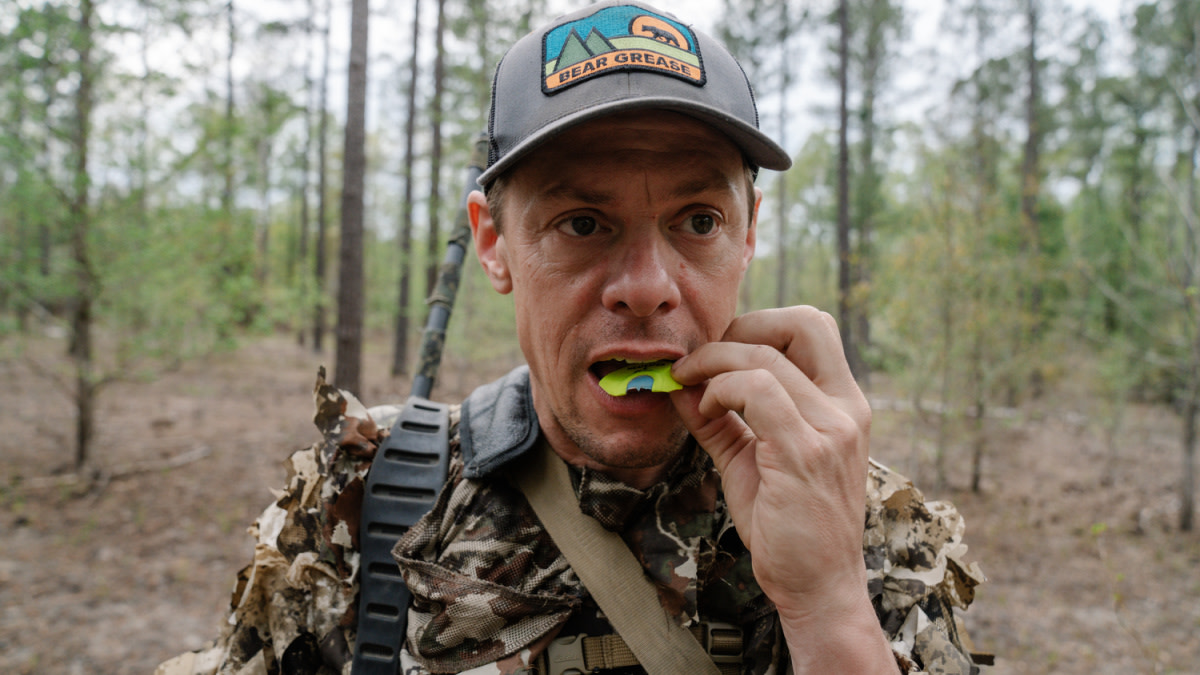
“I try to find a call, usually a mouth call, that allows me to put my own twist on the sounds,” Swisher said. “Don’t get me wrong, I love box calls, and slates, but there is so much versatility to a mouth call.”
This strategy is Swisher’s response to hunting pressured birds, and it’s mine as well. There’s something to be said about calling with some inflection, which a mouth call allows, versus what you can create with other calls. I know there are some callers out there who can play some beautiful music with whatever call they pick up, but most folks can’t.
That makes a mouth call the best choice for learning to add your own sound to the mix. Not only does this allow you to put some emotion in your turkey speak, but you can create every single vocalization a turkey makes with one single call.
Better yet, you can use a mouth call in conjunction with other calls. My personal favorite combo is to sound like two hens about to go ham on one another via a mouth call and a slate or box. Whether you master that multi-task sequence or just get really good with your chosen calls, it’s a matter of sounding different from your competition.
Most hunters think about calling mistakes being something simple like cutting when he wants to hear a yelp or using a soft-sounding slate call when a raspy, loud box call would be better. The truth is, it’s not that simple. Over- and under-calling, not trusting your abilities, and following the same rules as all of your competition are actually the biggest offenses.
Stay in the loop with The MeatEater Newsletter
Shop

Related

Turkey
Calling Tips from Steve Rinella's Favorite Turkey Hunter

Turkey
3 Common Mistakes Turkey Hunters Make


Turkey
3 Calling Mistakes Every Turkey Hunter Makes
The comments section requires Functionality cookies. Please enable Functionality cookies in Cookie Settings to view this content.