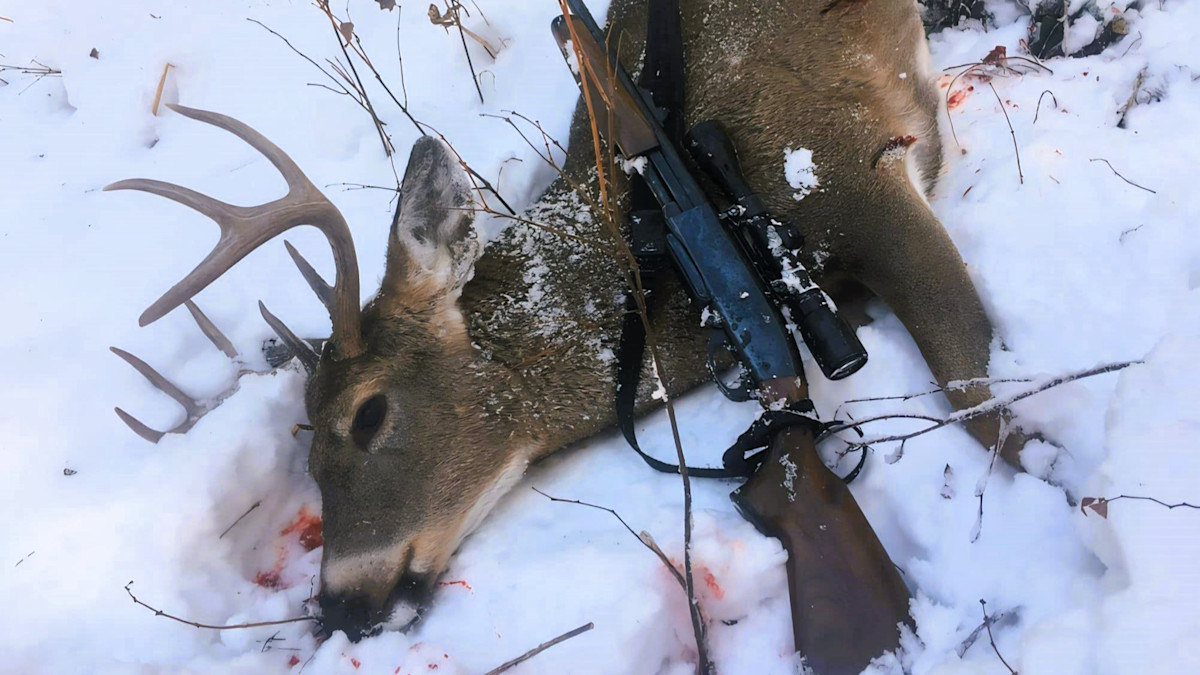

The modern hunting world is obsessed with long-range shooting. From the rise in popularity of rifles like the 6.5 Creedmoor to thousand-yard gun ranges and shooting courses popping up like new Starbucks locations, it seems like every hunter wants to dial it in at a distance. Now, I’m not saying there’s anything wrong with being able to knock a flea off a cockroach’s eyeball from half a mile away; I’m just saying it’s not always necessary.
As an avid Western hunter who chases mule deer, antelope, and elk in the mountain ranges and open plains, I spend hours adjusting for windage and dialing in my scope so I can make tight groupings at distance. Yet, whenever I’m heading into the deep woods to try and track down a big whitetail buck (or a muley, or even a bull elk or black bear, for that matter), I leave my long-range rifles in the gun cabinet and take to the trees with my carbine.
Tradition for a Reason
A “carbine” is a shortened version of an existing rifle, though the term can be used to describe any rifle with a shorter-than-usual barrel (usually between 16 and 20 inches in the U.S.). The first carbines came on the scene in the 17th century during the Napoleonic Wars. At the time, English, French, and German soldiers all wanted a high-caliber rifle with a compact frame that they could easily slip in and out of their saddles. The early designs of these rifles were such a success that eventually, almost every country was jumping on the carbine bandwagon. Different carbine designs continued to circulate in the military through WWII before eventually making it to the world of hunting as the returning soldiers wanted to take to the woods with a familiar weapon. It was here that carbines began to truly shine, especially in the world of big woods bucks.
“Those old timers had it right,” says avid big woods buck hunter and registered Maine hunting guide Timmy Bolduc. “There’s a reason that those short-barreled carbines like the Remington 760 and 7600 have been passed down through the generations and have become a part of big woods hunting culture because they work. It’s the same reason we still wear wool and rubber boots—they are just the most efficient tools for the job, both then and now.”
Bolduc hunts big whitetail bucks in both Maine and New Hampshire. As both a still hunter and a tracker, he believes that when hunting from the ground in the thick woods of northern New England, having a rifle that translates so well from combat to hunting is key.
“If you’re hunting from a tree stand or a ground blind, where you’re above the brush or have a wide view on a powerline or in a meadow, then a long-barreled rifle will work just fine,” Bolduc told MeatEater. “In those situations, you’re a sniper that has time to get your breathing under control and to wait for that perfect broadside shot. But when you’re in the shit, tracking a big buck in the thick brush and dense timber of a northern forest, where those bucks often take you, you’re a soldier behind enemy lines and want a rifle that you can get into action quickly. Carbines are just the perfect weapon for that type of hunting. It’s why they’ve been so popular for so many years, because you can get them into action quickly when you’re up close and personal with a big buck.”
Into the Thick of It
Both tracking and still hunting in the big woods is a game that requires patience and a lot of woodsmanship. You need to be able to get into both bedding and feeding areas silently and then go wherever you need to go through thick cover without making a ton of noise–while also being ready to shoot at any second. This often requires contorting yourself a bit and doing things like ducking under fallen trees, side-hilling along the edges of cliffs and gulches, or soft stepping and maneuvering through and around brush and branches.
Whether you’re hunting with a modern AR-15 or your grandfather’s old .30-30, a short-barreled, light, and easy-to-carry carbine is more maneuverable and easier to raise to your shoulder and shoot than a longer-barreled, heavier rifle. This is especially true when you’re hunting on the move and carrying the gun for endless miles and where your shot may suddenly come out of nowhere.
“Carbines are great because you can always carry them in the ready position,” Bolduc told MeatEater. “They’re so light, you can hold them in one hand or even with the stock on your shoulder when you’re creeping through the woods for miles, and you can keep them there all day long. It’s a huge advantage, too, when you’ve suddenly got your buck staring at you from 30 yards away because you can swing around in the thick stuff without worrying about a long rifle barrel getting hung up in the brush or anything like that. Plus, that short carbine just brings the sights or scope to your eye, which is a huge advantage when you need to shoot quick.”
Fast and Accurate Shooting
One of the perceived disadvantages of hunting with a carbine is the loss of range and velocity. However, while carbine rifles aren’t ideal for long ranges, with the proper preparation and ammunition, you can easily make accurate shots at 300 yards. This makes a carbine more than capable of taking down a myriad of big game animals at long range. In fact, many hunters will use a 3-9x40mm or slightly larger scope on their carbines as opposed to the more traditional peep sight or red dot sights. It’s the perfect scope to have for short-range shots but can also be cranked up for when you need to reach out and touch something.
Still, long-range work isn’t what carbine rifles were designed to do. They’re meant to deliver a hard-hitting round at close range at what is often a moving target.
“When you’re hunting a big buck in the big woods, you’ve got to take your opportunities when you get them,” Bolduc said. “In thick woods, the only thing you might see is a patch of brown fur and a pair of antlers through the brush, and you may only get to see them for a second before the buck takes off. It’s these moments where using a carbine rifle truly shines.”
Many big woods buck hunters prize carbine rifles that have the ability to fire multiple rounds quickly, which means they tend to prefer semi-automatic, lever-action, or pump-action rifles.
“Shooting quick has a bad rap, and a lot of people frown on it in this day and age,” Bolduc told MeatEater. “Modern hunting culture is all about looking for accurate, broadside shots from stands, and I can understand why. But as I am a product of quick shooting and getting good at it, I can say that it’s not as morally bad as many hunters believe. Because, like most famous big woods buck hunters like Lanny Benoit and Hal Blood, I got good at it.”
Bolduc believes that successfully shooting at a running deer with a carbine rifle is a quintessential part of big woods hunting culture. While taking quick shots at moving targets may be controversial, with many hunters that fear making a bad hit and having to trail the animal, Bolduc, and many other big woods hunters, believe that with the right rifle and the right practice, you can be as accurate as if the deer is standing still.
“It’s like practicing with a bow,” Bolduc said. “You can’t just go out and fire off arrows a couple times and then expect to go hunting. You have to go out and practice, practice a lot, and get that sight picture in your head until it becomes second nature.”
“You’ve got to do things like shooting at rolling tires,” he explained. “That’s why we all like carbines because you can bring that front bead or cross hair into your line of sight so quickly that you learn to control the chaos of a moving front sight on a moving target. That short gun lets you snap into play and helps you learn to hold on to that extra second and make a 5-ring shot into a 10-ring shot. When you’re shooting quick, I always tell people it’s the difference between coming back to camp with a story about a missed shot or going to get your buddies to help you drag out your buck. It all comes down to just shooting, and carbines are the best thing for it.”
The Gun of a Hunter
When you review the history of hunting and great hunters, carbines can’t be overlooked. In the past, when hunting was less of a sport and when getting a deer meant you were putting food on the table for your family, hunters weren’t so worried about making long-range shots. Instead, they used their stalking and tracking skills to get close to big game, and then they made quick and accurate shots when they mattered most. These hunters weren’t out there doing that with some ultralight, composite plastic rifle with a turreted scope—they were out there with a carbine.
Perhaps that’s the biggest reason why a carbine is the best big woods rifle. In a modern world where so much of the tradition and skill of hunting is objectively being lost and replaced with ever-expanding technological advancements, the carbine’s simple design and use as a tool stands out. In the big woods where stalking close and quick reaction shooting are the norm, the carbine remains a testament to the skills of a hunter, and just like the trees themselves, its roots run deep.
Stay in the loop with The MeatEater Newsletter
Shop
Related

Hunt
How to Track a Buck in the Big Woods

Manage
Best Food Sources for Big Woods Whitetails


Scout
Breaking Down the Big Woods
The comments section requires Functionality cookies. Please enable Functionality cookies in Cookie Settings to view this content.