
When hunters think of elk hunting, they generally picture being high on some thick-timbered slope listening to the sound of elk bugles reverberating through the mountains. They fantasize about ambushing big rutting bulls around wallows and calling and working elk in over drainages like tom turkeys.
While this type of hunting is all well and good during the rut, the fact is that as breeding activity winds down, the picturesque image we have about chasing bugling bulls through the mountains becomes less realistic as it’s replaced by the cold, gray reality of late-season elk hunting.
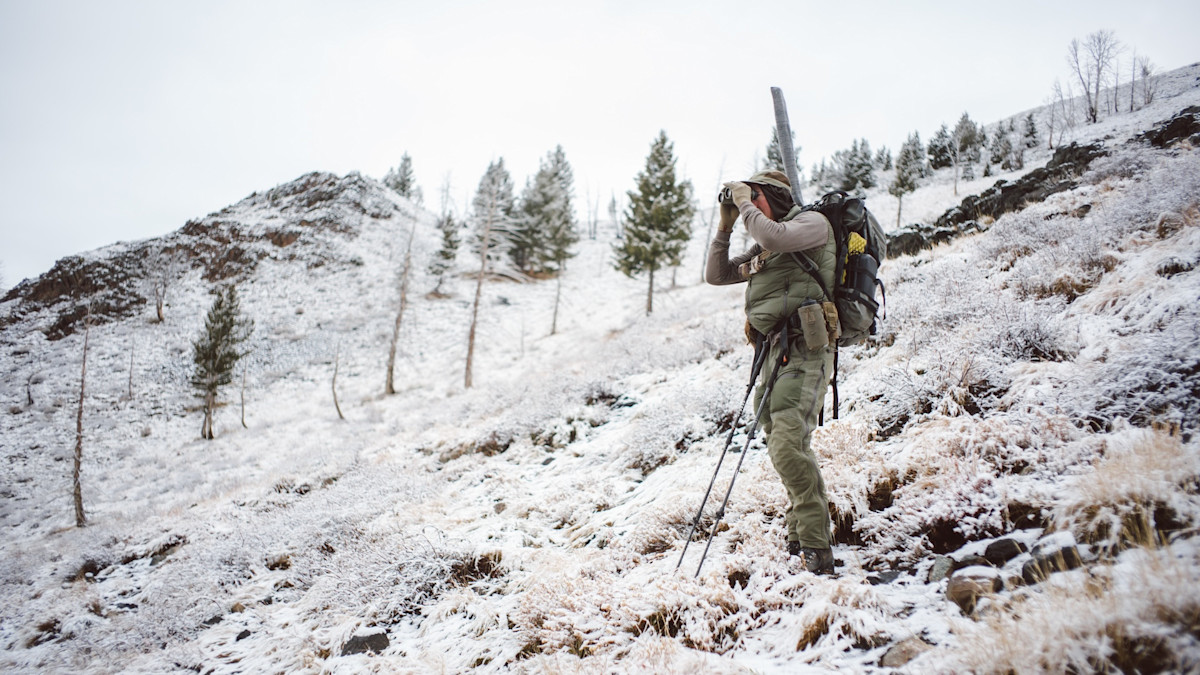
Late-season elk hunting adds a whole new level of challenge to what is already a tough sport. It’s a game of walking miles upon miles of seemingly empty country and glassing ridgelines and mountain sides until your eyes bleed, all in what are usually brutally cold conditions. Yet at the same time, late-season elk hunting can be one of the best and most beautiful times to take on the elk woods and may even get you the bull of your dreams.
Forget About Bugling and Look for Food
While calling elk can be incredibly effective during the early part of the season, once the rut comes to an end in the late season, bugling bulls go silent. Now, this doesn’t mean you shouldn’t still carry an elk call with you during a late season hunt. Third-cycle cows that haven’t been bred will often still be very vocal, even into late November, and elk of all shapes and sizes will still mew and chirp at one another as herds gather and move through cover.
You can still use cow and calf calls to comfort spooked elk or even draw a herd slightly closer during the late season. However, bugling and chuckling your head off to find elk during the late season is pretty pointless and can even spook the elk you’re hoping to find. Instead of trying to call elk to you during the late season, you must go after them, and the best way to do that is by finding their food.
Unlike mule deer and whitetail, which are browsers that eat a mixed bag of leaves, twigs, nuts, and other vegetation, elk are grazers that primarily feed on grasses. This makes any open fields or meadows in elk country prime targets, especially for post-rut bulls that are looking to pack on calories before the onset of winter. You can find bulls and other elk by using good e-scouting tools such as onX to locate open meadows and hillsides, concentrating on south-facing slopes and recent burns where grasses are more prevalent.
Once you find a couple good-looking meadows and fields, hike into the area so you can glass them from a distance. Start looking for elk in the early morning and late evening when they’re most active. However, with days being shorter and elk extending their feeding windows to make up for it, staying in place until the late morning and starting your glassing sessions in the early afternoon is also a good idea, as you may catch a late- or early-moving herd. Try to focus your search around any slightly greener or darker-looking grass.
Finding Hell Hole Bulls
Once the rut is officially over, most bull elk will separate themselves from herds of cows and calves and go off on their own. Generally, smaller and less mature bulls will form bachelor groups or small herds of 2 to 10 animals (though I’ve seen groups of 20 or more), while the larger trophy bulls will either travel alone or in pairs. Hunting these bulls presents its own particular challenge during the late season, and the pursuit will often drag you into the steepest, thickest, and most brutal terrain on the planet.
Start looking for these late-season pockets of bulls by finding the cows first. Once you’ve located a herd of cows and/or spikes in the open, start setting your sights higher. Look for close-by elevation gains where saddles and ridgelines as well as deep drainages form pinch points of cover between 1,500 and 2,000 feet above where cows and smaller bulls are feeding.
For the most part, bachelor groups and larger bulls will both be frequenting these areas above the cows, especially in areas where steep open slopes and other chunks of open terrain offer easy grazing opportunities. You can hunt these areas by either glassing the open terrain and stalking in on feeding bulls or even by still hunting through any nearby timber where big bull elk will likely bed down during the day.
Chasing hell hole bulls in the late season is not easy but can be incredibly rewarding. You’re going where other hunters won’t, so the elk are relatively unpressured and generally stay in one place, offering you some great opportunities to find the bull of a lifetime.
Hunt Low in The Snow
Almost every seasoned elk hunter knows that snow is the great equalizer when it comes to late season hunting. Once the temperature drops and a few feet of the white stuff begins to cover the mountains and any easily accessible forage, elk will begin to head downhill toward their winter ranges in droves. These late season migrations can offer some of the best elk hunting of the year, so long as you hunt in the right places at the right times.
Elk that have been pushed down to lower elevations by snow will gather in a lot of places, from deep canyons to open prairies, to recently harvested agricultural fields. After a big snow, I’ve found late-season elk on the open plains in the middle of nowhere, seen them cruising along the sides of major highways, and even wandering through fields of standing corn like whitetail. The key similarity in all those locations was that these were places where the elk could easily find food and cover that were immediately adjacent to the higher elevations they had recently escaped.
Once you have 18 to 24-plus inches of snow falling in the mountains, move into the foothills around the bases of the mountains and start looking for elk. Concentrate your efforts on fields and valleys as well as south- and west-facing hillsides, wind-blown hills, and short ridgelines that all shed snow more quickly. You should also look for areas where grassy basins and drainages meet up with steppe shrubs like sagebrush and bitterbrush, as well as creek bottoms with open timber like aspen, willow, and dogwood where elk can easily bed and feed.
As winter range elk generally gather in only one or two smaller areas, you usually have to cover a lot of ground either by road or on foot to find them. Work your way up onto higher points and glass the heck out of any likely-looking areas throughout the day. While it may take a few hours or even a few days to find the elk you’re after, once you find a good group of elk, they’ll usually be in very approachable locations where you can easily stalk in range for a shot.
Last Ditch Effort
For me, hunting late season elk always feels like I’m fighting against the clock. The days are short and the terrain is often brutal, and as the season draws to a close, I feel a frantic need to get after it. Yet at the same time, that late season rush is a beautiful thing. Like a buzzer beater shot to win the game, when it all comes together and you’ve got your elk on the ground, it can make you feel flat out heroic because you fought it out to the bitter end and came out on top.
Stay in the loop with The MeatEater Newsletter
Related
Shop
The comments section requires Functionality cookies. Please enable Functionality cookies in Cookie Settings to view this content.