How to Be a More Efficient Shed Hunter
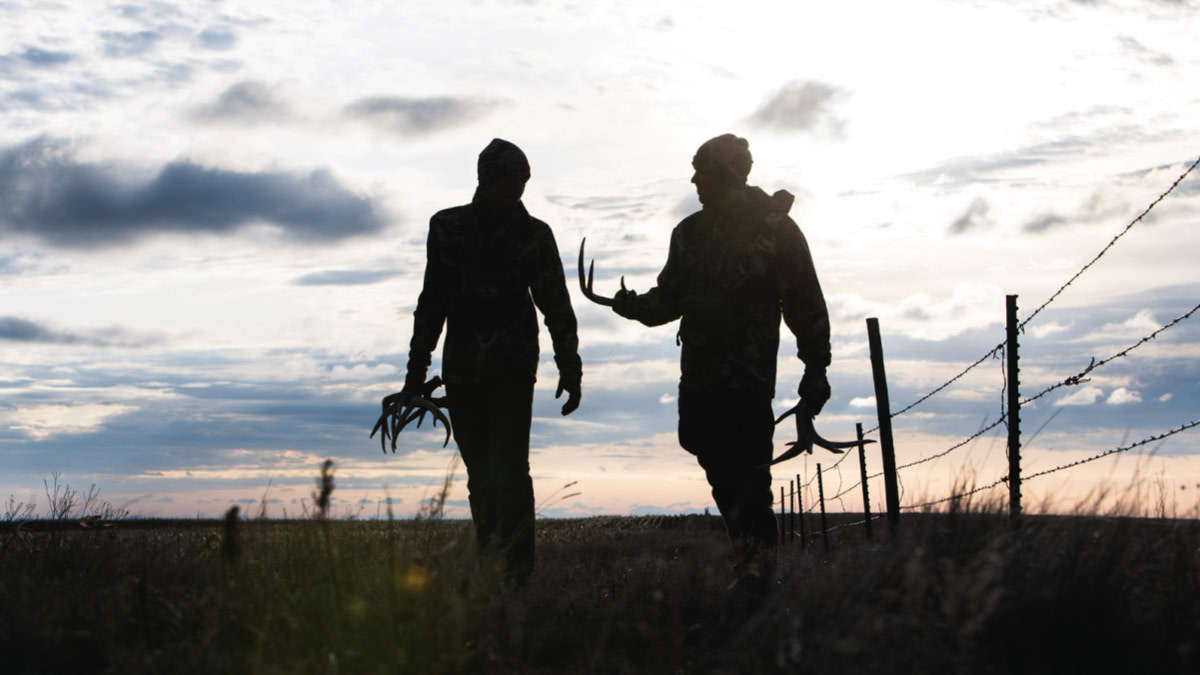

The best and worst shed hunting advice I ever received was, “just keep walking.” There’s a beautiful simplicity (and truth) to that maxim, but also dangerous deceit.
When I first began searching for shed antlers, I took this approach to heart and simply walked. As most beginning shed hunters do, I blindly traversed every square inch of every property I had access to. On occasion, I’d actually find an antler and it was a great rush. But the more years I spent scouring the forest floors of the Midwest, the more I came to realize my approach was flawed. More precisely, it was inefficient.
I’ve found that the key to picking up more sheds is not just endless, determined walking, but more efficient walking.
Why Efficiency Matters
I found more than 50 whitetail antlers last year across Michigan, Ohio and Montana, and when studying the location of each of those antlers, a pattern emerged that was consistent with my own observations from the past decade. The vast majority of the antlers I found were located in the most predictable locations and this pattern seemed to adhere to something I learned in economics called the Pareto Principle, or more commonly, the 80/20 rule. This rule states that 80 percent of a given outcome generally results from 20 percent of the input or work. When this is applied to shed hunting, it matches the pattern I observed almost perfectly.
Approximately 80 percent of the sheds I found were located in only about 20 percent of the area I had access to.
I’ve seen this now time and time again. Shed antlers are not spread randomly across a landscape. Instead, they are most commonly found in concentrated areas for very specific reasons. With this being the case, the most effective shed hunters are the most efficient shed hunters. It’s those who spend the majority of their time focused on searching these key areas.
Rather than spreading your shed hunting time equally across an entire property or area, you want to apply a higher degree of thoroughness to the highest potential areas.
Identifying Your 20 Percent
When looking at my 50 antlers from last year, and the dozens of others from previous years, it’s clear that the majority of sheds were found in one of two types of locations: food sources and bedding areas.
For food sources, focus on those that are highly attractive to deer during the winter months. These food sources are the hub of the wheel that a winter whitetail’s world revolves around, as quality food at this time is hard to come by. For this reason, winter whitetails will frequently relocate from their typical summer or fall ranges to be close to the best food.
Depending on your location, this quality winter food source might come in the form of corn, beans, alfalfa, turnips, radishes, winter wheat or any other number of quality agricultural or native forage options. The key to locating the best late season food sources in your area is to identify the field or location with the highest amount of recent deer sign. In particular, I seek out fresh tracks and fresh droppings.
Rubs, scrapes and trails from the previous fall don’t help you at this point, because what matters is where deer have been from January through March. Once you’ve found these best food sources, you’re halfway to your 20 percent.
The second half of your high priority area comes in the form of bedding areas nearest these food sources. Winter bedding can come in the form of sunny, southern-facing hillsides, cedar or pine groves, native grasses or CRP, or any other thick cover adjacent to high quality, late season food. Again you’ll want to confirm that a given area is a winter bedding area by seeking out fresh tracks, droppings and the oval depressions formed by bedded animals.
Now you have your 20 percent focus area.
Using Your 80 Percent
Once you’ve identified your top 20 percent, it’s time to apply your shed hunting time to these sections in earnest, placing a disproportionate amount of focus on these high priority regions.
Before my efficiency revelation, I would spend my days grid searching an entire property, walking a straight line down a border, shifting 40 or 50 yards, and then walking back all the way in the other direction. The issue here wasn’t just that I was spending too much time walking through low-odds locations, but that when I did actually arrive at high-odds spots, I was either too short on available time to properly search them, or so burnt out that my focus dipped.
Rather than spending 10 hours walking an entire property, I’ll now spend the first eight scouring the bedding and feeding areas. Fully engaged and with high hopes, my time spent here is higher quality, more focused and ultimately more productive. With more time to spend in these small areas I can make the extra effort to change my perspective, which means sometimes standing on top of logs for a different view, or looking back behind me at an area that might otherwise have been blocked by brush.
I move more slowly and scan with more attention to detail. I pick apart a landscape for any telltale flash of white or curve of a beam. I carefully look behind downed trees, underneath lone cedars and in tall grass bordering food, picking apart each particularly promising piece of habitat.
Execution
In a perfect world, by focusing your shed hunting time on the top 20 percent of a property, you’ll have more time to spend on additional shed hunting areas and focus on the top 20 percent there as well. The end result should be 100 percent of your time, or close to it, spent in high probability locations, rather than wasting it on the low probability sections that comprise most areas.
All rules are made to be broken, and I certainly do find sheds every year in random locations not associated with winter bedding or feeding areas, but the general trend almost always applies. Efficiency is the name of the game when it comes to smart and productive shed hunting, and the 80/20 rule can help you achieve it.
Feature image via Captured Creative.
Stay in the loop with The Wired to Hunt Newsletter
Related

Scout
Finding Holyfield’s Shed – #WiredToHuntWeekly 32
Scout
How to Plan an Out-of-State Shed Hunting Trip
Scout
3 Best Natural Food Sources to Shed Hunt

The comments section requires Functionality cookies. Please enable Functionality cookies in Cookie Settings to view this content.