3 Nasty Plants to Avoid During Summer Deer Projects

For a dedicated whitetail hunter, there is no off-season. There are food plots to plant, stands to hang, cameras to run, and new spots to scout. You want to enjoy every second spent outdoors in pursuit of your hunting goals. But in the summer, the outdoors like to fight back.
You’re probably pretty familiar with the unholy trinity of summertime beasts–ticks, mosquitoes, and chiggers. But the plant kingdom can also be a formidable foe in the peak of the growing season. And there’s a lot more to look out for than everyone’s favorite leaf-of-three.
One tree in particular is the bane of my existence, and that is the honey locust.
Honey Locust
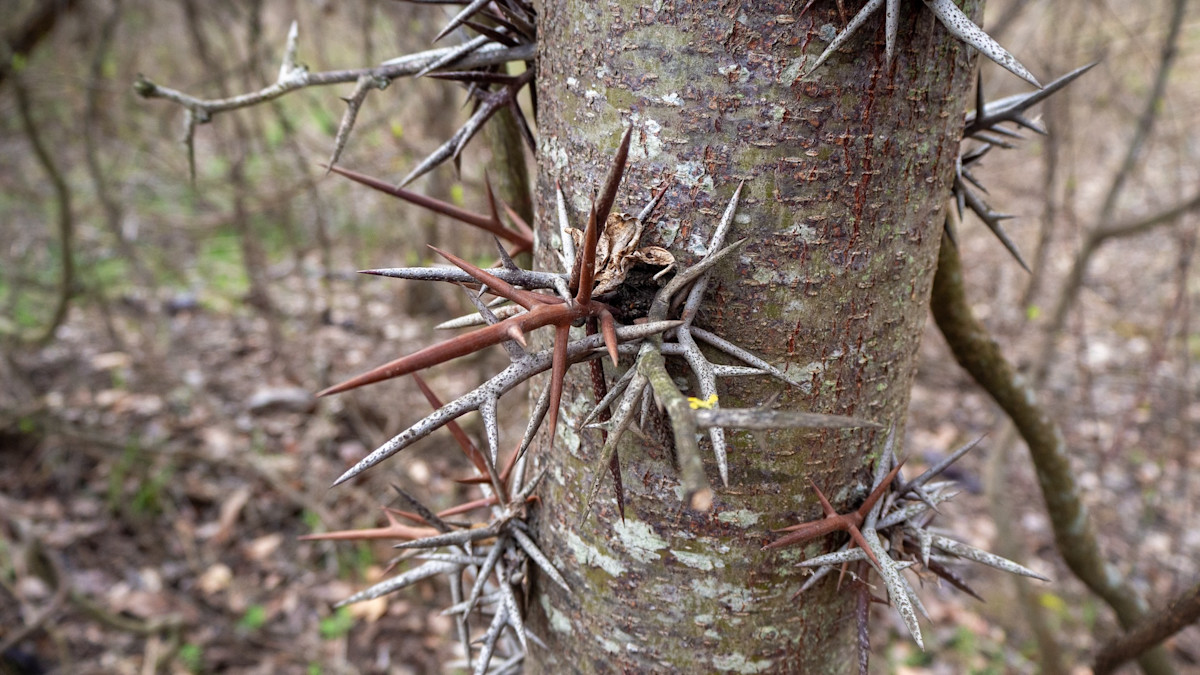
Don’t let that sweet, innocent name fool you–it should be known as the stabby asshole murder tree. A friend only to shrikes looking to impale their victims, the honey locust is a serial day-ruiner from the Midwest to the Deep South and north along the Appalachian Mountains.
This tree sports a flak jacket of compound thorns that are tough as nails, surgically sharp, and up to a foot long. Some farmers believe honey locusts evolved specifically to pop tractor tires—which should give you a good idea of how threatening they are to human flesh. In reality, the honey locust’s brutal defences evolved to deter herbivory by Pleistocene megafauna. Now, we’re stuck with the same thorns that were enough to phase a browsing mastodon.
Once most of the plant kingdom has gone dormant in winter, these needle-barked jerks are relatively easy to spot and avoid. However, the dense foliage of summer does a great job of hiding them for a fun surprise while you’re brush-busting. Honey locusts are also highly rot-resistant, so their pokey parts maintain their potency long after death.
In my time as a trapper, every bobcat and coyote I’ve skinned has had broken-off honey locust thorns embedded in their appendages. If someone were to skin me, they’d find a few in my right hand and one in my right foot, which pinned the boot of my waders to my arch when I stepped on a dead branch underwater while running beaver traps.
If you’re in the field with these suckers this summer, don’t let your guard down. They’ll let the air out of you, your dog, and your tires in a single afternoon.
Nettles
On my first day of field work as a wildlife research technician, we pulled up to a bottomland hardwood forest, and I breathed a big sigh of relief. The understory was a homogenous layer of some benign-looking forb with no poison ivy or thorns in sight. Super easy to walk through–or so I thought.
The first thing I realized upon wading into the green was that this mystery plant was much taller than it looked from the outside. Then, as the fire erupted from my thighs to my ankles, I realized that despite being friend-shaped, this forb was no friend. It was the spicy horror known as wood nettle.
Stinging nettles, including wood nettle and the nearly continent-wide common nettle, belong to the family Urticaceae. You might recognize the Latin root, “urtica,” from some other unpleasant things, like urticating hairs on a tarantula, or the skin condition urticaria (a.k.a. hives). It means “to burn,” which is exactly how it feels when the silica-tipped and chemical-filled trichomes of a nettle break off in your skin.
Not even brush pants can save you in a sea of these devils. Unless you want to face the misery of a thousand tiny bee stings, nettles are best avoided or confronted with a thick pair of chaps.
Poison Hemlock
Known affectionately by me as murder parsley, poison hemlock is undoubtedly one of the most important plants for outdoorsmen and women to know on sight. While native to Europe, Asia, and northern Africa, it has become a widespread invasive across North America, often growing in dense stands along field edges, roadsides, and pastures.
This nightmare cousin of the carrot produces a cocktail of alkaloid toxins that attack the nervous system and can ultimately cause respiratory failure if consumed by livestock or people. Think you’re safe because you don’t put random plants in your mouth? Think again. The toxins in poison hemlock are so potent that contact with the leaves can trigger dermatitis, and full-blown poisoning can occur if the toxins enter your bloodstream via a cut or mucus membrane.
You may be wondering why landowners and state agencies aren’t waging war to stop this horrible death plant from spreading, and there’s an answer for that. Poison hemlock is so toxic that the airborne particles produced by disturbing it are enough to be life-threatening if inhaled. Any attempt at removal requires HAZMAT-level PPE for everyone in the vicinity, and the odds of successful eradication at any scale are essentially zero.
This invader is here to stay, so awareness is your best defense against it while you enjoy your summer in the great outdoors.
Stay in the loop with The Wired to Hunt Newsletter
Related

Manage
Summer Habitat Improvements for Whitetails

Manage
3 Nasty Plants to Avoid During Summer Deer Projects

