

Prep time
5 minutes
Cook time
40 minutes
Course
Main
Skill level
Beginner
Season
Spring
Serves
2 to 4
Garlic mustard (Alliaria petiolata) came to the New World by way of early European settlers who used it for food and medicine. In favorable conditions, the species escaped from gardens and spread uncontrollably. Today, it’s regarded as an invasive species. Garlic mustard grows prolifically in practically all of the Northeastern and Midwestern United States and has made its way into Colorado, Utah, and Oregon.
Common control methods include burning, pulling, and spraying. Another way to help control the sprawl of garlic mustard is to make it popular to eat. It’s one of the oldest herbs/spices used in Europe, and with our populations of ramps in decline, I propose that garlic mustard take its place. Market foragers can shift their focus to this plant instead.
Garlic mustard’s flavor profile is garlicky and peppery. Use it in place of arugula, mustard greens, or watercress in recipes. You can eat it raw or cooked. It’s delicious in pesto, marinades, salads, dressing, and compound butter—anywhere that would benefit from a little bit of garlic flavor.
Harvest garlic mustard in spring when leaves taste mild and have yet to develop bitterness. Although I tend to use the leaves only for cooking, I urge you to pull up the entire root. The more plants you can take out of a population, the better.
Ingredients
- 4 skin-on chicken thighs
- ½ cup chopped garlic mustard leaves, packed
- ½ cup whipped cream cheese
- ½ cup shredded mozzarella cheese
- ¼ cup grated Parmesan cheese
- Olive oil
- Kosher salt
- Freshly cracked pepper
Also works with
Special equipment
Preparation
-
Move oven rack to second level from the top, and preheat oven to 425°F. In a small mixing bowl, combine chopped garlic mustard leaves, cream cheese, mozzarella and Parmesan.
-
Debone chicken thighs and butterfly each piece to make more surface area. Lightly sprinkle the meat side with salt, and then spread on an even layer of the garlic mustard and cheese mixture. Roll and secure snugly with kitchen twine. Brush oil all over the outside skin and season with salt.
-
Transfer the stuffed chicken thighs onto a rimmed baking dish lined with foil or in a cast iron skillet. Bake at 425°F for 30 to 40 minutes, or until internal temperature reaches at least 165°F and the skin becomes crispy. Remove twine, season with pepper, and serve immediately.
Sign In or Create a Free Account
Related
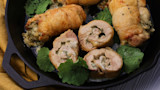
Recipes
Garlic Mustard Stuffed Chicken
(1)
Recipes
‘Biloxi Bacon’ (Striped Mullet)
(0)
Recipes
Elderflower Panna Cotta with Lemon Sauce
(0)The comments section requires Functionality cookies. Please enable Functionality cookies in Cookie Settings to view this content.
Garlic Mustard Stuffed Chicken
Prep time
5 minutes
Cook time
40 minutes
Course
Main
Skill level
Beginner
Season
Spring
Serves
2 to 4
Garlic mustard (Alliaria petiolata) came to the New World by way of early European settlers who used it for food and medicine. In favorable conditions, the species escaped from gardens and spread uncontrollably. Today, it’s regarded as an invasive species. Garlic mustard grows prolifically in practically all of the Northeastern and Midwestern United States and has made its way into Colorado, Utah, and Oregon.
Common control methods include burning, pulling, and spraying. Another way to help control the sprawl of garlic mustard is to make it popular to eat. It’s one of the oldest herbs/spices used in Europe, and with our populations of ramps in decline, I propose that garlic mustard take its place. Market foragers can shift their focus to this plant instead.
Garlic mustard’s flavor profile is garlicky and peppery. Use it in place of arugula, mustard greens, or watercress in recipes. You can eat it raw or cooked. It’s delicious in pesto, marinades, salads, dressing, and compound butter—anywhere that would benefit from a little bit of garlic flavor.
Harvest garlic mustard in spring when leaves taste mild and have yet to develop bitterness. Although I tend to use the leaves only for cooking, I urge you to pull up the entire root. The more plants you can take out of a population, the better.
Ingredients
- 4 skin-on chicken thighs
- ½ cup chopped garlic mustard leaves, packed
- ½ cup whipped cream cheese
- ½ cup shredded mozzarella cheese
- ¼ cup grated Parmesan cheese
- Olive oil
- Kosher salt
- Freshly cracked pepper
Also works with
Special equipment
Preparation
-
Move oven rack to second level from the top, and preheat oven to 425°F. In a small mixing bowl, combine chopped garlic mustard leaves, cream cheese, mozzarella and Parmesan.
-
Debone chicken thighs and butterfly each piece to make more surface area. Lightly sprinkle the meat side with salt, and then spread on an even layer of the garlic mustard and cheese mixture. Roll and secure snugly with kitchen twine. Brush oil all over the outside skin and season with salt.
-
Transfer the stuffed chicken thighs onto a rimmed baking dish lined with foil or in a cast iron skillet. Bake at 425°F for 30 to 40 minutes, or until internal temperature reaches at least 165°F and the skin becomes crispy. Remove twine, season with pepper, and serve immediately.