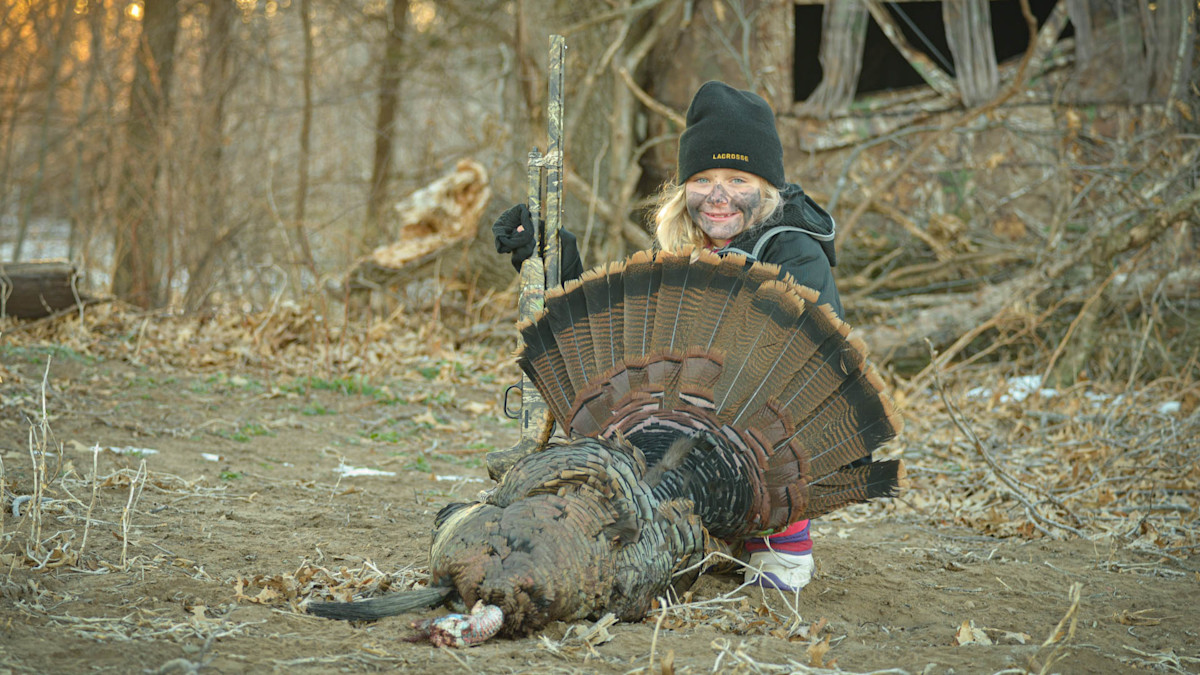

When the boys at Double Bull unleashed their first camouflage cubes on the turkey market, it wasn’t exactly a quick burn. Until then, most turkey hunters just put their backs to a tree and then went into statue mode to fool gobblers. Some hunters employed camo netting or stake-out style blinds, but no one entered into voluntary confinement to kill a bird.
Born largely out of the desire to be able to bowhunt turkeys more effectively, pop-up blinds have now become a standard tool in the turkey arsenal. And why not? They are comfortable and provide a huge advantage when used correctly. That last part is a kicker though, because a lot of folks still don’t seem to understand how to truly maximize their blind time. This all starts with understanding how blinds really work.
Darkness & Light
Before he passed away in a motorcycle accident, we had a neighbor who retired early and absolutely loved my daughters. Fred would often be found sitting in his yard with his overweight chocolate Lab, Chainsaw Sam, or he’d be tinkering in his garage working on some type of project.
I’d be pushing my twin daughters around the block in a double stroller, and then I’d hear a voice from inside the garage asking if I wanted to stop by for a beer. I rarely turned down an offer for a cold one at that point in my life. He knew it, so he’d emerge from the darkness of the garage into the sunlight without waiting for my response, a Michelob Golden in each hand.
I think about Fred just about every time I set up a turkey blind, because on those sunny days when we’d have a beer in his driveway, I couldn’t see him in that garage unless he had a light on. The contrast between a bright, sunny day and a dark garage is no different from the contrast between a bright, sunny day and a turkey blind.
If you learn to use light and shadows correctly, you learn how to use blinds correctly. This is more important for bowhunters, or anyone hunting with kids, but the truth remains that if you want to get away with a lot of movement in a blind, you have to heed a few simple principles.
The closer you are to the windows, the more likely you are to get spotted. The less black you wear, on your hands, face, and anywhere else, the more likely you are to get picked off. The lower the light outside, the more likely you are to get spotted. The more you set up to face directly into either the rising or setting sun, well, you get the drift.
The whole goal of using a pop-up blind is to keep you and your hunting partners from tripping off that little warning system in a tom’s brain. Think about light when you set up your blinds, and then you actually hunt out of them, because it’s the best way to not get busted.

Sell a Scene, Earn a Shot
While I think decoy choice, as it relates to the seasonal timing, is probably the number one factor for drawing longbeards in close (accompanied by top-notch calling, of course), the way you envision birds using the land around you matters blind-wise.
The standard mode of operation is to put a blind on a field edge and call birds in. This works, because well, they’re turkeys. Even then, specific location matters, and if you’re not going to post up on an ag field, you have to think about how the birds are likely to approach and what that means to your setup.
I like putting my blinds up so that birds are most likely to approach from anywhere but straight ahead or straight behind. Straight ahead, and they’ll have lots of time to catch sight of movement. Straight behind, and they’ll often catch you off-guard, and they’ll be looking at the one side of your blind you might not brush in as well as the rest.
For bowhunts, I have to consider that my decoys will be within 10 yards. My blind has to be in a great spot that allows it to be brushed in but also allows for an easy shot. With a 12-gauge, you have more margin for error on exact blind placement and shooting range. The rules still stand, though. As you’re looking for a perfect spot to place your blind, think about how longbeards are likely to get there, and what they’re likely to see when they first lay eyes on your decoy spread.
Then, bust out the handsaw and get busy.

Brush or No Brush?
Several years ago I was tasked with filming a whitetail bowhunt in northern Wisconsin for Bowhunter TV. While setting up a couple of blinds, my cameraman casually said that when he hunts out of a blind, he really brushes them in. I came from the world where you could pop up a blind anywhere, and the turkeys would mostly ignore it. I figured the deer would as well.
I followed his advice anyway, and he was right. The more I brushed in my blinds and let them season, the more deer I killed from them. Then, I started doing the same thing for turkeys. I quickly realized that while some gobblers just don’t care about a new blind in the middle of a picked cornfield, most of them do. At least pressured birds do.
You want to brush in your blind to achieve a few goals. Depth is a big one, because it tucks you farther into the shadows and helps obscure your movements. You also want to ensure that no panel of your blind shines too brightly at any point in the day. This means you just need to break things up and allow the shadows to do their thing. Lastly, you don’t just want the birds to accept your blind as a part of the landscape; you want them to not even notice it.
This means tucking it between pine trees, in the middle of a deadfall, or just anywhere that allows you to use natural vegetation as your starting point. Then brush it in, and when you think you’re good, keep going. There’s no downside to a little overkill on this front.
Stay in the loop with The MeatEater Newsletter
Shop
Related
Turkey
3 Common Mistakes Turkey Hunters Make


Turkey
3 Common Pop-Up Blind Mistakes Spring Turkey Hunters Make
Turkey
3 Calling Mistakes Every Turkey Hunter Makes
The comments section requires Functionality cookies. Please enable Functionality cookies in Cookie Settings to view this content.