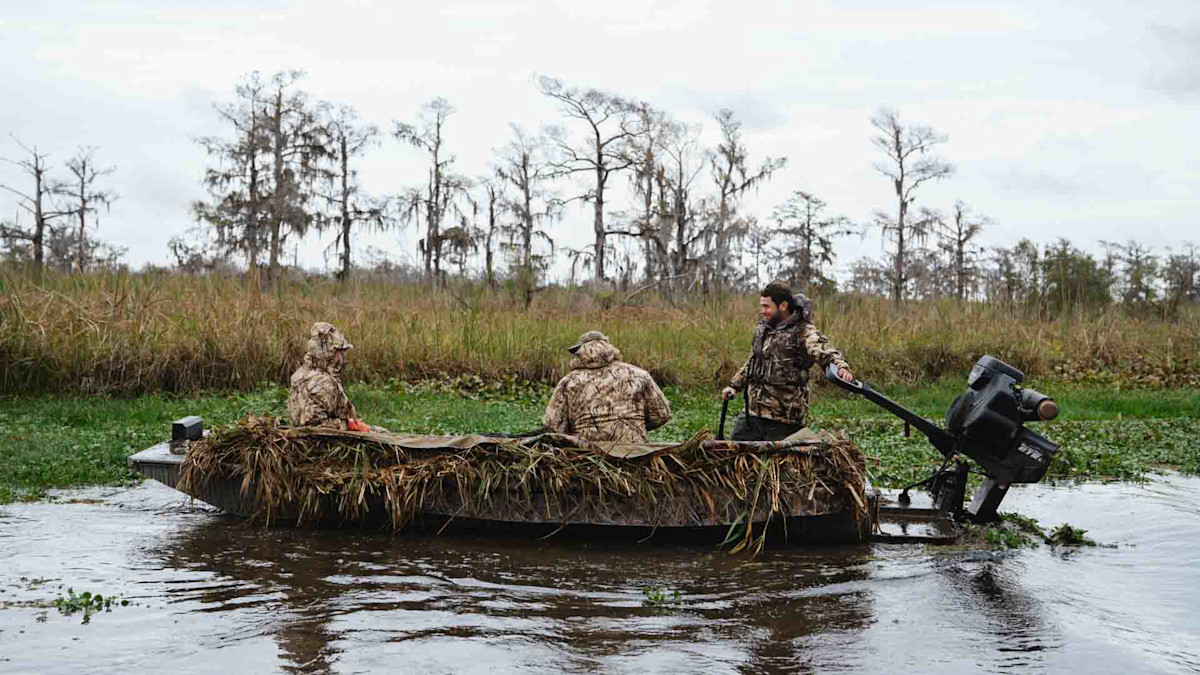

I duck hunt in a lot of different ways. From sitting in massive A-Frame blinds in reliable swamps and marshes, to hiding in the grass along the edges of small backcountry ponds, to layout blinds or flooded timber and fields, I love it all. But if I had to pick a gun-to-the-head favorite way to hunt ducks, it would have to be from a boat.
Boats are a way to stay comfortable and dry on a duck hunt and approach birds from an entirely new angle. Whether you’re hunting divers from a coffin boat, jump shooting wood ducks from a canoe, or plugging migrating mallards from a pimped out pontoon, there’s something about hunting from a boat that feels like a cheat code. It puts you on the duck’s level and allows you to hunt in areas you could never access foot. Before you set sail after a limit of ducks, make sure you’re hunting from the right boat in the right places.
The Right Boat For The Job
While you can probably knock down a few ducks from any boat, selecting the right boat from your hunting area and hunting style is vital for consistent success. On larger lakes or big rivers, you generally want a larger boat that will be able to cover more water and keep you afloat and safe during rough weather conditions. On smaller waters, anything from a kayak to an inflatable raft will probably work, but you need to keep things like mobility, cargo space, and camouflage in mind.
If I had to choose an all-rounder style boat for larger waters, it would be hard to look past a basic jon boat. These flat-bottomed, low-profile boats have a shallow draft, are relatively inexpensive, and can be propelled by oars, an electric trolling motor or gas outboard, or even all three, making them the ultimate all-water-vehicle (is AWV a thing?). However, the challenges of duck hunting from a jon boat or similar sized watercraft are both keeping a low profile while moving to and from different spots and/or approaching roosting birds. To help with this, you should either buy a boat or paint your boat with natural woodland colors, brush them out with netting and natural materials, and even carry an additional pop-up portable blind to make sure you stay hidden.
When it comes to smaller boats, there are a lot of different options including paddle boats and float tubes. When it comes to keeping both a low profile and stashing all your gear, a canoe is generally the best choice.
Canoes are timeless. They’ve been used by outdoorsfolk for everything from fishing trips to backcountry big game hunting for millennia. They’re lightweight and easy to carry and portage, allowing you to effectively hunt a plethora of smaller, hard-to-reach waterways. Canoes are also small enough that they can easily be tucked into and hidden in the reeds or even covered over with a camouflage cover or a simple framework of brush and branches. Canoes are perfect for hunting everything from small streams to shallow wetlands as they can easily be maneuvered, hidden, and hunted from, by a single or even a couple hunters wielding nothing but paddles and shotguns, so long as they’re hunting from them in the right places at the right times.
Stick To The Edges On Big Water
Unless you’re layout hunting for divers in the middle of a massive lake or in the ocean, your best bet for success when hunting on larger waterways is by anchoring up along the edges. This can include thick cattail covered banks, points off islands and peninsulas, and even gravel and sand bars in the middle of large rivers. The reason for this is simple as most duck species prefer to feed in shallow water near the bank and because the birds are extremely wary of floating objects in the middle of the water.
Before launching your boat on a large lake or river, do a bit of scouting to figure out where ducks are gathering and where you need to set up. Using both a bathymetric map or mapping app as well as a good pair of binoculars, look over your chosen hunting area, concentrating on spots with relatively shallow water. If you can, try and choose an area with a tree line or thicker brush close to the water or reeds along the bank that will help break up the outline of your boat, while still being relatively close to where ducks are moving. Once you find a few good-looking edges, double check that they’re deep enough to get your boat into when it’s time to hunt.
Make sure to launch your boat well before first light, even if it means setting out in the middle of the night to get to more distant spots. Use a spotlight to light the way and to make sure the water ahead is clear of any rocks or other hazards on the way into your spot. Once you arrive, get as close to the edge of the bank as you can and then anchor in place and set up whatever cover or blind you brought along to ensure you’re hidden from any ducks that will soon be circling overhead.
After getting everything set up and in place, put out your decoys in a rough “U” shape off the bow and stern. Then throw out a couple in the middle relatively close to the boat before settling in and waiting for birds to arrive.
Hunting The Bends On Small Water
I’ve always liked hunting small water from a boat because it gives you the opportunity to set up a blind in a normally unreachable place or jump shoot ducks as you go along. Whether you’re waiting for birds to come in or jump shooting, bends should be your focus. These can include the obvious turns and twists in a creek or river, as well as meanders in a wetland, or even the curving edges of a pond. All these areas provide both great, steep-bank cover for blinds or for approaching ducks, as well as excellent areas to find concentrations of birds.
On rivers and small streams, ducks will often gather on the open edges of bends where faster currents erode the banks and push soil, invertebrates, and vegetation downstream into muddy flats and pockets.
When you’re jump shooting ducks on a creek, you can use inside bends for cover when approaching these open areas off of the bend. Simply hug the bank on the inside and keep low as you come around the corner and then either stand up and look over the top of the bend or raise your gun and get ready to shoot as soon as you clear the point.
The deeper edges of bends in marshes and curves ponds are also great areas to set up blinds. Generally, these natural curves in the structure have high banks and a lot of overhead cover to help keep you hidden while also acting as a natural funnel for ducks circling over or approaching directly in front of your blind.
When hunting from a blind along a curve or bend from a boat, set a line of decoy directly off the bow or stern and as close to the bank along the curve as possible to represent ducks at ease. Then, if you can, try and set up two to three decoys with either a vibrating or dunking motion to imitate feeding ducks in the shallowest water you can find out from the center of the curve. This will give ducks a gap to land in between the decoys that won’t take them directly over your watercraft, offering a relatively easy shot as the birds usually won’t notice the boat until it’s too late.
Batten Down The Hatches
Hunting ducks from a boat gives you a bit more flexibility than stationary blinds. Plus, it’s also a convenient way to get your limit of ducks without ever getting your feet wet. Just make sure you check and follow local rules and regulations regarding hunting from a boat to make sure you’re in the clear before heading out.
Stay in the loop with The MeatEater Newsletter
Shop
Related
Waterfowl
How and When to Hunt a Duck Roost


Waterfowl
How to Kill Ducks at Midday
Waterfowl
What You Need to Know as a New Duck Caller

The comments section requires Functionality cookies. Please enable Functionality cookies in Cookie Settings to view this content.