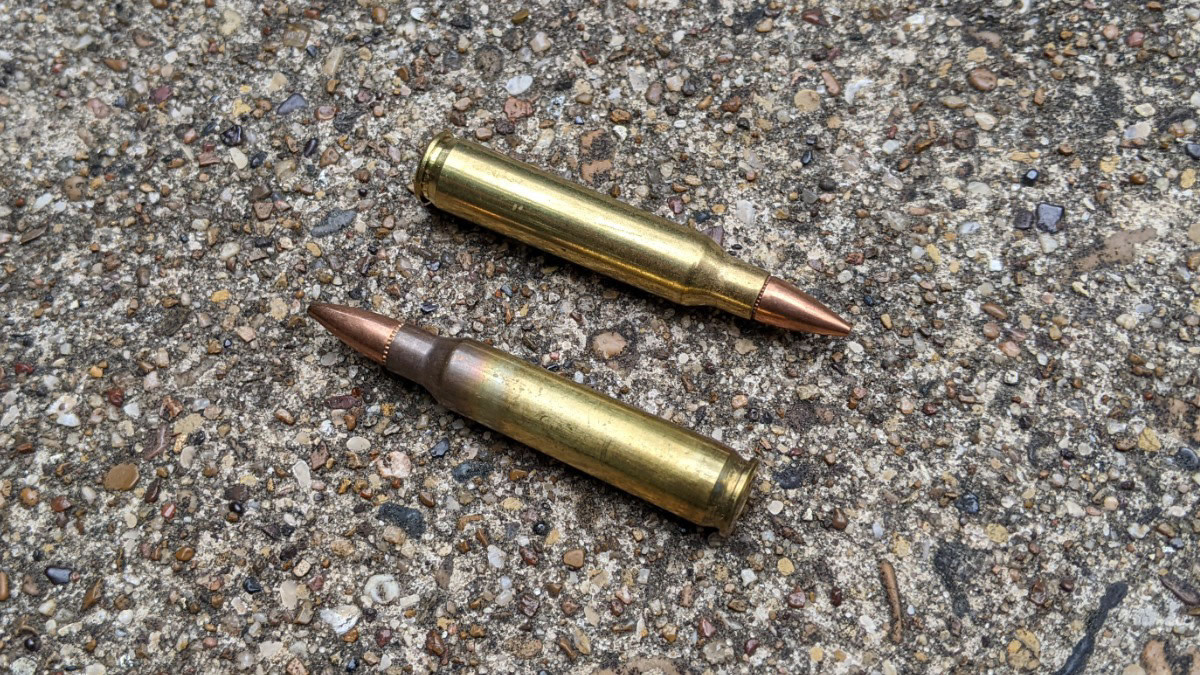

“They’re totally interchangeable,” I heard a gun clerk tell a customer purchasing a rifle chambered in .223 Remington. The customer had asked whether he could fire 5.56 NATO from his new rifle, and the helpful youngster assured him that since the rounds are dimensionally identical, he wouldn’t have any trouble swapping between them.
He wasn’t wrong about one thing: the .223 Remington and the 5.56 NATO are identical on the outside. But there are important differences underneath the surface of both the cartridge and the gun, and understanding those differences is essential for safe and effective use.
A Brief History
The .223 Remington/5.56 NATO first appeared in 1957 as an experimental military cartridge for the Armalite AR-15. The U.S. military adopted that cartridge as one of their official military rounds in 1964 and designated it the “5.56mm Ball, M193.” A few years later, NATO adopted the same cartridge (with slight variations in loading and bullet design) and called it the 5.56x45mm NATO.
Shortly after the military adopted the 5.56mm, Remington released a sporting version of that cartridge called the .223 Remington, which is why both cartridges are available today.
So, What’s the Difference?
There are two primary differences between the .223 Remington and the 5.56 NATO. The first is that the 5.56 is loaded at higher pressures than the .223. The 5.56 NATO cartridge runs around 58,000 pounds-per-square-inch (psi), while the .223 Remington is loaded to approximately 55,000 psi.
While this isn’t a terribly significant difference, that pressure difference can create a problem when you take into account the fact that the 5.56 chamber is not identical to the .223. The leade–the portion of the chamber in front of the cartridge case–in a 5.56 rifle is 0.125” longer than the .223 Remington. This means that firing a 5.56 NATO cartridge in a .223-chambered weapon will increase pressure to 65,000 psi or more.
This is why the Sporting Arms and Ammunition Manufacturer’s Institute (SAAMI) warns against shooting a 5.56 NATO cartridge in a rifle chambered in .223 Remington. “This can result in serious injury or death to the user and/or bystanders, as well as damage to the firearm,” the organization writes on its FAQ page.
Frank C. Barnes adds in “Cartridges of the World” that while a bolt-action rifle chambered in .223 Remington will likely be able to fire a 5.56 NATO cartridge, the same can’t be said for semi-auto guns.
“In a semi-auto rifle, problems can be experienced. These can be as minor as reliability issues and as unsafe as blown primers and even firearm damage and shooter injury,” he writes.
It’s best to exercise caution, no matter the rifle’s action. With a few notable exceptions, a manufacturer only guarantees that a cartridge is safe to shoot if it’s printed on the barrel of a gun. Anything else can be dangerous.
“Maybe the simplest way to explain the difference is to say that the 5.56 NATO round is a +P (overpressured) version of the .223 Remington. Exercise the necessary caution and sort your ammunition accordingly,” Barnes concludes.
The good news is that any rifle chambered in 5.56 NATO can safely shoot .223 Remington. It may not be as accurate, given the chamber difference mentioned above, but it won’t blow up in your face.
One additional note of caution for all the handloaders out there: military brass cases are sometimes heavier or thicker than commercial cases. This can cause higher loading density and increased pressure with the same powder charge when compared to a .223 Rem. case. So, if you have a bunch of military 5.56 cases you’d like to load for a .223 Rem. rifle, reduce the max load by at least 10%.
.223 Rem. vs. 5.56 Performance
Safety concerns aside, the .223 Rem. and 5.56 NATO sometimes produce different ballistics even with the same bullet. One might assume that the 5.56 would produce higher velocities given its higher chamber pressure, but that’s not always the case.
These 50-grain 5.56 cartridges, for example, produce 3,100 feet-per-second (fps) at the muzzle while these 50-grain .223 Rem. cartridges produce 3,325 fps. The same is true with these 55-grain 5.56 and these 55-grain .223: the .223 offers 75 additional fps at the muzzle (3,240fps vs. 3,165fps).
A 5.56 and .223 don’t always differ like this. Sig Sauer reports that both these 77-grain .223 projectiles and these 77-grain 5.56 projectiles leave the muzzle at 2,750 fps.
The velocity data reported by ammunition companies can’t always be replicated at the range. Barrel length impacts muzzle velocity, and these manufacturers don’t always identify the length of their test barrels. The only way to truly know how two cartridges will perform in your gun is to test them yourself.
The .223 Rem. might be slightly faster in some instances than the 5.56 NATO, but the differences in the other Caliber Battle factors are essentially nil. You won’t notice any difference in recoil, and both cartridges are ubiquitous and inexpensive. The one real advantage of purchasing a 5.56 NATO rifle is that you don’t have to worry about which cartridge you’re using.
Last Shot
The .223 Rem. and the 5.56 NATO are nearly identical, but not identical enough to disregard their slight differences. Those differences are unlikely to impact performance, but they can impact safety, which is why you should never fire a 5.56 NATO cartridge in a gun chambered for .223 Rem. You might be able to get away with it, but given how common and inexpensive .223 cartridges are, why take the risk?
Stay in the loop with The MeatEater Newsletter
Shop
Related

Firearms
7mm-08 Remington vs. .25-06 Remington

Firearms
Caliber Battle: .357 Magnum vs. .44 Remington Magnum