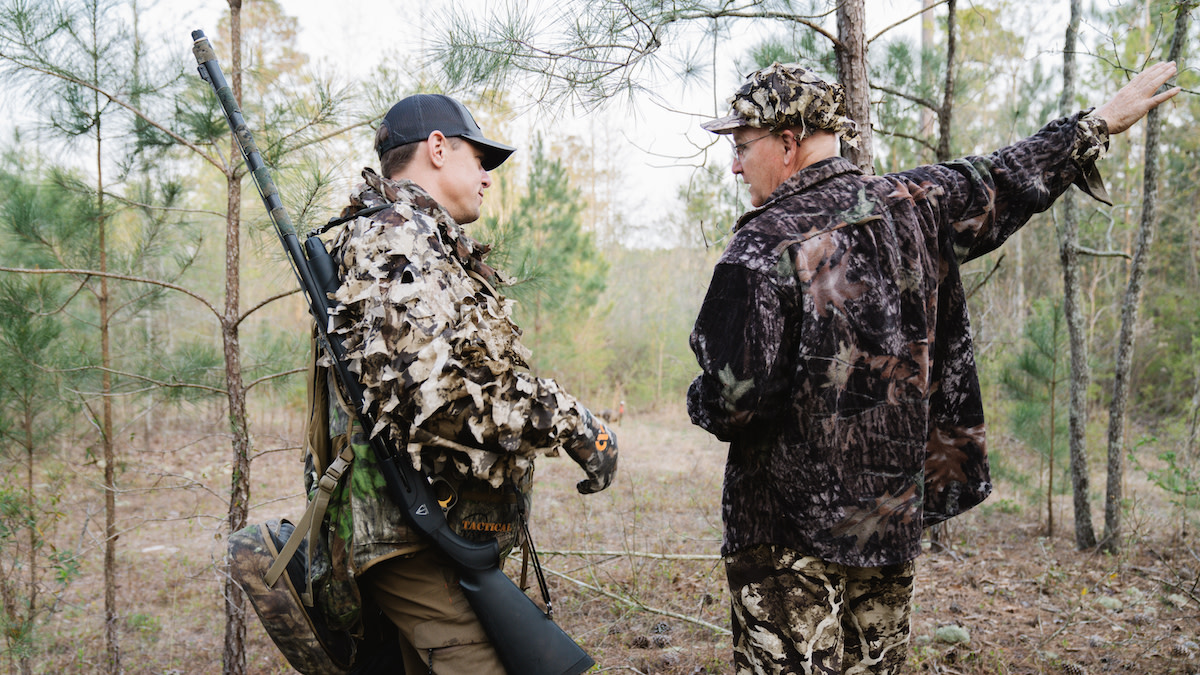

There aren’t many gun products that offer drastically improved performance without costing an arm and a leg. You could argue that shotgun choke tubes are one of them.
“A choke is one of the easiest and cheapest things you can change on a shotgun to improve efficacy,” MeatEater’s waterfowl guru, Sean Weaver, said.
In simple terms, shotgun chokes reduce the diameter of the gun’s bore to tighten the shot pattern and extend effective range. In some situations, you might want a wider pattern, but Weaver encourages hunters to use as narrow a choke as possible.
“I would love to see more hunters shooting a tighter choke. Sometimes they’re going to whiff, but they’re also going to end up with more stone-cold dead birds in the bag,” Weaver said. Thousands of birds are wounded and lost every year, partly because hunters aren’t using the right chokes.
What is a Choke on a Shotgun? A shotgun choke is the small metal tube that screws into the end of the barrel. Your shotgun probably came with one and a tool to remove it. There are a variety of choke sizes that restrict a shotgun’s bore to a greater or lesser degree.
“Cylinder” chokes don’t constrict the bore diameter at all. “Full” chokes constrict the bore by about .035 inches. Between cylinder and full, “improved cylinder” chokes constrict the bore about .010 inches, “modified” constrict about .020 inches, and “improved modified” constrict about .025 inches.
Between, above, and below these choke variations are additional choke sizes that further restrict (or sometimes expand) bore diameters.
Changing a shotgun bore’s diameter changes the “pattern” of the shotgun’s BBs. “The tighter the choke, the denser the pattern will be,” Weatherby’s Zach Hein told MeatEater.
A dense pattern of BBs will be more effective at a longer distance because the shot cloud will stay together longer. A wider pattern requires less precision and is ideal for scenarios in which birds are close, erratic, and fast.
Generally speaking, a cylinder choke will produce a 40-inch shot spread at 25 yards, an improved cylinder will produce a 40-inch spread at 30 yards, a modified will produce that spread at 35 yards, and a full choke will do the same at 40 yards. While new hunters at the range might benefit from a modified cylinder choke, Weaver never shoots anything wider than a modified in the field. For a quality choke, he recommends Carlson Chokes and Pattern Master.
The choke size you choose depends on what kind of game you’re hunting. Turkey hunters often use a full choke (or an extended full choke like the one on this Weatherby Element), waterfowlers usually opt for a modified, and upland bird hunters frequently go with an improved cylinder.
The Complications Everything in the previous section is generally true, and if you’re just dipping your toe into shotgun hunting, it’s a good place to start. But if you dig a little deeper, things start to get a bit more complicated.
First, different shotguns can produce varying patterns even with the same choke and shot because shotgun manufacturers don’t use the same bore diameters, Hein explained. If a 12-gauge bore starts out at .724 inches, a modified choke will reduce it down to .704 inches. But if it starts at .730 inches, a modified will bring it down to .710 inches.
Believe it or not, .006 inches is enough to change the shot pattern and affect the result. “Knowing your particular shotgun, especially with the shells you’re shooting, is really important,” Hein said.
To make matters worse, different brands of the same type of choke might perform differently even in the same gun and with the same shot. A choke must have enough room after the constriction to allow the BBs to “settle” (about one inch for a 12 GA). If the choke isn’t long enough, patterns will be inconsistent or produce gaps.
“You’ll find that one choke tends to throw a little high, or a little off to one side, or for whatever reason doesn’t hold a nice, tight pattern,” Weaver said.
Different types of shot can also affect shot patterns. Lead, steel, bismuth, and tungsten all react differently to being squeezed through a choke, so it’s important to make sure your choke can accommodate the type of shot you’re using.
One final complication: different choke and shotgun manufacturers use different choke “patterns.” Hein likened choke patterns to thread pitches in screws. Weatherby uses a variety of choke patterns in their shotguns, and your gun’s user manual should list the pattern you’re looking for.
Testing, Testing, Testing Changing even one variable in your setup—whether the gun, the shot, or the choke—can affect shot pattern, but there’s only one way to know for sure.
“Everyone needs to get in the habit of patterning their shotguns,” Weaver said. “No one shoots a rifle without sighting it in.”
“Patterning” a shotgun isn’t difficult. As with sighting in a rifle, make sure you’re shooting from a stable rest. Pattern boards are available online or you can make your own from cardboard or butcher paper (just make sure you have at least 40 inches of board).
You can shoot from whatever distance makes the most sense, but Hein and Weaver recommended between 30 and 40 yards. At that distance, you’ll know pretty well what your shot is doing.
Fire at the center of the board with the shotgun, shells, and choke you plan to use for hunting. Weaver said that if you see any holes in the pattern larger than a cantaloupe, “you have a problem.” Test different chokes and shells until you see a nice, solid shot pattern right in the middle of your pattern board.
Patterning a shotgun might sound tedious, but it’s crucial to successful, ethical hunting. Weaver recalled a choke that caused the wad to invert and fail to open as it exited the barrel. At 30 yards, the wad was traveling fast enough to punch a hole in the paper.
Hein also noted that shotgun manufacturers have different standards for shotgun regulation. Some regulate their guns to hit dead center every time. Others, well, not so much.
You'll also notice while testing that quality shotgun shells are a must. Some of our favorites are Federal's Bismuth for upland, 3rd Degree with HEAVYWEIGHT TSS for turkeys, and Black Cloud for waterfowl. These shells will deliver consistent patterns every time, whether you're at the range or in the field.
Why Chokes Matter Many hunters do just fine without thinking too much about chokes or shot patterns. But they could be doing even better and helping wildlife conservation in the process.
Both Hein and Weaver agreed that testing different shotgun chokes on paper increases confidence and leads to more successful hunts. If you know for a fact that your gun produces a tight shot pattern at 30 yards, you’ll squeeze the trigger with more confidence when a mallard swoops in at that distance. If you miss, you’ll also know that it isn’t the gun’s fault.
It’s tempting to compensate for those misses by using a wider choke, but Weaver argues that you aren’t doing yourself—or the ducks—any favors.
Estimates vary, but most researchers agree that “crippling loss” accounts for between 20% to 40% of all ducks hit by gunfire. These ducks are hit with some BBs but not enough to stop them cold. They fly over the next hill and are never recovered.
“That is a sickening number,” Weaver said.
Some of that loss is due to poor shot selection, but sometimes, it’s due to poor choke selection. That’s why Weaver always recommends using as tight a choke as possible.
“Shooting a tight choke is an all-or-nothing proposition of either killing the bird dead, or it lives to see another day,” Weaver said. “If spending $60 on a choke means that many more mallards coming down the flyway every year, that seems like an easy proposition to me.”
Stay in the loop with The MeatEater Newsletter
Shop
Related

Firearms
Everything You Need to Know About Shotgun Recoil


Firearms
Everything You Need to Know About Shotgun Choke Tubes

Firearms
Everything You Need to Know About Hunting with a Suppressor
The comments section requires Functionality cookies. Please enable Functionality cookies in Cookie Settings to view this content.