This Invasive Species Is Decimating Native Wildlife in Texas (And It's Not Feral Hogs)
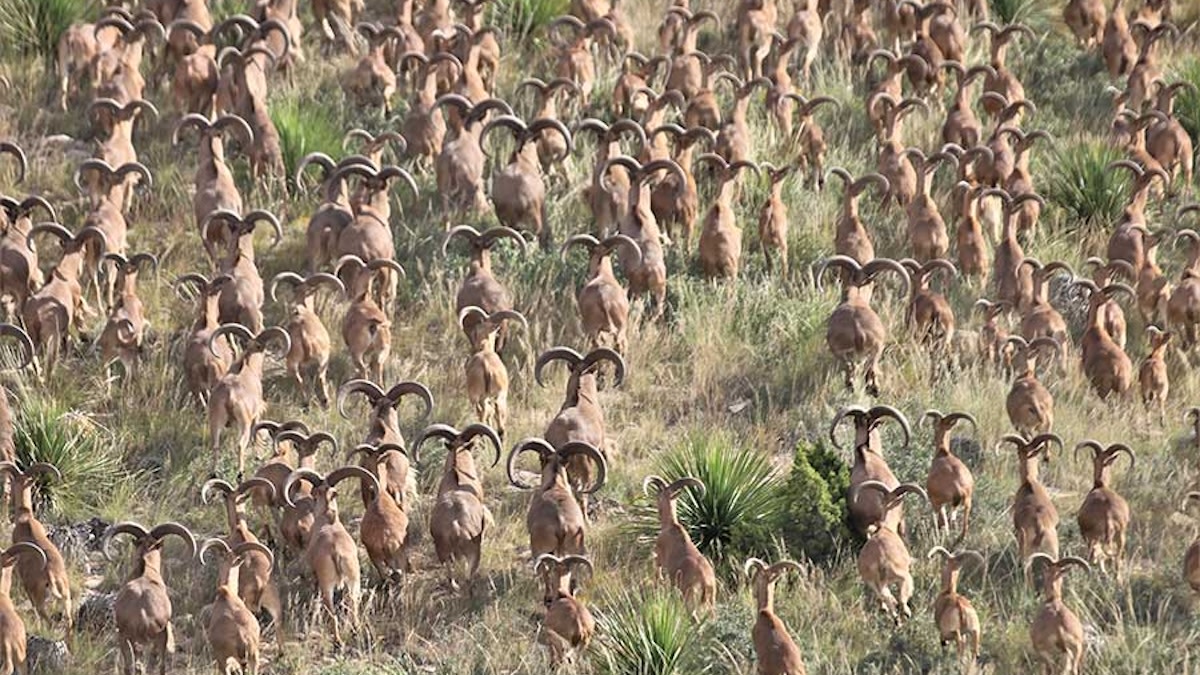

In 1957, Texas Parks and Wildlife (TPWD) released 31 aoudad, or barbary sheep, a species native to North Africa, in the Texas panhandleto increase hunting opportunities. The species took well to the arid Texas land, and another 40 animals were released by the following year. Today, those few dozen animals have grown to an estimated population of more than 20,000according to TPWD.
From those initial releases in the Panhandle, aoudad have since expanded across a large portion of the state, pushing west into the rugged mountains and deserts of the Trans-Pecos region—prime habitat for native desert bighorn sheep. That overlap has raised growing concern among wildlife professionals and hunters.
In 2025,TPWD surveysobserved just 730 desert bighorns statewide, a fraction of the aoudad population. Unlike bighorn,aoudad reproduce quickly,often having two sets of twins annually, compared to a bighorn ewe's singular baby a year. Aoudad also compete with native sheep for limited forage and, perhaps most concerning, can carry and spread diseases that pose a serious threat to native sheep.
Those concerns aren’t theoretical.In 2019, desert bighorn sheep in West Texas were hit by an outbreak of pneumonia linked toMycoplasma ovipneumoniae(M. ovi), a pathogen known to cause devastating die-offs in wild sheep across North America. Prior to that, Texas’ desert bighorn populations had largely avoided exposure, but as aoudad populations expanded across the Trans-Pecos, researchers began to link the invasive sheep as reservoirs for the disease.
The impact was severe. In 2019, Texas’ desert bighorn population was estimated at around 1,500 animals, near a historic high. By 2024, that number had dropped to fewer than 500. Aoudad, by contrast, often carry the disease with few or no symptoms, allowing it to spread quickly through overlapping habitat and making the spread almost impossible to manage.
Just as desert bighorn sheep begin to recover from recent pneumonia outbreaks, another potential threat is emerging on the landscape. An outbreak of infectious keratoconjunctivitis (IKC), commonly known as pinkeye, is now spreading through aoudad populations in West Texas, causing severe eye infections and blindness, which can ultimately lead to death.
In a recent update, Texas Parks and Wildlife officials reported that “Since December [2025], approximately 25 Aoudad showing severe clinical characteristics (e.g., blindness) in one or both eyes have been documented across 30 miles.”
They described pink eye as “a highly contagious eye infection that can be a common disease in livestock. IKC has also been described in many wildlife species. It rarely affects just one animal, but spreads throughout a herd.” Stating it “can be spread by flies, dust, and other exposed environmental vectors. In wildlife populations there is no available treatment and the disease naturally runs its course through the herd.”

TPWD has not yet documented any cases of IKC in Texas bighorn sheep but is closely and actively monitoring, as an outbreak could be detrimental.
So how are the aoudad being managed? One way is throughTexas Senate Bill 1245, which went into effect September 1, 2025, and legalized aerial harvest of aoudad.
Through this bill, landowners and private land hunters will be able to hunt aoudad from a helicopter, a great advantage in the rough and vast West Texas terrain. It is important to note that over 93% of the land in Texas is privately owned. Therefore, wildlife management often depends on what happens beyond public ground. Additionally, as anexotic species in Texas, there is no closed season or bag limit for these animals on private land.
TPWD is doing their part as well, offeringdrawn hunt opportunitiesfor trophy aoudad, controlling populations on public lands, and working with partners such asTexas A&M Universityand theBorderlands Research Instituteto better understand disease transmission.
Feature images via TPWD.
Shop
Sign In or Create a Free Account
Related

Wildlife Management
This Invasive Species Is Decimating Native Wildlife in Texas (And It's Not Feral Hogs)

Wildlife Management
Study Claims Feral Hogs Really Aren't All That Bad


