Pet-Owner’s Arrest Sparks Fish Cruelty Debate
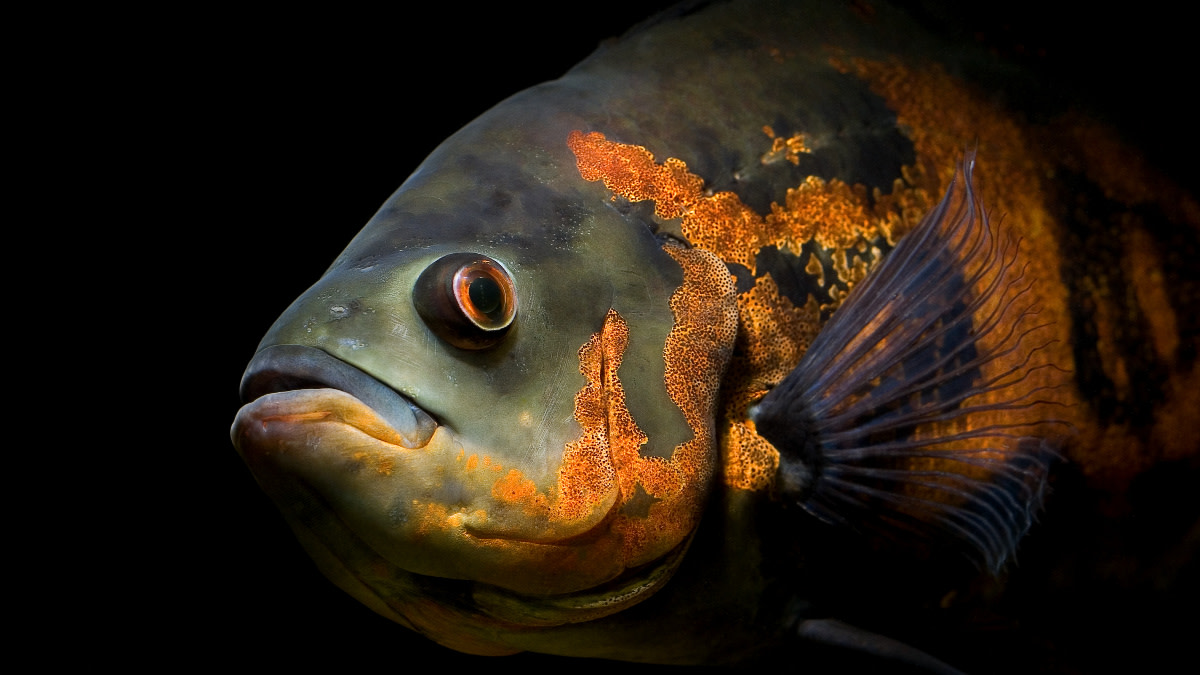

A recent arrest in North Carolina has re-launched the subject of fish welfare into the broader cultural conversation. On April 4, Michael Ray Hinson was charged with one count of abandonment of an animal and three counts of misdemeanor cruelty to animals after he vacated a home he was renting and left a neglected, malnourished and diseased pet fish behind.
Hinson was evicted from his home in Wilmington on March 22. Police checked on the home three days later and found the six-inch oscar fish living in “deplorable” conditions and suffering from parasitic hole-in-the-head-disease. Unconfirmed reports claim the fish survived by eating cockroaches that fell into the tank.
A week later, New Hanover County District Attorney Ben David dropped all charges against Hinson after his office failed to find ways to apply animal cruelty statutes to fish, though he wasn’t pleased.
In a statement, David said, “We take a very dim view of anyone who would abuse any creature great or small and appreciate [animal services] enforcement of the laws to protect vulnerable animals.”
Fish are generally ignored in laws concerning animal welfare. Animal cruelty legislation regarding pet treatment is written and enforced at the state level. Though the specific language varies, state laws generally fail to mention fish. When fish are noted , it’s to exclude them from protection. The Animal Welfare Act regulates animal treatment for research and exhibition at the federal level, but only applies to warm-blooded creatures.
The recent case in North Carolina, however, has garnered national attention and could re-invigorate public interest in a debate about how we treat fish. In the early 2000s that debate gained momentum in some corners of the mainstream media, resulting in PETA’s rebranding of fish as “Sea Kittens” in 2009. Though conversations about fish welfare and treatment come and go in popular culture, they remain lively and consistent in certain academic circles.
“Among non-scientists, many people firmly believe fish are dim-witted creatures incapable of feeling pain. But others, equally committed to their beliefs, argue that we should provide fish with the same level of care and welfare that we do for birds and mammals,” wrote Dr. Victoria Braithwaite in her 2010 book, Do Fish Feel Pain?
Professor Braithwaite and other researchers have concluded that fish might experience pain. “We believe that currently available evidence indicates that fish have the capacity for pain perception and suffering.”
Other professors and researchers in fisheries biology, zoology and physiology do not agree with that assertion. In his 2016 paper, “Why Fish do not Feel Pain,” published in the journal Animal Sentience, Dr. Brian Key concludes, “that fish lack the necessary neurocytoarchitecture, microcircuitry, and structural connectivity for the neural processing required for feeling pain.”
How can qualified, capable researchers working on the same problem with similar data draw completely different conclusions? Because pain is incredibly difficult to study. Pain and suffering are inherently subjective experiences. Researchers differentiate un-conscious responses to harmful stimuli from conscious pain, so pain is tied up in our definition of consciousness. And consciousness is an even less well-defined biological concept than pain.
Dr. James Rose, who researched and published extensively on the subject of fish pain perception over his 37-year career, told me, “I would strongly defend the conclusions of myself and my colleagues as to the absence of fish awareness. Fishes are unlikely to experience pain.” But Dr. Rose also wrote, “the question of animal consciousness is unlikely to be decisively resolved for some time, but welfare considerations for animals don’t hinge on assuming them to be conscious. In the case of animals held in captivity for human entertainment, it is incumbent on the owner to provide at least adequate conditions for maintenance of objective welfare”
Dr. Braithwaite’s conclusion goes significantly further. “It would seem timely to reflect on the implications of fish pain and suffering and to consider what steps can be taken to ensure the welfare of the fish we exploit.”
The opacity of available evidence and widely differing conclusions could lend credence to arguments that fish deserve the same level of protection as dogs, cats, rabbits and other captive creatures. This is already the case in some parts of Europe, but not the U.S. Currently, fish here are reared and harvested in ways that do not conform to standards of humane treatment mandated for other animals. Were that to change, the impacts on our daily lives could be immense.
Much of our seafood could become drastically more expensive, or disappear altogether. Communities that have depended on fish and fishing for their survival could be decimated. Aquaculture could become much more highly regulated. The organic fertilizer market, which depends on fish and fish byproducts, could be impacted. Scientific research itself would also likely change, since 7-15% of laboratory animals are fish. Recreational fishing could come under intense scrutiny, threatening the multi-million dollar industry that supports it. Not to mention the entire pet fish and aquarium market, which is how the man in North Carolina came to have a pet fish that he then abused.
According to Dr. Rose, “Publicity of such cases predictably provokes public outrage. Much of the outrage stems from anthropomorphic views of fish psychology.”
Well founded or not, public outrage can be powerful. We have upended industries by mandating changes in animal treatment in the past. Most of us agree that those changes reflect values we embrace as a culture. While all life survives by consuming other life, the capacity for empathy is a defining characteristic of the human experience.
For now, at least, the media seems focused on a single instance of an abused pet fish. Dr. Rose offered some advice for pet owners hoping to avoid similar scrutiny: “Mr. Hinson would have avoided legal problems if he had simply flushed the unwanted fish down his toilet. My choice for humane killing of a fish would be ike jime, but many squeamish pet owners would probably prefer the toilet option”
Feature image via Wiki Commons.
Stay in the loop with The MeatEater Newsletter
Shop
Related

Public Lands & Waters
North Carolina May Reconsider Sunday Hunting Ban


Policy & Legislation
Hunters Rally to End Sunday Hunting Ban in North Carolina

Animal Rights
Pet-Owner’s Arrest Sparks Fish Cruelty Debate
The comments section requires Functionality cookies. Please enable Functionality cookies in Cookie Settings to view this content.