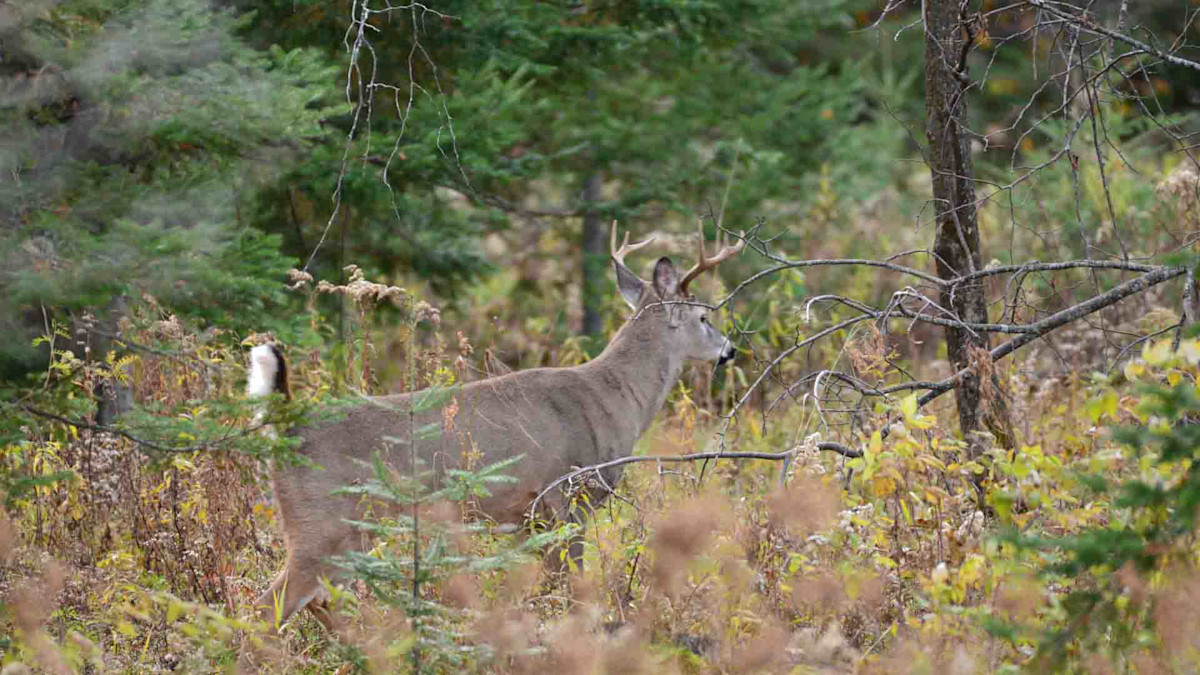

Question: I live in Michigan's lower peninsula and recently purchased a property in the upper peninsula. I love hunting up there but have had a hard time patterning deer.
I’ve always looked for food and bedding and then found their paths in between. However, where I am in the UP, there are no significant mast crops or ag. The deer primarily feed on browse in the cedar swamps and maple stands that exist in this area. Therefore, everything around them is a potential food source and they don’t have to travel to get a meal.
My question is, with the absence of a destination food source, what is the best way to pattern deer?
Answer: Deciphering movement in the big woods is a different game from farm country. I think it’s the hardest deer hunting out there, but it’s also some of the most rewarding. I spend more time each season working on this problem than anything else, so I have some ideas for you. But first, I’m going to address something that holds a lot of hunters back.
You might think that the deer have food everywhere in the big woods and that they don’t need to travel, but that thought isn’t going to set you up for success. Even in the absence of ag and mast, there are food sources that come and go at certain points of the season. The deer feeding in those maple stands will key on that food source when the leaves are really dropping. Cold mornings with stiff wind will bring those deer to that food source.
The lack of mast crops can actually be an advantage, too. In northern Wisconsin, where I spend much of my fall, I’m always looking for oak trees. A single tree can be a difference maker, and you can bet that the bucks know when that tree is dropping.
They generally won’t bed right in those food sources, either. Which means they have to go from one spot to another. The main problem I tend to encounter in the big woods isn’t that they don’t travel, it’s that the low deer density makes pinning down travel really difficult.
Winter scouting to find rublines has been a huge advantage for me when hunting deer in vast swaths of timber. Where bucks walk consistently, they leave sign. That sign is there for me to see in March and shows up throughout the season. Even if I can’t pin deer down on a soft edge, or a swamp edge, or some maple stand, I can use rubs to see where bucks are likely to travel. Those rublines tell me how they get around low areas, how they leave their ridgetop beds, and generally, how they navigate that mono-habitat.
Now, owning land up there in the north country gives you a unique opportunity to learn how they use terrain. I leave trail cameras out year round on my property in Wisconsin, which teaches me a lot. Camera intel shows me that the best funnels might have a couple of deer pass through them during any given week. That ramps up some during the rut, but it’s never like it is in higher deer density regions.
That does give me confidence to wait them out, and I think that’s maybe the hardest part of this whole thing. All whitetail hunting requires patience to be successful, but it’s a different thing entirely in the big woods. We are conditioned to want to make something happen when the deer activity is slow, but you can blind call all season long in some of those areas and never get a positive response.
The game is won by doing your best to predict some deer movement, and then putting in a lot of time to prove whether you’re right or not. That’s the biggest test I face each season in all of my hunting. You have to scout enough, run cameras if you can, and then observe as much as possible while you’re hunting. It takes a big buy-in with effort, but it’s also just the best way to encounter bucks where there just aren’t very many of them, and they have a lot of habitat with which to work.
Over enough seasons, you will start to flatten that learning curve and begin to figure out that they actually do give you a chance to pattern them (somewhat) and that they do have preferred food sources at certain points of the season.
It’s a lot of work, but when it all comes together, it’s as rewarding as anything you can do with a bow in your hands.
Good luck this fall!
Have a whitetail related question? Send it to wiredtohunt@themeateater.com and check back weekly to see if we cover it.
Stay in the loop with The Wired to Hunt Newsletter
Related

Scout
How to Hunt Edges in the Big Woods Down South

Scout
How to Scout Big Woods Bucks in Early Summer

Hunt
5 Rut Funnels to Hunt in the Big Woods

The comments section requires Functionality cookies. Please enable Functionality cookies in Cookie Settings to view this content.