MeatEater Conservation
Ep. 91: The Old Chevro-let Set, Red Ochre, and Dangerous Poachers
Play Episode
22m
00:00:09 Speaker 1: From Mediator's World News headquarters in Bozeman, Montana. This is Kel's we Can Review with Ryan Kel Kelly and now here's Kel. If you recall that great old John Prine song the jet Set, which may be a commentary on how the other half lives kind of broken down in terms of the jet set, the old Chevrolette set well. Recently, in Rome, New York, not to be confused with Rome, Georgia, a man who was openly barbecuing a canine was approached by a police officer to enforce New York state animal cruelty laws. The man's meal was confiscated and a violation is pending on whether the test results come back positive for domestic dog or wild Canada. No word on whether the meal is being kept frozen while the results are out, but the Rome Police Department did confirm that there are no missing animals that fit the description of the one on the grill. For those of you wondering the grill master belongs in the Old Chevrolette set category is baching. Tchaikowski is haggard and husky. What I'm saying is his steak and Martinis is clam beer with wienies. I'm confident it won't be clam beer with wiener dogs. But we gotta love Colorado parks and wildlife. In conjunction with three members of the Loveland, Colorado Fire Department, fished cow elk out of an outdoor pool in Loveland, Colorado, Which is how you know you're in Colorado, v state with the largest elk population. You have an elk in your pool. If you were in Florida, it would be a gator in Texas, a feral pig Montana, possibly a grizzly South Dakota, a pheasant New York Rudy Giuliani. Anyway, we finally have the answer to that question of how many people does it take to get an help out of the swimming pool? A lot more than it takes to get it in the oldest grizzly in the Greater Yellowstone ecosystem has been confirmed. The bore or male bear number one six eight was in a rough shape, reportedly emaciated and missing practically all of his teeth. He was killed as he apparently tried to come to death some livestock on the Wyoming side of the g y E or Greater Yellowstone ecosystem, which when it comes to old age. Honestly, sounds a lot better than getting your food through a straw and wondering if the kids are gonna come by One six eight was thirty four years old. He was captured as a one hundred and eighty pound three year old bear in n six which makes it the oldest recorded grizzly in the lower forty eight. This week, we've got the Wells Catfish, a pigeon who done it, and the art desk. But first, I'm gonna tell you about my week. In my week as well as this podcast is sponsored by Steel Power Equipment, so much to talk about this week. We're just getting back from northern Sonora, Mexico, where we once again hunted Cou's deer, that famous little southern white tailed that you just have to burn your eyeballs out to get a look at. They're tiny, the brush is tall. They blend in amazingly. Well. I caught some deer in odd, odd ways, one of which was looking at a rock that was definitely a rock, but to the right hand side the lookers right side of that rock, there was a perfect deer shadow staring at the rock long enough eventually got the shadow and the rock to move another good one and glassing tip for you are vertical and horizontal lines, not many straight lines in nature. A dark shaded hillside resulted in two vertical white stripes, and if you stared at those white stripes long enough, they would walk. They were the inside the white insides of a deer's legs at many, many yards. You need very good optics, you need a good chunk of time, and you need to be able to recalibrate your brain to the size of this deer. It is so small. Everyone you walk up to you're like, I really didn't understand how small this is, which makes it hard to put in context of the brush and the oak trees. I brought Vortex eighteen by fifty six binoculars this year. They were fantastic. If you were considering a coup's hunt, or cows deer hunt, or even in addition to your shed hunting optics, I would consider the eight teen by fifty six U h d s. People ask me all the time for gear tips, not selling you anything, Okay, this would just be something to consider it as an investment. They're expensive, but it is one of the few pieces of new gear that I tried this year. That really made a difference. So there you have take it to leave it. Great eye relief, field view clarity, Wow, triple action relief changes This year. It was my third year down there. Pretty darned dry down in Old Mexico. The oaks, which are typically green, were dropping leaves on a lot of the aspects. The southern face and slopes were getting real beat up. The deer we're eating acorns and manzanita berries, spending very little time in the open. It seemed to me like instead of playing in the grass like they typically do, they were just hauling butt from tree to tree, bush to bush. The rut activity, which is the breeding craziness that you count on to bring big deer into the open, seemed much more limited as well. But despite this, we almost all got dear. I am the only one who did not snap a cap, but all of our first time cows deer hunters did and that's just an awesome thing to be a part of. It's an amazing trip. It's addictive. I'm gonna try to fig year out how to get back there again next year. Tell you it's kind of a sickness. Sonora is gorgeous. The food is amazing, and as I've said before, there is something about hiking those ranches, interacting with those folks down there that makes me think of Montana a few hundred years ago, which I like. This next week, I'm hitting the road again for the Sacramento Valley and the last weekend of waterfowl season there, hoping to bring a little snort for one last hunt before we have to go into our yearly depression, which lasts coincidentally until Turkey and maybe Bear starts up. Moving on. In case you missed it, a Knew presidential administration has just begun, and already we have narrowly averted an international diplomatic crisis that had geopolitical feathers flying. Get off my plane. The Australian government recently announced that they had no choice but to destroy a pigeon that had apparently flown all the way across the Pacific Ocean from Oregon. The rock Duve was ideed faster than a rioter at the Capitol by a leg band stating its point of origin. That's over eight thousand miles. You'd think that kind of a journey might be rewarded with the bottle of champagne. Or a sleepy retiree on a park bench with a spilt bag of popcorn. However, as any listener to this show knows, non native animals can introduce disease to a new ecosystem, whether that animal shows up in the hold of a ship or under its own power. So the pigeon had to go. But this is just the shallow end of the bird bath my squabs. The Australian man who found the pigeon, Kevin Kelly Bird, seriously had named him Joe, after Joe Biden, so killing him would have been a terrible look for the Australian government. Yet another reason not to give names to wild animals. It can bring two countries to heighten international tensions and do terrible thanks for this podcast as people lose their minds when I mentioned politics, yet somehow still managed to write direct messages if you were skeptical at a pigeon flying eight thousand miles across the ocean, rightfully, so it seems that you weren't the only one that bird seed sat a little wrong in their crop. As soon as this story broke, people began to get a bit skeptical. Pigeons aren't migratory outside of some intentionally long races that people organize, pigeons don't fly farther than a few dozen miles. That's where the homing comes in in the term homing pigeon. These are birds who have an uncanny ability and drive to return to where they came from. The next fact that didn't sit right was the band around Joe's leg. Initially, Mr Kelly Bird had called up the American Pigeon Racing Union, the authority that issues the kind of band that Joe was wearing, to report the band's I D number. Their records showed that the number matched a bird that had in fact been lost in Oregon. But wait, when the a p r you inspected pictures of Joe, they saw that he wasn't a racing pigeon at all, just a standard blue bar rock dove, almost definitely an Australian native. The Australian government could be executing one of their own. At first, people suspected an I D band counterfeiting scheme designed a dupe novice pigeon fanciers into paying top dollar for what they thought was a highly trained specialty bird from the US. After all, as reported right here on the Weekend Review November of a prized pigeon sold for one point nine million dollars, and just as tensions could not get any higher, possible pigeon thieves ideed getting ready to fly the coupe came the more banal truth. Turns out that the American Pigeon Racing Union just makes a pretty darn good leg band, and people all over the world by them for their own domestic birds instead of going to the trouble of making their own. So Joe Biden the pigeon was granted a pardon and is now free to strut around sunny Melbourne for the rest of his days. Where there's bird seed, there's birds. Moving on to the French city of Albi. National Geographic reported recently that Frederick Santol, a fish ecologist living in Albi, which is about four hundred miles south of Paris, was crossing a bridge over the River Tarn when he glanced down to see a flock of pigeons on a sandbar, which is nothing special, But then Sam Toole witnessed a catfish launching itself out of the water on the dry land, grabbing one of the pigeons in its mouth and disappearing back into the water with its prey. Although city dwellers don't usually shed a tear for pigeons, that is some terrifying fish behavior. No matter how you slice it, listeners to this show might be able to predict where I'm going next. This particular fish, the Wells catfish, is non native to Western Europe. He said it, He said it. It was introduced in the nineteen seventies from its home range in eastern Europe by anglers who were eager for a new species to go after. It's a classic bit of bucket biology, and the results for the waterways of France, Belgium and elsewhere in the continent haven't been pretty. You will not be surprised that a predator bold enough to snatch pigeons off of dry ground has been murder on native fish populations, including the already threatened local ala shad and Atlantic salmon. The Wells catfish can grow to ten feet in length and over six hundred pounds, and not only does it eat native wildlife, it also thrives in conditions that other species can't handle, specifically as temperatures go up and oxygen levels decrease. In European waterways, the Wells catfish flourishes, while fish adapted to cooler tamps and more oxygen die off. According to National Geographic which did a deep dive on this problem, fishing for the Wells catfish is popular in your but it is almost entirely limited to catch and release. We all know catfish are very hardy. Mortality with catching release angling is very low. Anglers aren't doing their job in reducing their problem. Child. Although the species is occasionally eating in Eastern Europe, it hardly ever makes its way to the table further west. Seems like an easy fix, after all, fried fish is an an American invention. However, the meat eater dot com has some catfish recipes that can make it as popular in Brussels or to lose as it is in Louisiana. Or how about introducing a Wells catfish world record. Who doesn't love beating a record. Although some records would exist even if humans didn't keep track of them World's tallest mountain, for example, wheels of cheese have no doubt gotten bigger and unbroken stretches of juggling have gotten longer because a record exists and people want to break it. For instance, the state of Maryland last year introduced a state record for largest flathead catfish, which is another invasive species to that area. Any fish over forty pounds would qualify. In late December, three year old Joshua Dixon caught a fifty inch fifty seven pound cat fish from the Susquehanna River. Dixon is the first holder of the Maryland record, and so many news outlets mentioned that his catch bested a couple of Pennsylvania anglers also pubbling fish out of the Susquehanna. And that's how you get a good rivalry going. So maybe our friends and Albi can start by calling Marseille anglers a bunch of whosses, and then Madrid can say that Frankfurt can't tell one end of a catfish rod from the other. In no time, Wells catfish will be under control. I will gladly come over for some topwater action. I mean, can you imagine dragging a pigeon imitation across the pond? Or even better, when we're talking about rural and populated waterways, if this cat could eat feral cats and pigeons, well, we may need to just start stocking them in the US. Moving on, It's time this week to get back over to the surprisingly busy prehistoric art desk. Researchers recently discovered the oldest known figurative painting, a forty five thousand year old depiction of a work covered pig on the Indonesian island of Sulawassi. There have been several oldest paintings in the world, but this time we're talking very old, so old that we can't be sure that it was US Homo sapiens who did the painting. Even though scientists have good evidence that the art is at least forty five thousand years old, none of the ancient human remains found on Sulawassi are even close to that old. Some scientists are nevertheless certain that the paintings have been done by anatomically modern humans. We always have to be the best and brightest, right, But some of the other scientists are wondering whether another member of the hominent family might have had an artistic temper meant before we humans even thought about holding a brush. So far, the only other human relative thought to have made any kind of aesthetic mark at all is Neanderthal, and those markings found in Europe are very simple lines and patterns. This Indonesian pig, on the other hand, is art with a complex use of perspective and shading. There's no lipstick on this pig, but it doesn't need any. So if this sophisticated painting was done by a pre Homo sapien hominid, that would be very interesting news. The pigment used for the pig painting is red ochre, one of the most common and important pigments in ancient painting all over the world, from Indonesia and Australia to Europe. In the Americas. Some scholars of prehistory speculate that red ochre is found so widely that it couldn't have been limited to just painting walls. People probably painted skins, wooden artifacts, and even themselves with red ochre. But because pigment is made up of clay and iron oxide, you can't use carbon dating to tell how old it is. Ocre contains no carbon to date, and so with this Indonesian pig painting, scientists had to get more sophisticated. A mineral deposit had collected over the surface of the painting, so by analyzing how old the deposit was, scientists could be sure that the painting was definitely made sometime before that. Luckily, the mineral deposit contained uranium. Because we know how long it takes uranium to decay, scientists were able to analyze the amount of each substance to determine how long ago the deposit formed, and that's how they came up with at least forty five thousand years. Evidence of artwork is one of the main ways we can tell when anatomically modern humans, those whose bodies are just like ours, became humans whose minds are like ours. Once there's art, we know that Homo sapiens were not just running and throwing and eating, but thinking and m magining and having the free time to do so. On the other end of the artistic time scale, a completely new blue pigment was just approved for commercial use. Ancient art has no blue in it at all. The first time humans were able to paint with blue was in ancient Egypt, when people began mixing calcium and copper together. But even since then, the blue pigments we have had, like cobalt or ultramarine, have always been expensive and not very durable. Enter Yen mean blue. The first new blue to be discovered in over two hundred years a combination of it tri um indium and manganese. It was discovered by accident in Oregon State University in two thousand nine. This stuff blows other blue pigments out of the water, extremely bright, much more durable, and it even reflects heat away from surfaces, which could make buildings painted with the stuff easier to cool. For now, though Yeman Blue costs almost two hundred bucks for three ounces, it should get cheaper and cheaper, and maybe soon anyone could have it in their paint kit, because, as that pig in Indonesia shows us, one of the things that makes us human is making art, and we're not about to stop anytime soon, which is exactly why this blue pigment discovery is included on the Weekend Review. Is a brand new discovery that ultimately shows us that we are not so different from Homo sapiens of forty five thousand years ago, possibly even Neanderthals, and to me, that is really cool stuff. We have this constant need to look back on the past and assume the worst. The environment was terrifying. Everything was out to kill us and eat us. There was no time to do anything other than survive. But as this site in Indonesia could possibly tell us. Despite things being very very very very very different than they were today, Bacon is good moving on. Even though most hunting seasons have come to a close, America's game wardens are still keeping plenty busy. Jeff Klausser, a warden with Kansas Wildlife, Parks and Tourism, was recently dispatched to the scene of two white tail bucks with antlers locked in Jackson County. It was unclear how long they had been tangling, but they seemed to have plenty of energy left, driving each other through thick forest up and down embankments, giving no opportunity to come close enough to get them unstuck. Bucks getting locked together and dying from exhaustion is not entirely uncommon, and it can be dangerous for the willing volunteer to help them out. However, you may remember a story from almost exactly a year ago of a warden up in Alberta, Canada, faced with exactly this problem. That warden shot the two dear apart with a well placed shotgun slug to the antlers. Back in Kansas, Klausser took the same approach, but with distinctly American flair, possibly even some South versus North one upsmanship. After taking careful aim, he shot the two bucks apart with his service pistol, a very neat bit of high speed surgery, one detail I particularly liked. In order to get the bucks to calm down for long enough for clouds you to get a clear shot, he managed to throw a towel over their heads, the same way you'd put parakeets to sleep. Thankfully, the antlers weren't completely hidden by the covering, and both deer bounded away, likely with ringing ears and splitting headaches, but free to tangle up another day. One more from the crime Desk. Twenty two year old Cody Cape of Blair, Nebraska was charged this month for threatening to kill a federal wildlife officer who had been investigating Cape for multiple poaching and fractions in Nebraska and Iowa. According to authorities, Cape and another man were issued violations for illegal hunting and fishing near the DeSoto National Wildlife Refuge in Iowa, which led to a more serious investigation for several earlier deer poaching incident. In response, Cape allegedly started casing the officer's house, then drove with a friend past the house, threatening to shoot the officer. He spoke of setting explosives in his car and throwing dynamite through the windows of his house, basically being a human version of wildly coyote. But dear, poaching is bad, murder and arson much worse. Although some of the threats seemed a little far fetched, Cape didn't exactly come off as a demolitions expert, many of the threats seemed very credible. Cape story brings to mind the recent arson that our friend Brandon Butler suffered when poachers burned down his hunting cabin in southern Missouri after he challenged their brazen poaching on his land. When talking about the incident, Brandon discussed the predicament of the wardens responsible for combating poachers. Game wardens wildlife officers just about anywhere, work in remote situations, mostly by themselves, and almost everyone they interact with is armed. They protect the wildlife we love. They protect the activities that we love. So next time you hand over your license or stop in at a deer check station, give him a big thank you. That's all I've got for you this week. Thanks so much for listening. If you are loving what you're hearing, Tell a friend or two. As per usual, let me know what's going on in your neck of the woods by writing in to a s K, C A L. That's ask Cal at the meat eater dot com. I'll talk to you next week.
Presented By
Featured Gear
While you're listening
Conservation News
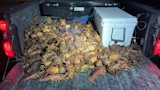
California Poachers Caught Red-Handed with Stunning Number of Spiny Lobsters

The California Department of Fish and Wildlife (CDFW) recently announced citations in a startling case of marine wildlife poaching. According to a Facebook post, CDFW officers were on a routine patrol on the evening of August 1, when they encountered suspicious activity around 11 p.m. near Royal...
Sage MarshallAug 15, 2025
Read MorePlay Now
Conservation News
Help MeatEater and onX Support Hurricane Relief with the Red Cross!

Recently, hurricanes Helene and Milton ripped across the Southeast, leaving behind a muddy wake of destruction in their paths. Communities affected by the hurricanes have been tragically impacted, and while initial relief efforts have addressed the most pressing immediate needs, there is still a...
MeatEater StaffOct 30, 2024
Read MorePlay Now
Wildlife Management
The Dumbest Poachers of 2021

This January, Devon Lewis, Taylor Luvaas, Jacob Fouts, Dylan Lewis, and Austin Lewis pleaded guilty to 48 wildlife violations in western Iowa’s Ida County court. According to a press release from the Iowa Department of Natural Resources, State Conservation Officer Kirby Bragg said that evidence...
Maggie HudlowMar 30, 2022
Read MorePlay NowConversation
Save this episode