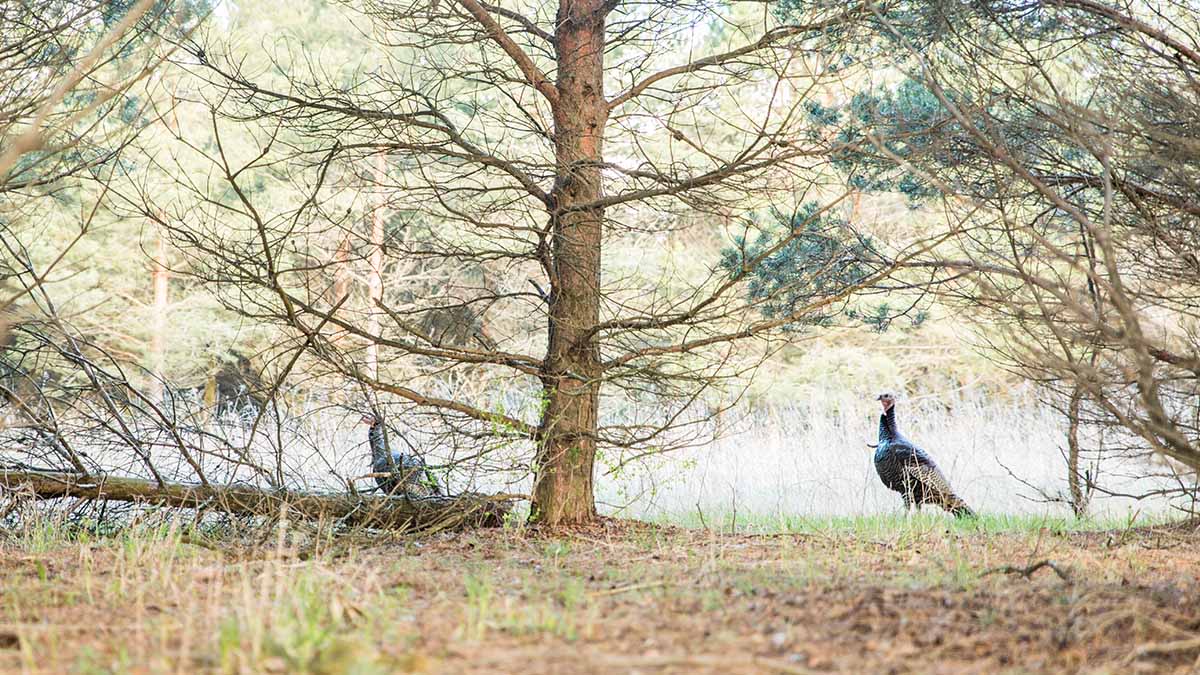

If you take away agriculture from turkey hunting, it starts to feel like chasing whitetails in big woods. Low game densities, sparse sign, and endless cover all conspire to make the process more challenging than typical turkey hunts. But big woods toms are available for the taking. Like their whitetail counterparts in the same terrain, they demand a unique hunting strategy and adjusted mindset.
For starters, forget about the dream turkey hunt of slipping into a picked corn field before first light to watch as gobblers pop out into the opening. Instead, you’ll need to get comfortable with the confines of the forest and limited visibility that comes with it.
Public land advocate and turkey junkie Sam Soholt is intimately familiar with hunting turkeys in the woods after years of hunting out West. For many hunts, it’s a struggle just to locate flocks. But since he started focusing more on finding roosts and staying mobile, his success has gone up.
“During the first morning and evening of any hunt, my goal is to just find birds on the roost,” Soholt said. “I use a coyote howler or an owl hooter to locate them, and just cover as much ground as necessary to establish a starting point. It can feel like you’re wasting your time, but locating a group or two of birds right away will help you be more successful.”
Be Mobile
Whether you’re after a Merriam’s in the Black Hills of South Dakota or an eastern in Upstate New York, big woods birds are often found on the biggest chunks of public lands. For Soholt, that means minimizing gear and showing up at the trailhead an hour earlier than normal so he can out-hike the competition. Often he has a few miles behind him before turks even begin talking on the roost.
This goes against a lot of hunters’ strategies. They don’t want to walk past birds they didn’t know were there. In many cases this makes sense. But for a forest with a limited amount of birds, it’s best to avoid the pressured flocks and instead get to the one longbeard that lives in a hard-to-reach place.
He won’t be easy to get to, but he’ll be significantly easier to fool. The cooperative behavior of unpressured toms makes up for an awful lot of the second-guessing that plagues big woods turkey hunters.
Find Their Food
Big woods turkey movement seems more random than that of ag-land birds—but it isn’t. Turkeys will always have preferred roost trees and favorite spots to scratch up calories. This applies to all big woods flocks, from Mississippi to Minnesota. Marginal territory composed of giant tracts of timber appears to offer up truly random turkey activity, but if you scout and hunt this habitat long enough, you realize that the randomness is in your head. Where I hunt big woods birds, this lesson was driven home after scouting swampy areas among timber.
The first greenery often pops up in those low, wet spots, and it’s also a great place for birds to grab emerging insects. The birds in this area visited those areas every day, as if the swamp was their version of a Midwestern feedlot or Eastern cornfield. In many ways, my big woods turkey hunts reflected my fall woodcock hunts.
No matter where you hunt big woods birds, scout when you’re able to and keep an eye open for travel patterns as you hunt. Birds that hit up a specific spot today will almost always come back tomorrow.
Always Be Hunting
Big timber can be awful deflating, but you can’t let that lull you into a funk where you cover miles without believing you’ll see a bird. If you stop to call, always stop where you can set up and have some cover in case you get an answer. You never know when you’ve slipped within earshot of a frisky tom. You don’t want to get caught unprepared, which might blow the only chance you get in a day or even a week.
I did this the first time I hunted the Black Hills in South Dakota and the lesson stuck with me. I’d lost hope, so when I made my 157th random call of the week and a tom gobbled close by, he was on me before I was ready. Watching him spook and fly away left me with a mental turkey hunting scar that still flares up whenever I step into the big woods.
Pay attention out there. Even when it feels like a lost cause in the biggest of big woods, you never know when there’s a longbeard nearby that’s willing to make or break your season. Killing a big woods tom is one of the greatest rewards in turkey hunting, so cherish every yelp that gets answered.
Stay in the loop with The MeatEater Newsletter
Shop
Related
Turkey
How to Turkey Hunt in High Winds

Turkey
How to Turkey Hunt Open-Country

Turkey
How to Turkey Hunt Small Properties
The comments section requires Functionality cookies. Please enable Functionality cookies in Cookie Settings to view this content.