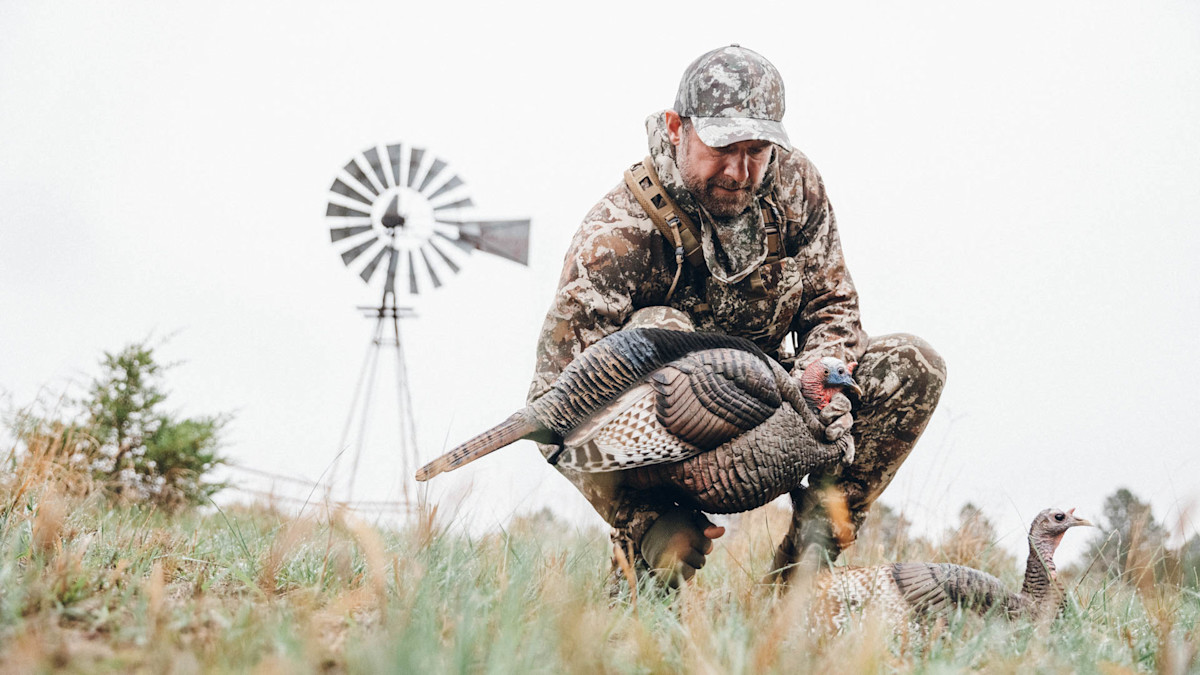

I got excited the second I heard the gobbler answer my pot call from his pine tree roost. I scraped a couple of soft yelps on my slate, and he hammered back a response that sounded like "Let's meet up at sunrise.”
He did everything you pray a gobbler will do. He flew down, cut the distance, and came in on a string. But he broke strut at 60 yards like he’d hit an invisible wall. He just stood there staring holes in my decoys before circling around and disappearing into the hardwoods like he’d never been interested.
The way that bird put on the brakes had me cussing the decoy company under my face mask. It had to be the decoys. They must have been too shiny, too stiff, too fake. It couldn’t have been me. But the hard truth is what hunters don’t always like to hear: the problem isn’t usually with what you stick in the ground, but how.
It’s easy to obsess over picking the perfect decoy, but when a decoy spooks a bird, it usually comes down to the setup, not the decoy itself. Typically, a small detail ends up blowing the whole gig. Here are a few of the most common mistakes hunters make with their turkey decoys.
You Get the Distance Wrong
It’s tempting to put your decoys where you’ve got a good view of them from your blind or setup. But good placement has nothing to do with your comfort and everything to do with the bird’s.
Placing decoys at 15 to 20 yards from your position is a good distance for pulling a gobbler into range and far enough to keep his focus off you. Closer than that, and you risk him staring straight through the decoy and into your soul. If he sees movement behind the decoy, it’s over. Set your decoys farther than that, and you risk him hanging up just out of range.
A gobbler doesn’t need much reason to abandon a setup. Sometimes bad distance is all the excuse he needs.
You Tell the Wrong Story
Turkeys do more than look at a decoy when they approach. They’re also reading their body language. Face a hen straight at an approaching gobbler, and you risk turning a courtship into a standoff. Gobblers like their hens to play a little hard to get—not look like they’re ready to fight.
A hen decoy facing slightly away from the gobbler’s expected angle of approach is tough to beat. It looks natural, like she’s feeding and potentially drifting away from him. Most gobblers will try to circle in front of her and often strut to impress her. If that decoy is angled toward you, that little positioning could be enough for him to step into shooting range.
You Pick the Wrong Mood
Most hunters choose decoys based on how they look to them when they should consider what the turkey sees and how they might react.
A feeding hen is your safest bet. It’s relaxed and non-threatening, and it works almost anywhere. An upright, alert hen can make a bird cautious, especially later in the season. Add a jake, and now you’re changing the script entirely. That might pull a dominant bird early in the season, but a few weeks of pressure can shut things down fast. If you’re not sure what kind of bird you’re dealing with, start with a single feeding hen decoy.
Out of Sight
Turkeys have sharp eyes, and after they hear calling, they come in looking for proof. A decoy is supposed to give them something to look at, but it will only work if they can see it.
If a gobbler hears your calls but doesn’t see the hen those calls are coming from, he’ll turn skeptical fast. That’s the whole point of using a decoy. But that decoy won’t be worth a hill of beans if the tom can’t see it. Because turkeys have such keen eyesight, a little brush or grass in between that gobbler coming in and your decoy can sometimes buy you a few more yards. Don’t just stick your decoy out in an open field unless that really makes sense for your setup. You want him to find it, not stand and study it from 80 yards.
Unrealistic
Real turkeys are rarely still. Watch a feeding flock, and you’ll see constant motion. Turkeys expect movement, and if they don’t see it, they get suspicious fast.
You don’t need remote control robot decoys to keep your setup realistic. Even subtle movement helps. Using lightweight decoys and flexible stakes that let the decoys twist and shift with the breeze can add enough realism to fool a wary bird. In some scenarios, a cheap decoy and a little wind can be far more convincing than a hyper-detailed statue. Turkeys can forgive a lot, but they won’t tolerate something that feels dead.
Final Thoughts
That gobbler that came in hot only to jump ship at 60 yards didn’t bust my decoys. He read my setup and decided it was telling a story he didn’t want to be a part of.
It’s far easier to blame your gear than to admit a bird with a brain the size of a walnut picked apart something small you didn’t even notice. Most of the time, success in the turkey woods doesn’t rest on how much money you dropped on your dekes, but how you position them.
Stay in the loop with The MeatEater Newsletter
Shop
Related
Turkey
When to Use or Ditch Your Turkey Decoys
Turkey
5 Ways to Sabotage Your Turkey Decoy Setup
Turkey
3 Underrated Turkey Decoy Setups

The comments section requires Functionality cookies. Please enable Functionality cookies in Cookie Settings to view this content.