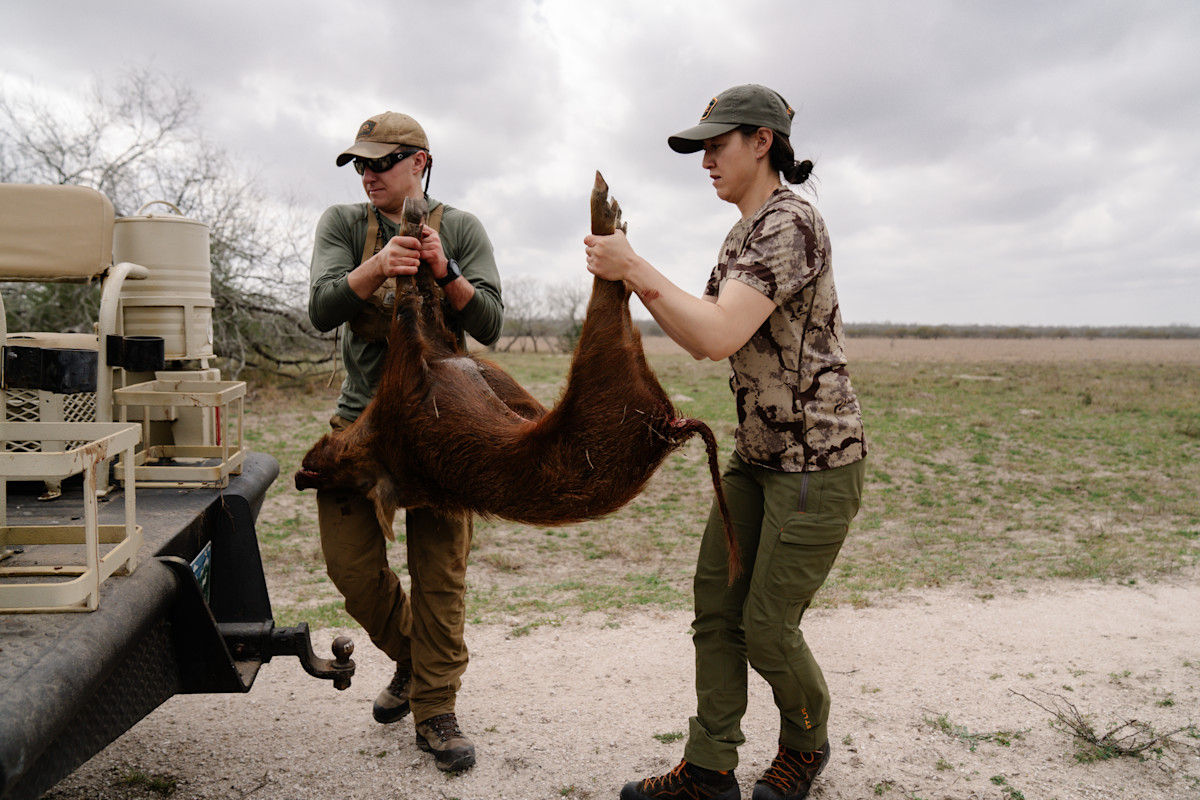

Wild hogs and deer don’t exactly mix. At least, that’s what any number of deer hunters or landowners in pig country will tell you. If you have experience hunting around wild hogs, then you probably have surmised as much. While anecdotal evidence might seem to support certain theories in the hunting world, it’s great to see science and data confirm what many hunters experience.
Dr. Melanie Boudreau, assistant research professor at Mississippi State University, recently conducted a collared experiment with both wild pigs and deer to better understand interactions between these two animals. While the study hasn’t been published yet, you can listen to her talk about her findings here. I spoke with her about their GPS findings and what these interactions might mean for CWD. Here’s what she had to say.
Parameters
Dr. Boudreau and her team were able to collar 10 wild pigs and 10 deer on the same large property just north of Starkville, Mississippi. The GPS collars were set to a one-hour fix rate, and they also had proximity sensors, which would give a reading anytime the deer or pigs were within 50 meters of one another.
“We collected data from March to October,” Dr. Boudreau said. “However, by October all our pigs were dead. Landowners in Mississippi like to handle their pig problems.”
In addition to the GPS collars, Dr. Boudreau and her team also deployed several cameras over bait piles (corn feeders).
Findings
The timeframe of the study allowed Dr. Boudreau and the team to look at how deer social groups reacted outside of the breeding season. For instance, doe groups usually congregate this time of year or rear fawns, bucks bachelor up, and these groups don’t really mingle.
“Deer were doing deer things,” she said. “They were segregating into different social groups, and it was really the pigs moving across the landscape that connected these deer.”
Here’s what Dr. Boudreau means by “connecting” these deer groups. Wild pigs' preferred habitat sometimes overlaps with deer habitat (like hardwood bottomland). Whenever pigs would move through areas with deer, they push them into other areas already inhabited by other deer groups that they might not otherwise meet.
Effects on Deer Behavior
Remember those proximity sensors? They were key to Dr. Boudreau’s findings, especially when it came to deer and pig interactions.
“Deer and pigs don’t like being next to each other,” she said. “We never had a proximity signal between deer and pigs. Ever. That’s not surprising, but it’s cool to see it in the data and that it supports what landowners and others are saying.”
Even with the camera traps over bait piles, Dr. Boudreau said out of 13,000 pictures they never had a deer and a pig in the same frame.
“We have lots of beautiful sequences of deer running out of frame and then pigs showing up shortly after but never together at the same bait pile. So that helps show that deer really don’t want to be in the same space as those pigs.”
While I’m sure there are exceptions to Dr. Boudreau’s observations, the lack of pictures suggests just what many suspect–deer and pigs don’t mix. Unfortunately, feeders create and promote these interactions between deer and wild hogs.
Feeders Don’t Help
Baiting whitetails is legal in Mississippi. While the feeders were useful for the purposes of Dr. Boudreau's research, they create interaction points between deer and hogs, like the deer fleeing from the photos. According to Dr. Boudreau, those interactions affect deer movement to the detriment of hunters.
“If a pig shows up then deer are less likely to return to that bait pile within a certain time frame,” she said. On average, there’s a two-day lag time before they’re back, but that varies by sex. For does, it could be 11 days. For bucks, it could be up to 25 days before that buck comes back.”
If you’re a landowner or lease a hunting property and you’re wondering if pig populations are affecting deer movement in your area, the short answer is yes. Depending on the size of your property, that buck might just move to the next available cover or vacate the entire area temporarily. If a buck happens to leave for 25 days, that’s an entire season in some places.
“Just looking at how deer move in relation to wild pigs' space use, they’re avoiding that space. From the lag return to bait, and deer avoiding primary pig use areas, all these items suggest that wild pigs are altering deer behavior.”
CWD Implications
Unfortunately, pigs might be affecting more than just deer behavior. Dr. Boudreau and her team also wanted to understand what implications these deer and pig interactions might pose for CWD concerns. Dr. Boudreau mentioned a concern with deer congregating with other social groups they might not otherwise interact with on a regular basis, but there’s also new research that suggests wild pigs might indirectly contribute to the spread of CWD.
In fact, a study from Arkansas revealed that wild pigs can carry CWD prions even though they’re not affected by them like cervids. This study pointed out that because of pigs’ “routine rooting and wallowing behaviors” this could allow for transmission of CWD prions within the soil. Places like feeders are no exception. This dilemma raises more concerns about the risk of using corn feeders to attract deer, which inadvertently attract wild pigs.
“Clearly, feeders are attracting animals that could be moving CWD around, so hunters have to decide if the feeders are worth that risk,” Dr. Boudreau said. “We did an aerial survey just to count how many feeders might be across the state of Mississippi…we found one feeder per square kilometer, and that’s just the ones we could see from a plane. So, that’s 1 feeder for every 14 deer. That’s a lot of corn on the landscape.”
Stay in the loop with The MeatEater Newsletter
Shop
Related
Whitetail
Research Shows Wild Pigs Affect Deer Movement

Hunt
New Research Confirms The Moon Doesn’t Affect Deer Movement
Hunt
Does Barometric Pressure Affect Deer Movement?

The comments section requires Functionality cookies. Please enable Functionality cookies in Cookie Settings to view this content.