Protecting the Boundary Waters Is a Test of Leadership for America’s Public Lands
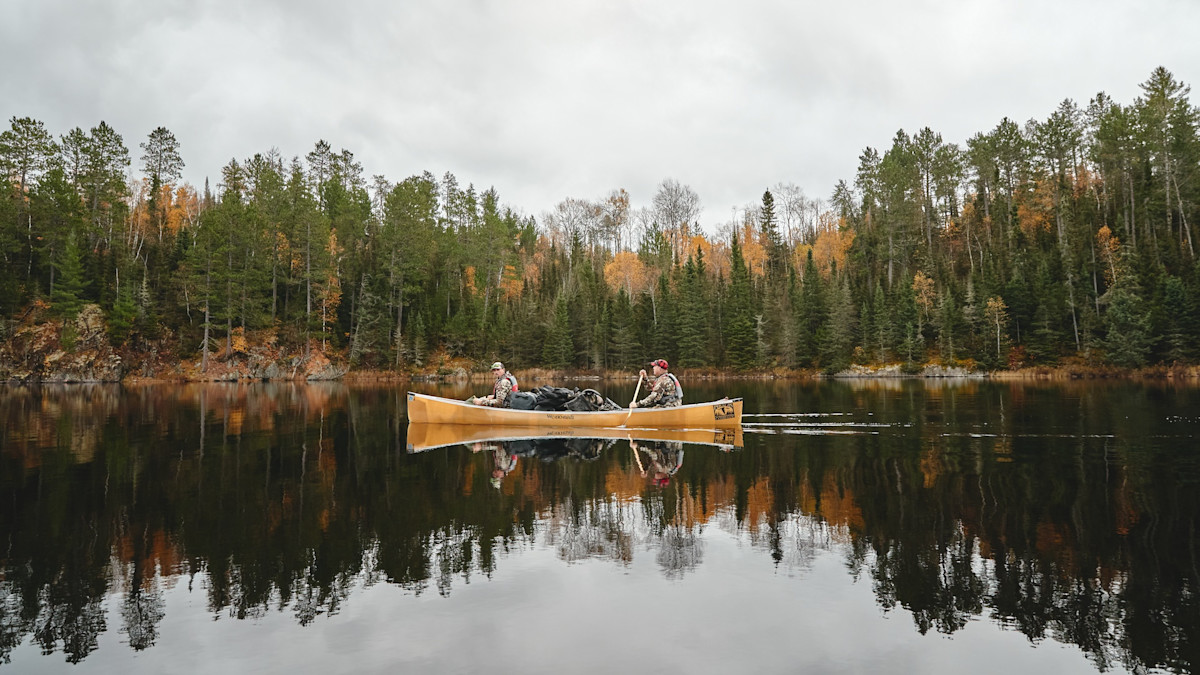


Editor’s Note: This column originally was published by Lee Montana Newspapers. “As you’ll read in this powerful op-ed from our own Steven Rinella and now BHA CEO Ryan Callaghan, the spectacular Boundary Waters Canoe Area Wilderness is once again at risk. But this time with national implications. This latest attempt to remove protections surrounding the BWCA is unprecedented in its method, and if successful, could be replicated on public lands all across the country. Whether you live in Minnesota, Montana, or Maine, HJR 140 deserves your attention.” - Mark Kenyon, Director of Conservation
We have hunted, fished and paddled Minnesota’s Boundary Waters Canoe Area Wilderness, just like millions of Americans. This is where fishing and hunting legends are made – and one of the only places in the Lower 48 where those opportunities still exist.
The Boundary Waters is the backcountry experience we all dream about. The water is so clean, you can dip a cup in the lakes and drink. You can catch 200 fish and bag a limit of grouse in a day. It’s that kind of place. And it’s available to us because President Teddy Roosevelt set it aside in 1909 and because, in 1964, Republicans in Congress unanimously voted to strengthen protections to conserve it in perpetuity.
Today, it faces one of the most serious threats in its history.
In 2023, after years of rigorous review and nearly unanimous public support, a 20-year mineral withdrawal was established in the Rainy River Watershed, home of the Boundary Waters. That decision reflects both science and common sense: Some places are too important to gamble.
However, a Chilean mining conglomerate, Antofagasta, continues to push the Twin Metals project, a proposed sulfide-ore copper mine immediately upstream of the Boundary Waters. At the behest of this foreign company and Congressman Pete Stauber of Minnesota, the Interior Department recently took steps to facilitate a Congressional Review Act vote, or CRA, to overturn the mineral withdrawal. The CRA is a blunt instrument infrequently used and intended to challenge agency rules. It was not designed for dismantling public land management decisions rooted in decades of law, science and public engagement.
Just days ago, on Jan. 12, Rep. Stauber took the next step and introduced HJR 140, which would revoke critical Boundary Waters protections. Stauber wants to fast-track the Twin Metals mine – all so a Chilean company can send American minerals to our nation’s adversaries, namely China.
Now, America needs minerals, and we support development of our domestic resources. But this is not the way. And this is absolutely not the place. What’s being pushed now does not respect the American hunter or angler, and it sure looks like a big giveaway, with Antofagasta planning to ship concentrates from Twin Metals straight to Chinese refineries for processing and sale.
Furthermore, if Stauber’s maneuver is successful, it wouldn’t just reopen the door to Twin Metals; it also would set a dangerous national precedent, enabling Congress to use the CRA to unravel public-land decisions anywhere in the country.
This is both a defining moment and a test of leadership.
And this is where the bipartisan House Public Lands Caucus comes into the picture. Created last year to make sure our public lands and waters are shielded from dangerous ideas in Congress, HJR 140 is exactly the type of proposal caucus members must work together to strike down. Republicans and Democrats pushing in the same direction can protect our outdoor heritage by making sure that our wildest places, like the Boundary Waters, remain in public hands.
This is not a narrow Minnesota issue. It’s a test of whether beloved public lands across the country can be stripped of protections with a simple majority vote, no filibuster and little public scrutiny.
That’s why Montana has an important role to play in what happens next. Our state is shaped by mining, timber and other extractive industries. Montanans have lived with the legacy of mining, both positive and sometimes damaging. We know that mines work in some places and in other places they are unacceptable. Hundreds of people spoke up in conservative Ravalli County to make this exact point just a few weeks ago.
Hunters and anglers are uniquely positioned to help determine what happens next – not just to the Boundary Waters or in Montana, but for the future of how our entire nation approaches conservation. We know the value of public lands, public access and the outdoor economy. It’s up to all of us and our champions in Congress to demonstrate that commitment in a meaningful way.
Together we urge House members – including our own delegation – to oppose HJR 140 and its wrongheaded goal of dismantling Boundary Waters protections.
Some places are worth fighting for. And just like Teddy Roosevelt and the many conservation-minded Republicans since, we believe that the Boundary Waters is one of those places.
Feature image via Charlie Williams.
Update: HJR 140 passed through the House of Representatives with a vote of 214 to 208. The resolution now heads to the Senate for consideration. If you want your voice heard about the future of BWCA, contact your Senators now.
Stay in the loop with The MeatEater Newsletter
Shop
Related
Public Lands & Waters
Unprecedented Congressional Action Could Strip Boundary Waters of Protections


Public Lands & Waters
Protecting the Boundary Waters Is a Test of Leadership for America’s Public Lands

Conservation News
Governor Walz is Trying to Block Mining in the Boundary Waters. Will it Work?
The comments section requires Functionality cookies. Please enable Functionality cookies in Cookie Settings to view this content.