
In this series, we look at the classic, discontinued, or longstanding guns that hunters still use in the field today (hence the name). Whether they’re out of production or not, you can still find them at gun shops and hunting camps all across the states.
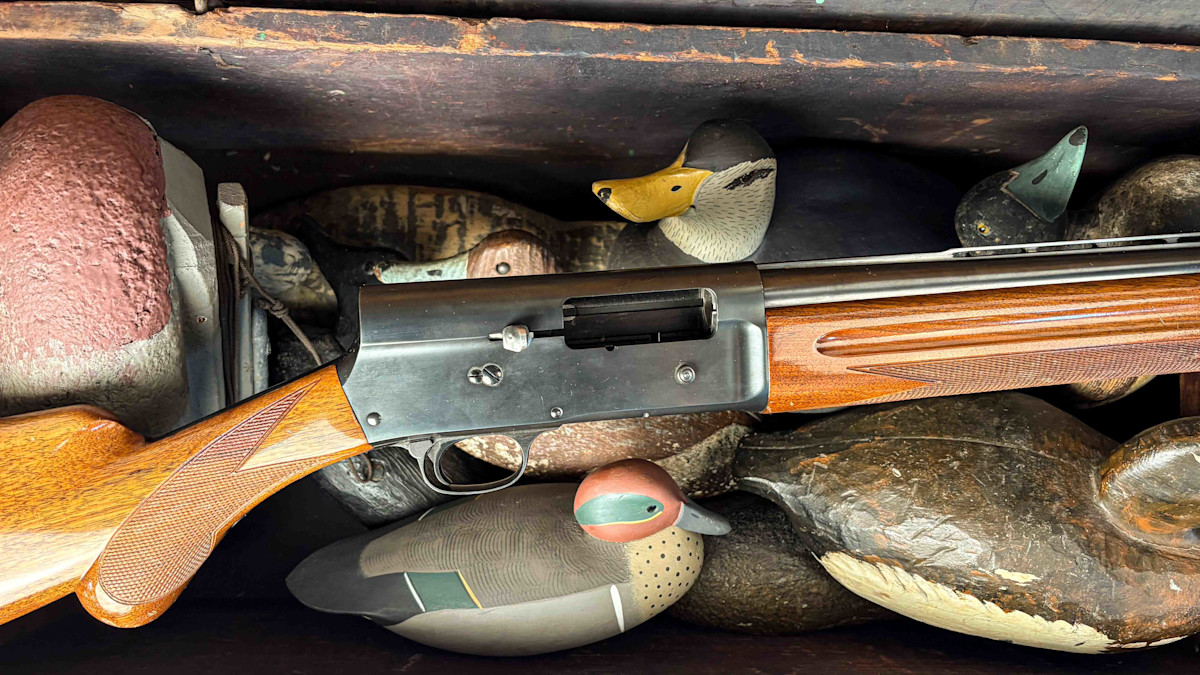
G.O.A.T. status only comes with longevity. Its the “all time” part of that acronym that says it all. For semiauto shotguns, there may be another greatest of all time waiting in the wings. For now, though, the title undoubtedly goes to the Browning Auto 5. It maintained its relevance in the face of competitors for a clean 100 years—the entire 20th century—which is one of many reasons it’s hard to beat.
The Auto 5 is also one of the world's most recognizable shotguns with its humpback profile and chunky steel receiver. Even though it was produced by several different companies, Browning’s straightforward, recoil-operated shotgun became a staple in duck blinds, pheasant fields, grouse covers, and anywhere else you might need a shotgun—including some pretty hostile warzones. Like all of John Browning’s guns, the Auto 5 just worked, and for many hunters, it’s still working today.

The Story of the Browning Auto 5
The heaviest of heavy hitters in American gun making came up with the Auto 5 in 1898. John M. Browning was fresh off of two years of missionary work in Georgia for the Mormon church when he got down to business making a patent for a recoil operated firearm (along with 20 other patents). That gun would become the Browning Auto 5.
At the time, Browning was working with Winchester to build his gun designs. He designed three self-loading shotguns to present to the company, with the last being the Auto 5. T.G. Bennett of Winchester would make the final call, and he felt the public wasn’t ready for a semiauto. Browning tried to strike a deal with the company that would give him royalties for every Auto 5 sold. Winchester said no way, and Browning walked. He actually sailed, on a steamship, all the way to Belgium, where he presented Fabrique Nationale (FN) with the new shotgun. The Belgians were intrigued and they decided to go with Browning’s royalty deal. In 1903, they started producing Auto 5s and shipping them back to the U.S.
To say Browning was taking a risk with the Auto 5 would be an understatement. The Auto 5 wasn’t just a new shotgun to market. It was essentially a new category of shotgun. Hunters were familiar with pumps and side-by-sides, but they had no concept of an autoloader. To up the ante, Browning personally financed the first run of 10,000 Auto 5s to be shipped to the States. His gamble paid off, though, and all of the first run Auto 5s were sold in under a year. As sales continued to rise, other companies started work on their own semi-auto shotguns to keep up. It would take 54 years before any competitor could touch the Auto 5.
Remington licensed and took up production of the Auto 5 in 1905 calling it the Model 11. Through the years, production of the gun bounced back and forth between FN, Remington, Savage, and finally Miroku in Japan. Copies of the gun were made by Franchi and Breda, too. An exact figure for how many Auto 5s were built is hard to come by, but the number is in the millions, with estimates between 3 and 4 million. Production ceased in the late 1990s with a tribute run of 1000 limited edition guns made at the Miroku factory in Japan.

What Makes Auto 5s So Great
Shotguns aren’t like rifles because they need to shoot a wider variety of loads at different pressures. It’s in this concept that Browning's genius with the Auto 5 is most evident. Shotgun shells have always been complicated, but in the late 1800s, they were especially so as shell manufacturers were making the switch from black powder to smokeless powder. Browning knew his autoloader needed to shoot any kind of shell if the public was going to accept it, so he needed to come up with a design that would cycle no matter what.
Most semi-automatic rifles cycle by harnessing gasses bled from each shot through a small hole in the barrel, kind of like an internal combustion engine. But rifles are relatively consistent between loads. For shotguns, the gas pressure between, say, a target load and a goose load or a black powder load and a smokeless load, varies, making it difficult to make a gas-operated shotgun that works reliably. Instead of gas-operation, Browning decided to harness the power of recoil to cycle the action for the Auto 5.
If you’ve ever shot an Auto 5, you’ll notice the "long" in its long-recoil action. The entire barrel and bolt move backwards with the shot before the barrel slams forward again followed by an ejecting shell and the bolt. The design relies on springs in the magazine tube and the stock. But the springs alone can’t account for the variety in shotgun shell payloads and pressures. Higher pressures would slam the bolt back too fast and low pressures weren’t powerful enough to cycle the action. To fix this, Browning added a set of adjustable friction rings as a simple, cheap, and effective shock absorber to compensate for different loads.
Since the Auto 5’s introduction, designers have come up with successful gas-operated shotguns. And improvements have been made to recoil-operated semiautos. But the Auto 5 was the gun almost all semiauto shotguns were built on. With this patent, Browning held a virtual monopoly on the semiauto shotgun market for half a century.
What to Look For in a Used Browning Auto 5
Auto 5s were made by four companies in a wide variety of sub-models in 12, 16, and 20 gauge. There are lightweight versions, some that hold only three shells, some with short barrels, and some that are full-blown modern workhorses. All of this to say, you want to do a little research before buying a used Auto 5.
As with any used firearm, you first need to figure out where you fall on the spectrum of collector vs. shooter. Diehard collectors prize original finish, condition, and rare short-run models. Those who like to hunt and shoot want a gun that can gather groceries and bust clays. They’re less likely to put up with the fact that many Auto 5s shouldn’t shoot steel. They’re also less picky about finish and condition. Collectors will generally pay more, and shooters will pay less.
For the practical hunter, one who wants their gun to perform above all else, the Japanese Auto-5s are what you’re after. These guns were made from 1976 to 1998. Specifically, you’re looking for a Miroku that was made between 1983 and 1998 because it has a nitride-coated magazine tube and removable Invector choke tubes. The Japanese also built a Magnum 12 with a 3-inch chamber in the late 1980s-90s. This gives you the vintage flare of a humpback A-5 with all the modern bells and whistles.
Classic Auto 5s are nothing to scoff at, though, especially the Belgian ones. These guns are beautifully made with a deep bluing, sharp checkering, good engraving, and an old-world fit and finish. Between 1958 and 1975 is the sweet spot for these guns. There are regular and magnum models in both 12 and 20 gauge, and they ditch the inside the trigger guard safety for a nice crossbolt safety. If you’re looking for a Light Twelve, Sweet Sixteen, or 20-ga to keep it classy in the uplands, check out Belgian guns from the aforementioned years. The Sweet Sixteens and 20-gauges weigh less than seven pounds.
To the collectors out there, you probably already know what you’re after. One interesting gun to find in good condition would be the 3-Shot Automatic A-5. In the 1930s, when duck hunters were first restricted to three shells, Browning came up with a three-shell-only 3-Shot Automatic A-5 with no magazine plug—just a two-shot tube and shorter forend. Plugs were later accepted as legal, and Browning eventually ceased production on these guns in 1946. There are also some incredibly fancy, high-grade Belgian guns made before WWII either by or under the supervision of master engraver Felix Funken.
There are some fantastic, full-coverage game scenes that came out of this period, but I’ve also seen some Art-Deco themes that really push the boundaries of engraving. Funken went on to open FNs custom shop in 1956, and as many hunters know, the Auto 5 keeps trucking on in the uplands, on the marsh, and anywhere else a reliable shotgun is needed.
Stay in the loop with The MeatEater Newsletter
Shop
Related
Firearms
Still in the Field: The Almighty Remington 870
Firearms
Still in The Field: The Winchester Model 70

Firearms
The Best Semi-Auto Shotguns

The comments section requires Functionality cookies. Please enable Functionality cookies in Cookie Settings to view this content.