
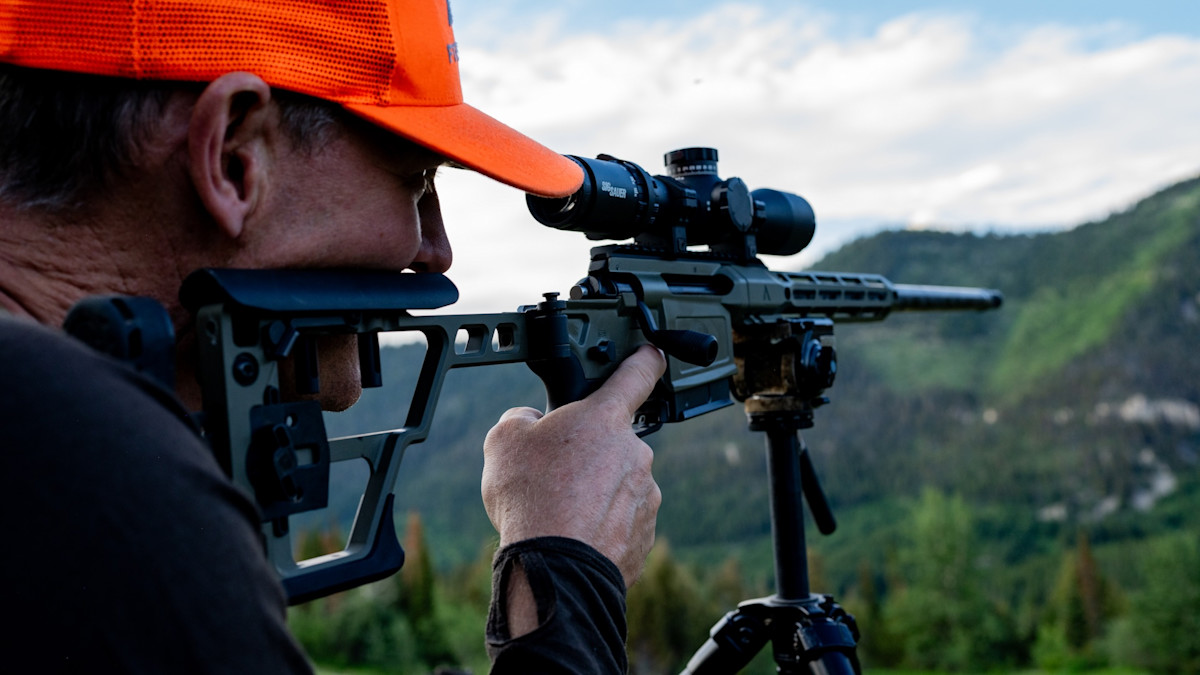

I’m not sure who started the rule of buying a scope that costs twice as much as your rifle, but they probably worked in marketing. While it might provide a general rule of thumb for some Western hunters, this hyperbole hardly applies to the rest of us and our budgets.
The truth is most hunters are buying and using way more scope than they’ll ever need. By “way more scope," I mean a lot of hunters buy scopes that are probably overkill for the majority of their hunting needs. I’m not saying good glass isn’t worth the cheese, but you don’t need the magnification of a long-range hunting scope if the majority of your hunts occur in a ladder stand.
On the other hand, there are times when it’s worth saving for a good scope, and I’ve never regretted having premium glass. If you’re in the market for a new scope, here’s a few points to consider.
Consider Where and How You Hunt
Location plays a much bigger role in determining the best rifle scope for your hunting situation. I’m sure most hunters east of the Mississippi are tired of hearing this, but we could get away with using a fixed power scope, especially for thick, timbered areas. I can see the argument for a little more magnification for hunters who shoot to 300 yards, but there are plenty of capable and affordable second focal plane (SFP) scopes for that. In fact, a standard 3-9x40 would cover most hunting scenarios you’ll encounter.
For Western hunters who regularly shoot beyond 300 yards, a first focal plane (FFP) scope probably makes sense when you need to make quick holdovers or buck the wind. In these situations, it’s imperative that your scope track as precisely as it should, and that often means forking out more money.
Speaking of money, FFP scopes typically run more than SFP scopes due to assembly costs, not because they’re inherently better. If you need a hunting scope for shots within 300 yards, there are plenty of scopes within the $500 range that are more than capable.
Glass
When it comes to glass, scopes under $1000 can offer good clarity and sharpness, but they probably won’t wow you. Whenever I would show someone a scope during my days as a firearms salesman, I would basically plead with folks to take them outside. Most customers would look through a scope in the shop, nod, and tell me to wrap it up. This is how most folks evaluate a scope’s glass. To be fair, a lot of those hunters just needed anything that would show them whatever deer appeared in their food plot first. That’s not a knock either. If that’s you, you have your pick of the litter for affordable hunting scopes.
In this case, edge-to-edge clarity, image sharpness, and optimal light transmission aren’t nearly as important as they are for the hunter who’s trying to decide if the mule deer across the canyon in a highly coveted unit is a bonafide shooter. While your scope might seem to check all those boxes during the daytime, they become glaringly apparent at dusk and dawn.
If you want to see this difference, go to your local sporting goods store and see if they’ll let you compare two scopes. If you’re considering an upgrade, compare a $500 scope and a $1500 scope. Just be sure to compare them at last light; that way you get a good idea of how your scope will perform when it’s prime shooting time. Cheaper scopes will exhibit flares, blurring around the edges, and darker image quality. Scopes above $1000 shouldn’t display those traits, barring the exceptions. Of course, there’s the matter of first and second focal plane reticles to consider as well.
First vs. Second Focal Plane
A brief understanding of FFP and SFP reticles might illuminate which scope better fits your hunting and shooting needs. At the front of your scope, the larger end is known as the objective lens. The end closest to your eye is called the ocular lens. FFP reticles are located near the objective lens (the first focal plane), while SFP reticles are located in the rear, behind the magnification lens (second focal plane). An easy way to remember this is that FFP reticles are located near the front of the scope, and “first” and “front” both start with an “F.”
Between those two planes lies a scope’s erector system. This is the middle portion of the scope where your turret controls sit. Based on the reticle location, this is why an FFP reticle will appear to increase while an SFP reticle remains the same.
Somewhere in the wake of the long-distance shooting craze, SFP scopes developed a reputation for being less desirable. If you’re reading this and you just discovered that your scope is an SFP, don’t worry, it’s just fine. The fact is, they have advantages and disadvantages relative to particular hunting situations.
The advantage of an FFP scope is that the reticle size appears to change as you adjust the magnification. As you turn the magnification up, the reticle enlarges and the subtensions become increasingly visible. Unlike SFP scopes, the subtensions remain the same whether you’re shooting at 2x or 15x. You don’t have to worry about doing a few math problems just because you turned the magnification up. For these reasons, a lot of precision or long-range shooters prefer FFP scopes.
SFP reticles, on the other hand, stay the same size regardless of the magnification setting. This makes them ideal for hunting, especially in low-light scenarios. Where FFP reticles can overshadow your target at dawn/dusk on greater magnification ranges, the SFP remains the same. This is why most affordable hunting scopes are SFP.
Magnification
A lot of rifle hunters tend to crank their magnification all the way up when it’s time to take a shot. Everyone has likely been guilty of this at some point. While it might give you a closer image of your target, you probably don’t need that much magnification most of the time. Nor will you always have the time to get a shot off if you’re fumbling with the magnification wheel.
Unless you’re regularly shooting beyond 300 yards, you’re probably carrying more scope (and weight) than you need. Most of my scopes have variable-power settings, but I typically set them around 5 or 6x, and they don’t really move. I’d argue that most hunters could probably get away with a similar setup. Either 5 or 6x magnification will give you plenty of zoom from zero to 100 yards, so if you need to make a quick shot, you won’t have to worry about adjusting your scope.
That’s not the case if you leave your scope cranked way up to 15x and a deer bounds out in front of you. By the time you make an adjustment, you’ll be lucky to see a white flag bounding out of sight.
For hunters in Western states or long-range shooters, you can likely justify the cost of an FFP over an SFP. Still, that doesn’t mean you necessarily need a scope that can identify landmarks on the moon or that requires a second mortgage. An SFP scope with holdover marks can serve you well. Just know that those subtensions will vary at different magnification ranges, whereas the subtensions on an FFP stay the same.
Last Call
The next time you need to buy a scope, be realistic about your hunting situations. As someone who used to work in a gun store, workers can sometimes pressure you into buying more scope “just in case” you need it. Instead, consider that many of the hunting rifles from the mid- to late part of last century relied on fixed-power scopes, even for hunters in sheep country.
If you have to upgrade your scope, consider investing in premium glass, rather than paying for magnification ranges you may never see. You’ll probably find that what you actually need is just a little more practice, not more zoom.
Stay in the loop with The MeatEater Newsletter
Shop
Related
Firearms
Do You Really Need a Scope that Costs as Much as Your Rifle?


Gear
How Much Scope Do You Really Need?

Gear
The Best Hunting Rifle Scopes Under $500
The comments section requires Functionality cookies. Please enable Functionality cookies in Cookie Settings to view this content.