Hunter Sets Florida Python Challenge Record with 96 Snakes
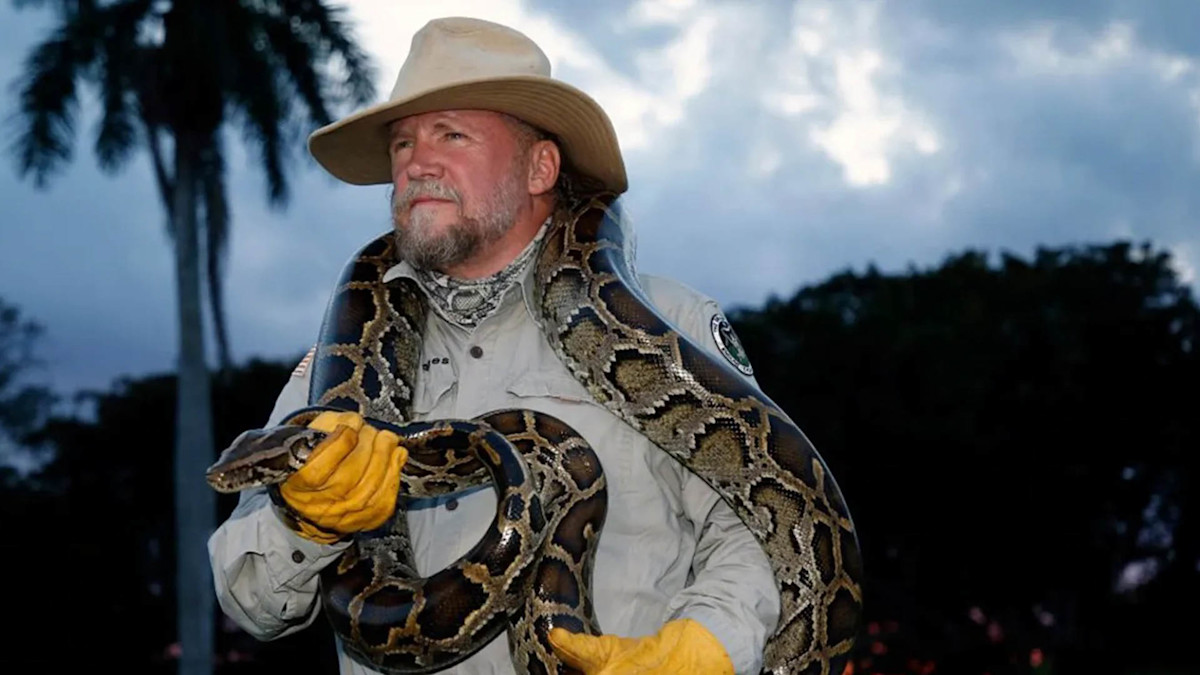

The results are finally in from Florida's annual Python Challenge, and one hunter put together a performance unlike anything the competition has seen before. Held July 10-19, the 10 day event drew more than 900 participants from across the U.S. and beyond, all with the same goal: remove as many invasive Burmese pythons from South Florida as possible. At the end of the competition, veteran python hunter Tom Rahill captured a staggering 96 snakes, a new single-competitor record that accounted for more than one-third of the 280 pythons removed during this year's challenge. And the best part–he caught them all in one day.
Tom Rahill’s massive haul (96) outscored the next contestant by 60. Rahill attributed his success to copious amounts of planning and his ‘granny bike,’ he told the Naples Daily News. Because of a bad back and recent hip replacement, the 69-year-old Floridian used an e-bike to get away from the crowds and target lesser-known areas. That gamble paid off.
Rahill and his partner came across a 17-foot female python. After bagging the massive python, they quickly scanned the area for her nest. That’s when they found 98 eggs, only two of which hadn’t hatched (rules for the contest state that only live pythons count toward the total). That one find was enough to win him the Florida Python Challenge.
So what is the Florida Python Challenge?
Started in 2013, the Florida Python Challenge is a 10-day competition hosted by the Florida Fish and Wildlife Conservation Commission (FWC) and the South Florida Water Management District (SFWMD). Each year, participants from around the country compete to remove invasive Burmese pythons from designated public lands in South Florida for a chance to win cash prizes.
Competitors can enter one of three divisions, Novice, Professional, or Military, and compete for awards recognizing both the most pythons removed and the longest python in each category. Cash prizes are awarded across all three divisions, including a $10,000 grand prize for the Professional division winner who removes the most pythons during the competition.
The competition exists because Burmese pythons have become one of the most destructive invasive species in the Everglades. Native to Southeast Asia, the snakes became established in South Florida through releases and escapes from the exotic pet trade decades ago. Today, wildlife officials estimate that tens of thousands of Burmese pythons inhabit the Greater Everglades, though their secretive nature makes an exact population estimate nearly impossible.
The snakes adapted remarkably well to South Florida because its warm, subtropical climate closely resembles their native range in Southeast Asia. With abundant prey, vast stretches of suitable habitat, and few natural predators, the python population expanded rapidly. Adult Burmese pythons are opportunistic apex predators capable of consuming dozens of native species, including rabbits, raccoons, opossums, birds, deer fawns, bobcats, and even alligators. Researchers have linked their spread to dramatic declines in native mammal populations throughout portions of the Everglades, making them one of the greatest conservation challenges facing the ecosystem today.
Ongoing Efforts
With wildlife officials estimating that tens of thousands of Burmese pythons still inhabit the Greater Everglades, removing 280 snakes over the course of 10 days may seem like a drop in the bucket. However, the Florida Python Challenge was never intended to solve the state's python problem on its own.
Year-round removal efforts remain the backbone of Florida's python management strategy. According to the Levy Citizen, contractors working for the Florida Fish and Wildlife Conservation Commission and the South Florida Water Management District have removed more than 19,000 Burmese pythons from the Everglades and surrounding areas since 2017.
The purpose of the annual challenge is designed to complement those ongoing efforts by educating the public about the threat invasive pythons pose to Florida's native wildlife while encouraging participants to become involved in conservation. The competition also brings together hunters, outdoorsmen and women, military members, and wildlife enthusiasts from across the country in a shared effort to protect one of North America's most unique ecosystems.
Before entering the competition, every participant is required to complete an online training course covering python identification, safe handling techniques, and humane euthanasia methods. The training helps ensure competitors can distinguish Burmese pythons from native snake species and safely remove the invasive reptiles if they encounter one.
Rahill's record-setting performance was made even more impressive by the return of Everglades National Park as an official competition site, where he captured all 96 of his Burmese pythons during the 10-day event. While his haul earned him the Challenge's $10,000 grand prize, it also serves as a reminder of the scale of Florida's invasive snake problem. And if this year's results are any indication, there are still plenty of pythons left to find. A complete list of winners from all three divisions is available on the Florida Python Challenge webpage.
Feature image via Swamp Apes
Stay in the loop with The MeatEater Newsletter
Shop
Related

Wildlife Management
Hunter Sets Florida Python Challenge Record with 96 Snakes

Wildlife Management
Anti-Hunter Campaign to Ruin Florida Bear Hunt Might Backfire