Elk Feedgrounds Could Help Bears and Wolves More Than Hunters
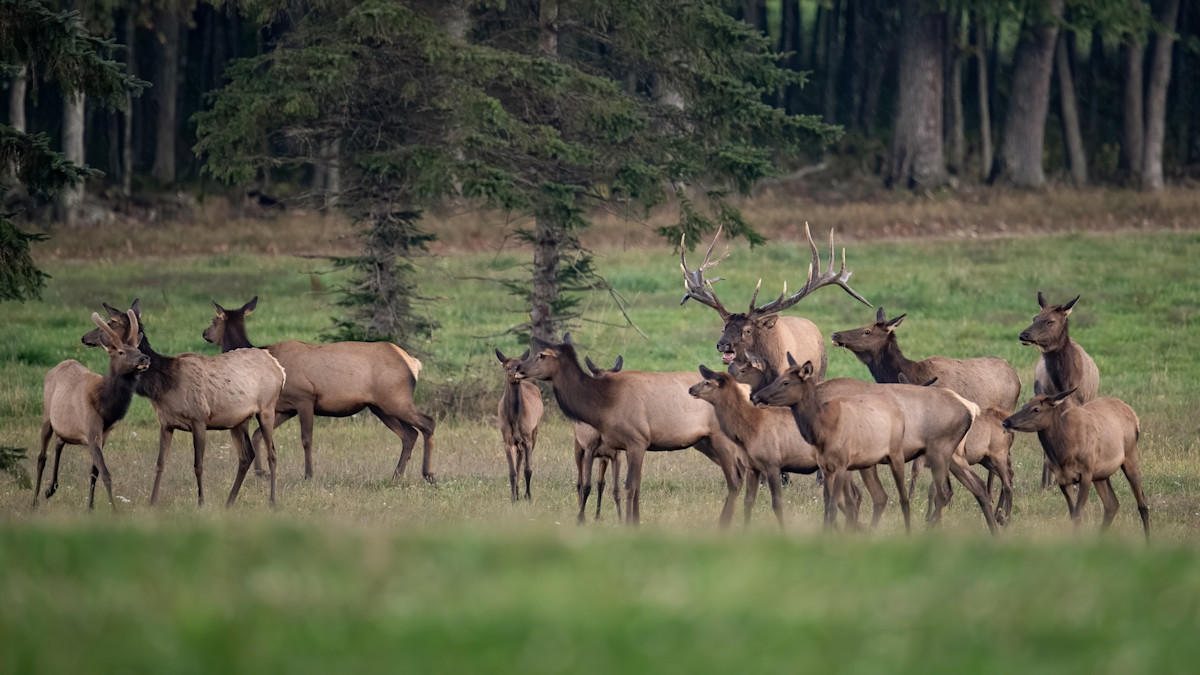

Winter-range elk feeding programs, like those near Jackson, Wyoming, are a double-edged sword for elk herds. On one hand, the hay and alfalfa handout stations can harbor and spread lethal diseases like CWD through the herds, but on the flip side, they’re also thought to prevent mass starvation and winter kill in heavy snow years. Ultimately, that means more elk for hunters to harvest—in theory, anyway.
New research conducted by the U.S. Geological Survey (USGS) casts doubt on the effectiveness of feeding programs, indicating that any increase in elk populations may be completely offset by wolf and grizzly predation. In a study published this summer, researchers came to the conclusion based on 26 years of Wyoming and Montana data gleaned from elk monitoring surveys, hunter harvest reports, predator abundance estimates, and seasonal precipitation trends.
Broadly, the study found that feeding elk herds does increase the number of calves born in the spring, but those gains are not carried over to the huntable, adult population. Herds with winter feeding programs exhibited a 4.9% increase in calf:cow ratios over herds with no feedgrounds. In total, fed herds had a 0.3 calf:cow ratio, whereas unfed herds had a ratio of 0.26. That might not seem like a very large difference, but it could be several hundred additional animals for a herd in the Greater Yellowstone Ecosystem, where the study was conducted (the Jackson herd alone, for example, has about 10,000 members).
Those additional animals, however, never appeared to make it to adulthood. Over the many years of data analyzed, it was clear that herd sizes in fed populations never increased, as would have been expected given the additional crop of calves.
To understand what was happening to the juveniles, the researchers examined how bears and wolves overlapped with 13 different elk herds in the region. Ultimately, they found that grizzly bear density increased around herds with a higher calf:cow ratio, likely due to increased food availability. The researchers found the same to be true with wolves, although with less certainty due to the lack of detailed data on wolf abundance.
“The benefit you might be getting from feeding was being mopped up by the predators,” lead author Brian Dugovich told WyoFile. “In a more intact ecosystem [that includes large carnivores], the energy you put into the system is going to be harder to get back out again as harvest.” Overall, that means feeding programs might be benefiting local predators more than local hunters.
Furthermore, to bolster the case against feedgrounds, the USGS study also found that winter severity was not a strong predictor of the calf:cow ratio in fed herds. In essence, that means supplemental feeding doesn’t actually help with calf survival on heavy winter years any more than it does on light winter years. “This casts doubt on the justification of supplemental feeding as a means of mitigating winter severity,” the authors write. “Although we acknowledge that calf mortality occurring later in the year (after our January–March assessment period) could mask such an effect.”
In the bigger picture, the study provides fairly convincing evidence that bears and wolves are trimming down the fed elk herds, but notably, the results were based on complex statistical models attempting to correlate many different environmental and biological factors. It’s entirely possible that the models misrepresented certain variables, the data had gaps (i.e., hunter harvest estimates could have been inaccurate), or the researchers overlooked something entirely (i.e., length and difficulty of herd migration routes). That’s to say, the study—as with most biology research—is a piece of a puzzle, but not a definitive answer.
Feeding programs are likely here to stay, despite an increasing amount of evidence against their efficacy. It’s an area in which wildlife managers will likely have to focus more attention in the coming years, as development further encroaches on elk winter ranges and CWD prevalence continues to increase. The bears and wolves, at least, will be well-fed if the feedgrounds stick around.
Stay in the loop with The MeatEater Newsletter
Shop
Related
Wildlife Management
Elk Feedgrounds Could Help Bears and Wolves More Than Hunters
Wildlife Management
Wyoming to Use GPS Collars to Help Hunters Target Specific Elk Population


Wildlife Management
How to Predator-Proof Big Game Herds

The comments section requires Functionality cookies. Please enable Functionality cookies in Cookie Settings to view this content.