Fisherman Discovered Two Friends Entombed in Car for 45 Years in Wisconsin Lake

This is the first of two articles on the haunting disappearance of two Wisconsin hunting/fishing buddies who vanished in February 1961.
Ronald Wick, 19, and Carl Stolz, 21, vanished for over 45 years after they went joyriding across a frozen Wisconsin lake around 3 a.m. on Feb. 21, 1961.
The baffling fate of the two hunting, fishing, and trapping buddies sparked decades of rumors, theories, and heartache for the men’s families and friends. ACapital Timesnewspaper article two years later in March 1963 described the search for Wick and Stolz as one of the most intensive efforts in the history of the Madison Police Department (MPD).
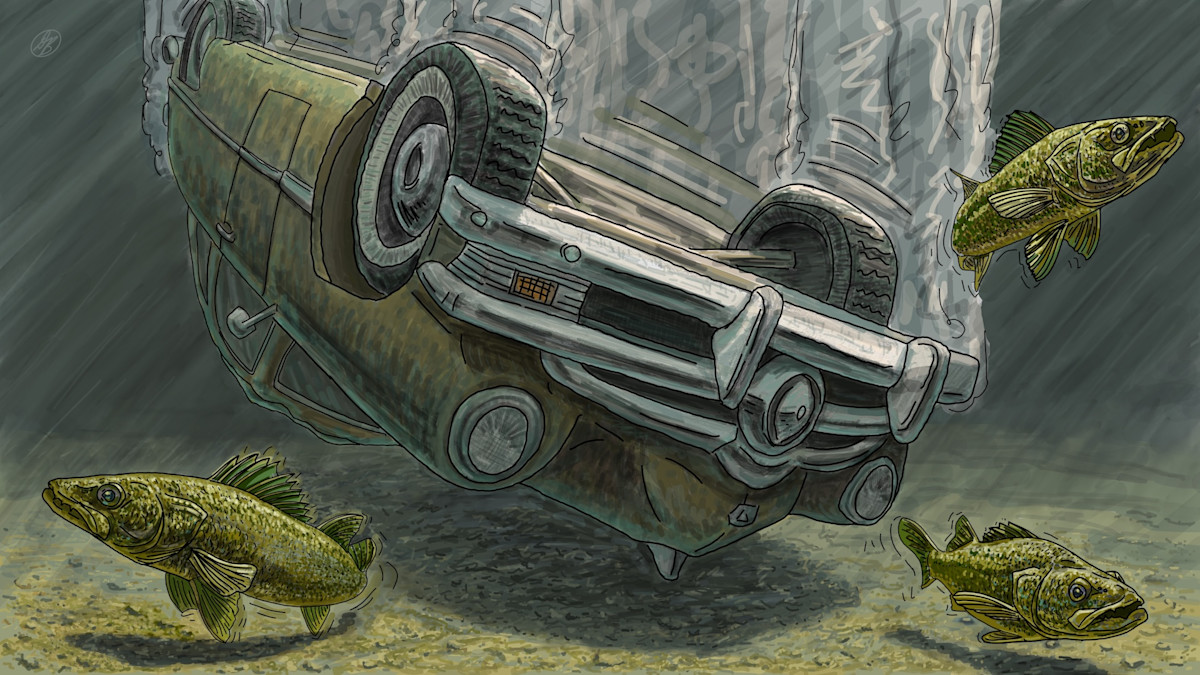
All verifiable reports and investigations indicated the young men were entombed in Wick’s1950 Ford coupesomewhere on the bottom of a Madison area lake. Unfortunately, that’s no small search area, given that theMadison chain of lakes—Mendota, Monona, Waubesa, Wingra, and Kegonsa—exceeds 29 square miles. The ensuing searches through 1963 involved the MPD, family members, scores of civilian volunteers, the Dane County Sheriff’s Department, Navy and Air Force equipment and personnel, University of Wisconsin-Madison experts, and even a world-famous clairvoyant,Peter Hurkos.

None of them found a solid clue to the car or even a specific lake, though Monona or Waubesa seemed the best bets. In the decades that followed, the sad mystery lived on among law-enforcement investigators, area anglers, and scuba divers. That group eventually included Rick Krueger, who was only eight years old when Wick and Stolz disappeared after a night of bar-hopping in downtown Madison, which covers a half-mile-by-2.5-mile-longisthmusbetween lakes Mendota and Monona.
Krueger, now 73, spent his adult life immersed in the fishing, diving, and law-enforcement communities. His colleagues dubbed him “Radio Shop Rick” during his career in the city of Madison’s radio communications division from 1985 through 2011. Whenever dive teams or law-enforcement officers needed help searching for sunken boats or drowning victims; or when choosing, installing, or learning how to use sophisticated electronics for their boats, they called Krueger.
Though he grew up fishing Madison’s lakes, Krueger’s interests shifted toward scuba diving as an adult. He liked finding fishing tackle and other underwater “treasures,” and that passion deepened in 2005. That’s when Krueger became one of the first anglers anywhere to mount a side-scan sonar unit in his boat afterHumminbird introduced its 987c SIto recreational fishing.
The morning of July 21, 2006, Krueger spotted an unusual object on his new side-scan sonar screen while searching Lake Waubesa for a 14-foot aluminum fishing boat. Four Illinois men had swamped it years before in heavy waves. Though the anglers were rescued, their boat sank in 35 feet of water, Waubesa’s deepest section.

Krueger locked in a GPS waypoint for the object and returned in the afternoon with his friend, Mike Michaels, to photograph it with Krueger’s underwater camera. As he lowered his camera to the bottom, Krueger felt it bang into something solid, probably metal. But when he activated the camera and studied his screen, the water proved too murky to identify anything in his photos.
Krueger and Michaels returned early the next morning, July 22, with Krueger’s scuba gear. After diving to the bottom, Krueger found an old car resting upside down at a 30-degree angle, its front hood pressed at least 3 feet into Waubesa’s silty bottom. Though some of the car’s windows were cracked, all were intact, as were the doors. Heavy siltation on the windows blocked any view of the car’s interior.
His excitement building, Krueger moved toward the trunk and rear bumper—the highest point on the wreck. The taillights were intact, so Krueger rubbed on a lens, hoping to find its year of manufacture. When the lens came off in his hand, he hung onto it and moved to the car’s license plate. It had a 1961 expiration date, which Krueger knew was the year Wick and Stolz disappeared.
Over the years, Krueger had spent time searching Waubesa and Monona for this car, and his circle of diving friends often discussed the case. Krueger removed the license plate, brought it up, and contacted acquaintances at the sheriff’s department. Rick Steinhauer, a longtime member of the department’s dive team, matched the plate with Wick’s old Ford.
Days later, during the sheriff’s department’s two-week recovery and salvage operation, divers found some of Stolz’s hand bones just outside the passenger-side door, which was cracked open one to two inches, and some of Wick’s hand bones wedged between the driver-side door and the car’s frame. Once the divers could reach inside, they recovered the men’s remaining bones.
The coroner’s office soon matched the remains with Wick and Stolz through medical records and personal effects like Stolz’s wedding band and Wick’s Wisconsin ID card, still intact inside his wallet. Investigators never found dental records for either man.
Despite being underwater 45 years and five months, the car was mostly intact, and its contents in decent condition. In fact, the coroner’s office told the divers they had recovered more items than what’s typically found at outdoors crime scenes, given how birds, animals, and the elements can chew, peck, and scatter items on the ground.

When Last Seen…
And just like that, Krueger had solved the Madison lakes’ long-running mystery, which began when Wick and Stolz failed to show up for work Tuesday morning, Feb. 21, 1961, at the Wisco Hardware Company near Wick’s home on South Brearly Street on the isthmus. After the young men again missed work Wednesday morning, Feb. 22, Wick’s older sister, Janet Hall, contacted the MPD, which began investigating their movements the previous days.
MPD reports state that Stolz had driven to Madison on Sunday evening, Feb. 19, from his home in Lake Delton, 50 miles to the northwest, where he had spent the weekend with his pregnant wife, Nancy, and infant son. After working Monday, Feb. 20, Stolz agreed to meet Wick that night to go bar-hopping. Wick then visited three young women he knew at their apartment, and discussed the possibility of going fox hunting west of Madison.
Instead, Wick met Stolz downtown, where they bumped into Wick’s old girlfriend at the Shuffle Inn on Park Street. The young woman left the bar with them when it closed at 1 a.m., and later told police she saw a half-empty 6-pack of beer in Wick’s car. She said they drove around a while before Wick parked at the end of South Few Street on Lake Monona’s northern shoreline and walked onto the ice to check it with his flashlight.
Around 1:30 a.m., Wick drove Stolz a few blocks to his parked car on East Main Street. The men talked five to 10 minutes behind Wick’s car while the girl waited inside. She told police she couldn’t hear what they discussed. After leaving Stolz by his car, Wick and the girl drove several blocks to Law Park on Monona’s shoreline, where he again inspected the ice. Police reports said water probably rimmed the shoreline because of recent warm weather.
While driving around with the girl, Wick told her he had driven on ice-covered lakes many times and that Stolz had agreed to join him later that night for another ride. Wick invited her to ride along, but she told him she’d jump out if he drove onto the ice. The girl said Wick repeatedly checked his watch while they talked, and then dropped her off at her apartment after arranging a date for the next night.
Stolz, meanwhile, had walked from his car to nearby South Brearly Street, where a woman he and Wick knew left her car and walked toward her apartment. The woman said Stolz approached and asked to go inside with her. She declined, and later told police Stolz was stumbling drunk. Stolz told her he planned to meet Wick at 2:30 a.m. to drive on “the lake.” She tried talking him out of it, but he walked off minutes later, presumably unpersuaded.

Icefishing or Joy-Riding?
Days later, after newspapers reported Wick and Stolz were missing after going icefishing or joyriding on “the lake,” police received a tip from two women who ran an all-night bait shop a mile north of the isthmus. They said the men pictured in the newspaper articles were in their shop around 2 a.m. on Tuesday or Wednesday night the previous week.
A man they identified as Stolz bought $2 worth of mayfly larvae and asked, “Aren’t we crazy to go out on the lake fishing at this hour of the morning?” The bait-shop owners, Lorraine Atchison and Marjorie Jackson, weren’t certain the man was Stolz. They said his hair was longer than the crewcut seen in the newspaper photo, a reprint from Stolz’s high-school yearbook portrait three or four years earlier.
Still, they said the customer looked like Stolz, and was wearing a zippered, faded-red sweatshirt, which coworkers said he often wore. Police never found the sweatshirt in Stolz’s car, Madison apartment, or Lake Delton home.
Atchison and Jackson also told police the men didn’t say which lake they intended to fish. Likewise, the young women Wick and Stolz met earlier that night didn't know where they intended to go. Either way, it had long been illegal to drive cars or trucks on Madison-area lakes, though the practice remains common today across Wisconsin. But even today, no vehicle heavier than 850 pounds can be driven on Madison’s lakeswithout a special-use permit.
Therefore, Wick possibly viewed his late-night ice drives as forbidden fruit in 1961, further heightening his joy-rides. Krueger, for one, doubts Wick and Stolz ever intended to go icefishing that night, and the evidence suggests he’s right. When divers on the bottom at Waubesa’s wreck site popped the trunk on Wick’s car in July 2006, they found no icefishing gear. Instead, they found a restored bolt-action 7mm Japanese military rifle and a 12-gauge Remington 870 Wingmaster pump-action shotgun inside a deteriorating soft-side gun case.
Likewise, after the car was hoisted off the bottom and taken to the MPD’s evidence facility in August 2006, the forensics investigator—Marie Burgette-Bach—found no icefishing gear inside, such as an ice-spud, ice-scooper, fishhooks, tip-ups, lead weights, handlines or jigging rods.
She did, however, find ample evidence that Wick was a hunter. Her forensics report listed two wooden duck calls, 18 Japanese “long rifle” rounds, 83 rounds of .22-caliber bullets, six brass shotgun-shell tops, a soft-sided gun case, a pair of mid-calf leather boots, a sheathed hunting knife, and a silver Rayovac flashlight. Neither Wick nor Stolz was wearing the boots when the car sank. Both were wearing low-cut leather shoes, evidenced by their foot bones found inside.

First Impressions Confirmed
The location of Wick’s car also confirmed investigators’ original belief that Wick and Stolz had died on Lake Waubesa. After all, Wick had told at least one co-worker how excited he was about finding a good access point on Waubesa from a road near an uncle’s adjacent farm. Wick told the co-worker the road dead-ended on Waubesa’s western shoreline and that fishermen launch small boats there in summer. (The site was later improved and is now theWilliam G. Lunney Lake Farm Park boat launch.)
Six days after Wick and Stolz vanished, MPD detective Robert Ferris used that tip to check out Libby Road, just north of a point named Hog Island. After arriving Feb. 27, 1961, Ferris followed a blacktop strip that angled left off the end of Libby Road. Where the blacktop ended, Ferris found tire tracks heading eastward across 20 feet of sandy shoreline toward the lake’s receding ice. Soon after, investigators learned the make of Wick’s tires when interviewing the man who sold him the car, but its tread didn’t match the tracks in the sand. Detectives later learned the tracks were made by a neighbor.
Meanwhile, Ferris contacted undersheriff Jack Leslie, and they met at Libby Road the next morning, Feb. 28, 1961. They had seen open water 200 yards offshore to the north, and Leslie and his crew spent the day dragging the bottom with a grappling hook. They finished the futile search at 4:30 p.m., but knew Wick and Stolz could have punched through Waubesa elsewhere. Temperatures had been warm the previous six days, and water from melting snow atop the ice was increasingly obscuring cracks and holes.
The investigators also knew Wick and Stolz had other options for joyriding. They might have driven onto Lake Monona, roughly three miles north of Waubesa, or even Lake Mendota, a half-mile north of Monona, just across Madison’s isthmus.
Therefore, the MPD and sheriff’s department asked the U.S. Air Force at Madison’s Truax Field to help search the lakes by helicopter the next day, March 1. That search found Lake Mendota remained mostly ice-covered except for expansion cracks and two large openings, one near Governor’s Island and the other along the isthmus at what’s nowJames Madison Park. Coordinated ground searches, however, found no sign of a car near either site, and scuba divers found nothing when searching waters off the park.
When searchers turned the helicopter east to inspect Lake Monona, the crew reported one-third of the lake was now open water. Further, power-generating turbines at the Madison Gas and Electric Company on the isthmus keep a large stretch of Monona ice-free all winter. The helicopter crew reported the lake’s remaining ice looked “very thin,” worse than it had been Feb. 21 when Wick checked two sites on its northern shoreline after 1 a.m. Detective Ferris thought Wick wouldn’t have gotten far if he had driven onto Monona’s ice that night.
The Air Force helicopter then searched Lakes Wingra, Waubesa, and Kegonsa before ending the initial search phase.
In the weeks that followed, the search continued as volunteers and diving clubs responded to pleas and reward money offered by the families of Wick and Stolz. And 30 months later, in early August 1963, the famous psychic, Peter Hurkos, led a two-day search that drew national attention.
To learn about those futile searches and how dive teams recovered Wick’s car and the missing men’s remains, read Part 2 of this series, dropping next week.
Feature image via Dave Burgess.
Stay in the loop withThe MeatEater Newsletter
Shop
Related
Public Lands & Waters
Fisherman Discovered Two Friends Entombed in Car for 45 Years in Wisconsin Lake: Part Two
Public Lands & Waters
Fisherman Discovered Two Friends Entombed in Car for 45 Years in Wisconsin Lake