Spirit of WWII Refugees Powers the Latvian Eagle’s Deer Camp
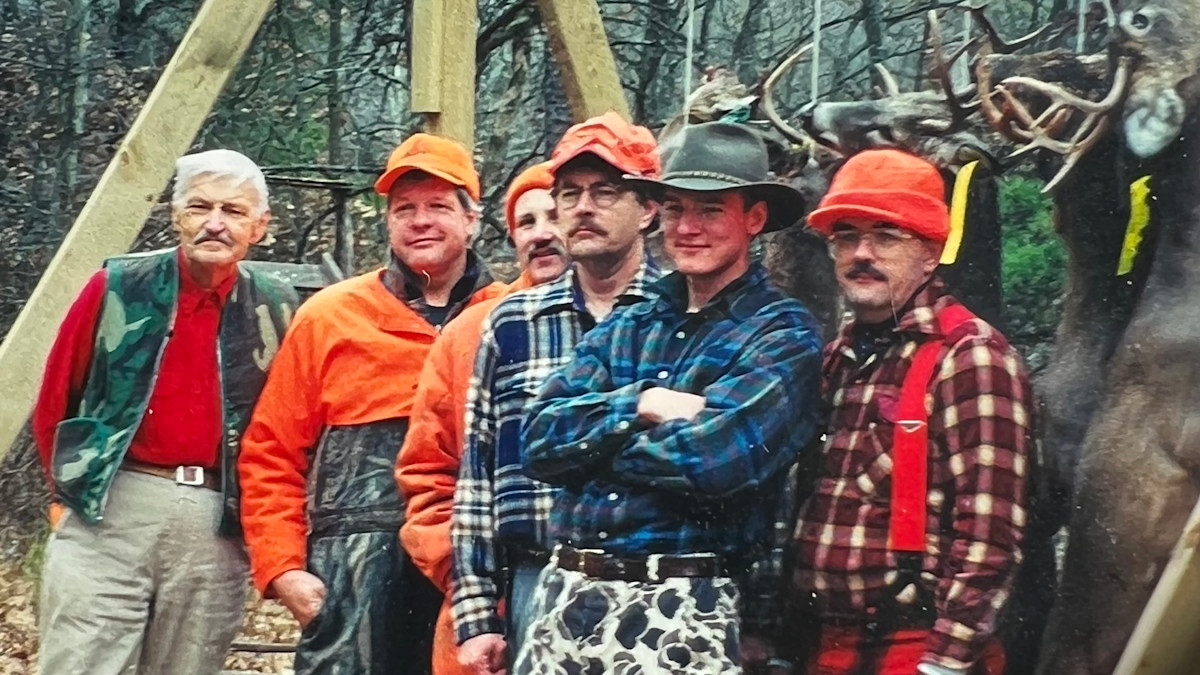

Most legendary deer camps began with a grandfather or other forebear who valued close kin, cherished lands, and a long-suffering shack.
To endure for decades, camps usually require a bloodline to outlast the founders’ generation. Without family heirs to bond the membership to their shack and deer woods, most camps splinter when the founder dies, quits hunting, or sells the property. Deer camps built on friendships alone seldom survive such disruptions, even if the camaraderie formed at work, school, church, or a neighborhood.
But yes, you’ll find exceptions. For example, a deer camp in western Wisconsin has persisted more than 80 years—over three generations—because of bonds forged by war, country, and a long, bitter peace. Its members have never named their camp and its 500 acres of woodlands, but neighboring landowners have long identified them as “the Latvians.”
Latvia, a small country in eastern Europe, covers 25,000 square miles, 2.6 times smaller than Wisconsin. The deer camp’s founding members reached the United States in the late 1940s and early 1950s as World War II refugees. After the Soviet Union forcibly annexed Latvia in August 1940, Russia’s invading Red Army chased them and their families from their homeland when they refused to submit.
Even after settling in Milwaukee and other Midwest cities, the Latvians planned to return one day to reclaim their country from the communists. But as the decades passed, most let go of those desires, long before Latvia regained its independence in 1991 when the Soviet Union collapsed. And though they celebrated Latvia joining NATO and the European Union in 2004, and some moved their families and businesses “home” to start anew, most stayed in the U.S., their adopted home.
Through it all, they maintained their Latvian roots, nurturing its culture, customs, foods, and native tongue while blending their love for hunting with American traditions. The deer camp where they still gather each fall began in the early 1950s on farmlands owned by “Old Man Kelpis,” his wife, and three sons. Kelpis and other Latvians settled there because the landscape reminded them of their homeland’s geography. As the years passed, Kelpis and other neighbors sold 40s, 80s, 120s and other parcels to Latvians seeking fellowship.
Most of the camp’s founders lived and worked five hours eastward in Milwaukee, the “Brew City.” That home base lasted through the 1960s, but gradually the Latvians dispersed or expanded their membership to include hunters from Utah, Texas, Michigan, Illinois, Indiana, Colorado, California, Montana, and North Carolina. When hunting Wisconsin’s nine-day firearms deer season each November, they stayed in two main encampments, sleeping on cots, bunks, and couches inside old shacks, camper-trailers, single-family homes, and mouse-infested house-trailers.

The Camp Roster
As the camp’s roster fluctuated in the decades that followed, it remained mostly pure-blooded Latvian. Besides the Staks brothers—John and Peter—the other family names were Avens, Auzins, Anderson, Berzins, Burvikovs, Brusubardis, Gebauers, Grendze, Grencions, Hunter, Inveiss, Junge, Mednis, Ozolins, Pedraudze, Petrovskis, Putelis, Putnins, Rimsans, Rozite, and Siltumens.
And just to fluster most observers, Latvian families endlessly recycle the name “Pēteris,” or “Peter,” and name their firstborn sons “Janis.” Therefore, camp members often share first names, but sometimes adopt American names or nicknames to clarify things. For instance, “Janis” can become “John,” and a hunter named Janis Inveiss became known as “Two Meals” for his insatiable appetite. Peter Avens said the Rozite brothers tagged Inveiss with the name, and claims playing high school football made Two Meals forever hungry.
Whatever their name or hunting experience, newcomers have always been welcomed by the camp’s regulars. “Papa Janis” Putelis, 75, the father of MeatEater’s Janis Putelis, 49, recalls arriving in 1987 from Indiana with a 16-gauge double-barrel shotgun he used for hunting rabbits and pheasants.
“I loaded a slug into my shotgun the first day and couldn’t hit a board at 20 feet,” Papa Janis said. “I had little clue of hunting deer. When you show up at deer camp with a shotgun and everyone else has a rifle, you know about it. It’s like bringing a spinning rod to a fly fishing-only river. Before I returned the next year, I bought my first deer rifle, a Model 700 BDL in .30-06 with a Redfield scope.”
The Latvians today still fly and drive in from myriad states, but their deer-camp roster usually hovers around 10 to 12, instead of 12 to 16 in previous decades. And instead of bunking in multiple dwellings, they share a modern two-story building owned and used by a Latvian church for retreats. It houses a kitchen and dining area upstairs, with bedrooms below in a walkout basement.
Though Latvian remains the camp’s official language, and members enjoy checking each other on Latvian grammar and pronunciations, they don’t insist on 100% compliance. “Some of us could talk entirely in Latvian, but you’ll hear sentences half in English and half in Latvian,” said Peter Staks, 73, of Salt Lake City. Staks hasn’t missed one trip to camp since his first deer hunt at age 15. That’s nearly 60 straight years, even though Staks hasn’t lived in Wisconsin since leaving Milwaukee four decades ago.

Inevitable Changes
Papa Janis said change is more constant and obvious in other aspects of the camp, though they never name bucks and seldom build roofs over their stands. For instance, during his nearly 40 years in camp, he’s seen its woodland habitats shift from ruffed grouse toward wild turkeys, and its deer drives and night-time singalongs fade from annual routines to rare occurrences.
“We still do some drives, but not like we used to when they were a big part of every hunt,” said Papa Janis. “Maybe we’ve gotten lazier, but there’s more deer now, and a lot of us are getting older. We also used to drive around to the different shacks and trailers at night to drink, sing, and play cards. Latvians love to do all three, but now we all stay in the same place and don’t sing or drink as much. Now it’s more about getting together, seeing your friends and family, playing Zolīte (a Latvian card game), and appreciating the time you spend with people you've hunted with for years.”
That includes storytelling, of course, and it’s sometimes futile to separate drinking from the camp’s fabled tales and traditions. One tradition holds that whoever shoots the year’s biggest buck must provide the camp a quality bottle of Scotch whiskey for next year. The tradition requires the shooter to buy the Scotch before going home, have everyone sign it, and then stash it inside the cabin wall in a spot known only to camp members. No one can touch the bottle until returning the next year.
One year, the late Peteris Siltumens shot the camp’s biggest buck. But when camp members showed up the following November, they found no bottle stashed inside the wall. Siltumens soon produced a bottle and ceremoniously placed it on the table. With one glance, everyone knew it was rot-gut liquor. Though shocked and disappointed, they held their tongues out of respect and embarrassment for Siltumens.
Finally, an ex-Marine named Reinis Ozolins couldn’t take it. “This is bullshit!” Ozolins yelled. He then grabbed the bottle, stomped to a second-story window, yanked it open, and heaved the bottle into the night. When the laughter faded, Siltumens hoisted a beautiful bottle of Johnny Walker Gold Label Scotch, and said, “Gee, I was only kidding!”
Peter Staks considers it one of the camp’s greatest pranks of all time. “It moved our respect for Peteris up a notch,” he said.

Names and Places
Unlike most American deer camps, the Latvians have never needed a captain or camp boss. They make decisions and offer suggestions as a group, with common knowledge informing their expectations, decisions, and contributions.
Chaos doesn’t result or reign. Arnis Burvikovs, 74, of Arlington Heights near Chicago, joined the camp in the late 1980s. “It’s fun because we give each other grief, we’re not super-competitive, and we don’t spend time being jealous of anyone’s big buck,” Burvikovs said. “For about 10 years, I organized work details, the food, and bought everything. I figured if I left it to someone else, they might not bring what I want. But I grew tired of it. I still do some organizing, but for hunting, we just tell each other where we're going and clear out.”
In fact, though the Latvians will never name their camp or any of its big bucks, they do name their deer stands and trail cameras to specify locations and reduce confusion about where everyone is hunting or spotting deer. Some names are geographical and self-explanatory, including the First Valley Stand, the Runway Stand, the High Point Stand, the Tunnel Stand, the Jungle Stand, and the Oak Flats Stand.
Other stands need more details to find. The camp hierarchy typically frowns on naming stands for individuals, but they make exceptions. For example, Pete Avens, 83, has at least three stands named after him: Avens North, Avens South, and Avens’ Meadow. Also, Papa Janis named the JP Ridge stand years ago for John and Peter Staks. Peter has hunted the stand for decades and has shot several bucks from it.
The Staks brothers also built two ground stands that woodland critters inadvertently named after themselves. After John Staks built a box stand in the Second Valley, raccoons converted it into their outhouse, hence its name, the Raccoon Stand. Likewise, after John Staks built “a truly legitimate box blind” on a ridge-line bench, the local mice repurposed it as an apartment complex. Neither traps nor poison have driven out the little four-legged tenants, and so now it’s called the Mouse House.
And still another site, the Corporate Stand, has been around so long that most members forgot what inspired its name. The junior Janis Putelis, aka the Latvian Eagle, said Janis (John) Staks and Reinis Ozolins built the corporate stand years ago in a tree. Once they finished, they and Arnis Burvikovs admired its size, height, and structural integrity. That inspired Burvikovs and Ozolins to name it.
“With its upper level, it had a certain ‘executive’ look, so they called it the ‘Corporate Stand,’” Janis said. “I’m pretty sure that we’ve never harmed a single deer from that stand. It’s in a valley where three smaller valleys come together, so the wind is tricky. We don’t hunt the original Corporate Stand anymore because the tree died and only remnants of it are still there. Someone put a big, fancy ladder stand next to it, so we still call the site the ‘Corporate Stand.’”
Treestands are the trend, after all. Although the camp’s older hunters built stands from planks and boards rather than assemble them from boxes, younger hunters and Papa Janis are turning to commercially manufactured blinds and treestands.
Likewise, as older members move through their 70s and 80s, it takes them longer to do camp chores, maintain trails, and clear shooting lanes. But they still tackle the jobs and adapt to changing tasks, like widening trails to handle Can-Am vehicles for hauling deer, and conducting timber-stand and habitat-improvement projects.
Papa Janis and his son, for example, have been re-creating an oak savannah on their 50-acre parcel the past couple of years. “The camp has often logged parts of the property for years because it’s enrolled in Wisconsin’s MFL (Managed Forest Law) program,” Janis said. “Logging is good for deer habitat for five to 10 years, and makes some money, but our 50 acres are the first to be logged and manipulated specifically for deer and turkey habitat.”
And like the camp’s other families, the Putelis clan keeps working to grow its membership from within. Janis first hunted there in 1990 at age 12, and his brother, Mahting, 45, began hunting there as an adult. More recently, Janis’ daughter Aina, 15, became the camp’s first female hunter when she started hunting there in 2022.

Latvia Revisited
Meanwhile, several camp members have visited Latvia in recent years to reconnect with their ancestral homeland. Some have even hunted there. Janis, for example, hunted Latvia in 2022 and 2024, and recorded three episodes for his MeatEater show “On the Hunt with Janis Putelis.”
Janis enjoyed those hunts and learned how Latvia is rebuilding its hunting culture after the Soviet Union eliminated it for a half-century. “The Latvians couldn’t own rifles all those years, only shotguns, because no one can overthrow a government with shotguns alone,” Janis said. “By the time they regained their independence (1991), a whole generation of Latvians had grown up without hunting. They lost all their old traditions because they couldn’t hand them down. Customs they practice now, like honoring the animals by lining them up and lighting torches, were learned by hunting in Austria and bringing Austrian traditions back to Latvia. Their hunting is more a melting pot of ideas they learned elsewhere.”
Janis also sees more differences than similarities when comparing hunting in Latvia and North America. “Latvia is a small country that’s been inhabited for thousands of years, so there’s no place you can walk three miles in one direction without hitting a road or human obstacle,” he said. “The size of our Western public lands or Wisconsin’s northern forests are almost incomprehensible to them.”
Janis was also intrigued by how native Latvians put stock in Diana, the Roman goddess of hunting, the moon, and wild animals. “If Diana decides it’s your day, she puts an animal in front of you,” Janis said. “If she wills it, it’s your day. If she doesn’t, the animal won’t go where you need. It’s kind of tongue-in-cheek when they say it, but the idea carries weight with them.”
He sees no similar mysticism among his fellow Latvian descendants in his Wisconsin deer camp. Its members, however, wish each other luck in back-handed fashion when heading out to hunt. He likens it to actors telling each other to “break a leg” when going on stage.
“We say quite a few things in Latvian, like, “Shoot over them,” or “I hope you miss,” or “Hope you don’t see hide nor hair,” Janis said. “Those kinds of backward wishes would probably die as a camp tradition if we didn’t say them in Latvian.”
One mutual love they share with their ancestral homeland, however, is the natural world. Arnis Burvikovs said all people of Latvian heritage are deeply connected to rural outdoor cultures.
“When we’re here (in camp), we’re like a sect, a group of pagans; nature-lovers,” he said. “We believe in the sun and Mother Nature. It's embedded in our souls. So when I have free time, and Peter Staks and (Papa) Janis Putelis have free time, we come up here to hunt, or clear trails, and mess around in the woods. We’d rather do that than almost anything else. It’s a big thing that keeps us together.”
Peter Staks agreed. In a 2022 journal entry, he wrote: “This little area on earth is special to many of us. In an odd way, it acts as a regulator to modern events. We know that for a few days each autumn we can get together, reacquaint and, above all, spend time observing the beautiful aspects of nature that God has endowed to our stewardship. It’s truly magnificent.”

Conclusion
But Burvikovs also sees his time in camp winding down. “Me, the Staks brothers, and (Papa) Janis are all in our 70s,” he said. “We’ll hunt and play cards as long as we can, but how long will that be?”
Similar thoughts hound Janis, the younger Putelis, when thinking about the camp, its elders, his habitat projects, his teenage daughters, and camp memories from his first four decades in camp.
“I think about the camp’s future a lot,” Janis said. “This is where kids can hang with adults and discuss adult things. Adults don’t change their card games for you. You play their game. They don’t pamper you as a child anymore. You chip in and do your part, because that’s what adults expect from everyone in camp.
“But there’ll come a time when our elders won’t be around,” he continued. “That weighs heavily on me. I might be the ringleader at some point, and then it’ll be my turn to keep it going for the next generation. It would be terrible if we went from 12 or 15 hunters down to five. Either way, the woods will still be there, so I hope young people keep it going. I want them to experience what we’ve all known.”
In the feature image, Janis Putelis, second from right, is 20 in this 1998 photo from the Latvian deer camp in Wisconsin. Also shown, from left, are Georgs Burvikovs, Arnis Burvikovs, Peter Siltumens, Peter Staks, and John Staks.
Stay in the loop with The Wired to Hunt Newsletter
Related
Shop
The comments section requires Functionality cookies. Please enable Functionality cookies in Cookie Settings to view this content.