You’re Hanging Your Tree Stands Wrong
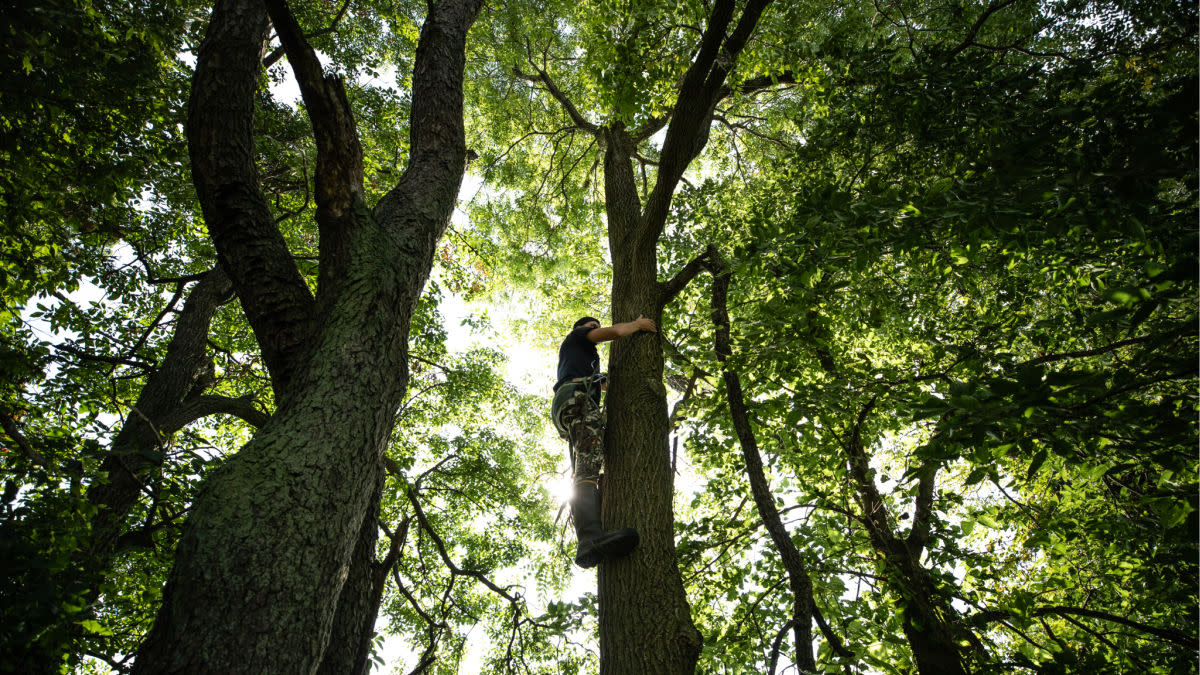

Between the biblical rain and plague-level ticks, I called it quits on the run-and-gun mission an hour before sunset. The late season Wisconsin birds weren’t gobbling, and it was clear the public land I was hunting had plenty of other turkey hunters. As I hiked out, I tried to salvage the day by following a deer trail through 40 acres of thick timber.
Before reaching the end, a small clearing in the woods caught my eye because it looked like an ideal staging area for bucks. Up ahead, the unmistakable sight of a portable stand also caught my eye. It was about 12 feet off the ground, facing directly down the trail and strapped to a bare tree. In other words, it was the worst stand placement in the perfect location.
This isn’t an uncommon sight for me on public land, or even a lot of the private properties where I share permission. It seems as if we’ve been led to believe that the bulk of tree stand work involves pouring over onX until we find the perfect pinch point or far corner of an ag field, then hiking in to hunt. While e-scouting is incredibly valuable, it doesn’t take into account the minutiae of hanging a stand for the best possible outcome.
You’re Too Visible
Whitetail Properties land agent Alex Gyllstrom is a hang-and-hunt fanatic who frequents several states each fall in search of public land glory. He consistently sees hunters across the Midwest make the same mistake, whether it’s early season, the rut, or post rut.
“Hunters too often set up where they want the deer to be, but not where the deer are,” Gyllstrom said. “They see a trail, or a rub, and set up right there instead of considering how an encounter would actually unfold.”
Not only is it easy to talk yourself into setting up in a weak spot just because it offers a nice view, but we often take that a step further by pointing stands directly toward where we expect deer to come from. Hunters just have an insatiable desire to see what’s going on. You know who else possesses that same desire? Prey animals like whitetails. They always seem to notice 200-pound lumps hanging off trees that weren’t there the day before.
The simplest way to set up better, aside from blending your onX work with boots-on-the-ground scouting, is to hang your stand facing away from the most likely place a deer will approach. I’m a right-handed shooter, so my ideal shot is to the left. That means I set my stands with the idea that when a buck does pass, he’ll be on my left side. By keeping stands parallel with trails, you’re able to keep your movement, such as ranging a spot or drawing your bow, hidden. I do this with almost every setup—even on field edges where it’s so tempting to face out toward the groceries.
Just remember this simple bit of advice: Set up to kill deer, not see deer.
You’re Still Too Visible
Whether you’re a saddle junkie, use lightweight hang-ons, or put up monster two-person ladder stands, you should consider your odds of getting busted due to lack of elevation. Generally, the lower you sit, the higher the likelihood of getting spotted. If you’re hunting Western whitetails that don’t have generations of death-by-arrow coded into their DNA, getting 18 feet up isn’t as crucial. But if you’re in Illinois or Pennsylvania, 12 feet might not be enough.
This is especially true if your chosen tree doesn’t offer much cover. I run into this in Northern Wisconsin every year when I tote a climber into public land that is in timber production. The remaining trees worth climbing are often absolutely bare, and that means I push it to my personal limit of about 20 feet.
I also get busted a lot. Those deer look up, and without anything to break up my outline I have to accept the fact that I’m going to get spotted a fair amount. It makes me appreciate the multi-trunked basswood tree, or the perfectly positioned limbs on a cottonwood hanging over a river crossing. It doesn’t take much, and a few limbs can go a long way toward cluttering your silhouette and allowing you to maneuver into shooting position.
Don’t ruin a good thing, either. New hunters often think they need to open up shooting lanes that you could drive an F-150 through. Keep your shooting lanes just big enough to slip an arrow through, but still dense enough to hide you. And this may seem obvious, but it’s worth touching on: As the season progresses, leaves fall and thick cover becomes thin. Don’t get in a situation where you over-trim in September and rob a spot of cover for November.
Why Good Gear Matters
You get what you pay for in the hunting world, and that’s especially true with tree stand gear. Good equipment in the form of saddles and tree stands allows you to get set up more quickly and quietly. When you always have the ability to get in the right spot in the right tree, you’ll stop settling for easier, less optimal setups.
For Gyllstrom, the best system is a two-pronged approach to mobile hunting. “For years I only used a lightweight stand and sticks that are designed specifically for the job, but now I mix in a saddle, depending on the circumstances.”
This method allows him to adapt to a wide variety of scenarios, whether he’s wandering the hardwoods in Illinois or eyeballing the only tree in an entire county in Kansas. A lightweight stand and saddle can get you into any tree in whitetail country—the same can’t be said for steel hang-ons and ladder stands.
In a nutshell, finding a spot and identifying a good tree only get you part way to a short blood trail. You still need to think through the exact positioning of your setup so that you’ve got the least chance of getting pegged by passing deer before they get into shooting range. Stay hidden, get in and out with minimal detection, and always keep the wind in your favor.
Stay in the loop with The Wired to Hunt Newsletter
Related
Gear
Opinion: Saddles Will Never Replace Tree Stands

Gear
Answering the 3 Most Common Questions About Tree Saddle Hunting

Gear
Saddle Hunting 101: Why You Should Try a Tree Saddle
The comments section requires Functionality cookies. Please enable Functionality cookies in Cookie Settings to view this content.