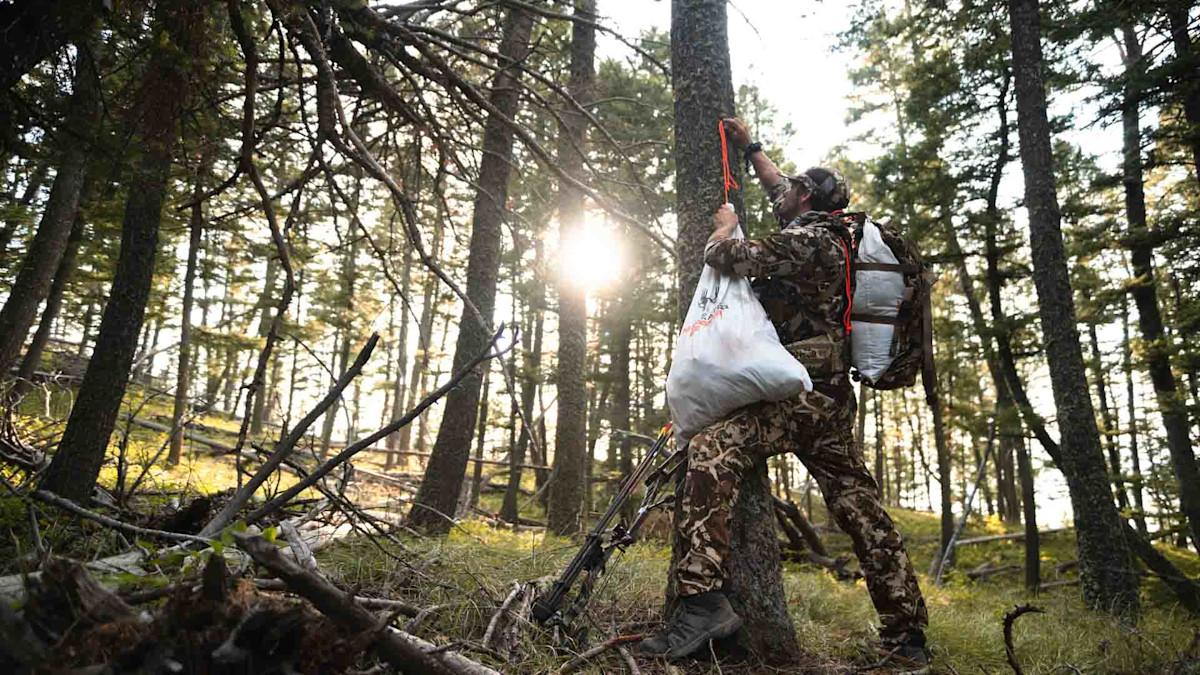

It happens to every hunter eventually. Whether you’re hunting solo in the backcountry or you take a big buck, bull, or bear at last light, you’ll suddenly find it impossible to get your meat out of the woods during the light of day. While you can chance an all-night pack out, this isn’t always a good idea in rough terrain or grizzly country. In that case, you’ll have to leave your meat in the woods overnight.
In all my years of hunting and guiding, I’ve left a lot of meat hanging until the next day, and I’ve also spent countless sleepless nights worrying about what I might find in the morning. While things usually go smoothly, I’ve faced some worst-case scenarios, like having an entire deer devoured by coyotes and having to drive a bear off a half-eaten elk. To avoid these nightmares, here’s a few things you can do to ensure you have a smooth packout come morning.
Prepare Ahead of Time
The easiest way to keep game meat safe overnight is to hang it out of reach of predators. Not only will this keep scavengers from getting to your meat before you do, but it will also help air to circulate and cool the meat in warmer weather. While it may seem easy enough, getting even a small doe, let alone an elk or moose quarter into a tree is a lot harder than it looks. So, if you’re hunting in an area where you may have to leave game for the night, make sure you prepare with the right supplies.
If you’re planning on quartering and packing your animal, you need quality game bags. Not only do game bags both help to keep meat dry and clean, but they also help prevent the spread of scent that can attract scavengers. Good quality game bags will keep your meat safe from bears and coyotes as well as arboreal scavengers like pine martens, fisher cats, and even mountain lions.
Whether you’re hanging meat or a whole animal, you’ll need some serious cordage. Carry at least 30 to 40 feet of nylon rope and/or 15 to 20 feet of paracord. While it may seem easy to get meat into a tree by yourself, it always ends up being a lot heavier than you think. I like to carry three to five inexpensive pulley wheels or even a small block and tackle set up to make the process a little easier.
Hang It High
Whenever you hang a carcass or meat in a tree, it’s important to get it high and away from tree trunks or other climbable areas. It can take a bit of searching to find the right spot, but it’s incredibly important not to rush the process, or you can risk losing everything.
Look for a lone tree that’s at least 50 to 100 yards away from the gut pile or butchered carcass. Try to find a tree with thicker branches that can bear heavy weights. Make sure the branch you use is at least 10 to 15 feet off the ground and then fling your rope over it. Attach your pulley or block and tackle to the rope and then tie it off to your meat or animal. Pull the rope and raise the meat until it’s nearly touching the branch, then tie it off securely to a nearby root, rock, or tree at ground level with a bowline or hitch tie.
Once your meat is secure, sweep the area and make sure there are no errant blood drops or other refuse that may attract scavengers to the hanging meat.
Cache Under Cover
While it may be easy to butcher and hang something as small as a deer or antelope by yourself, taking on a larger animal like a moose or elk is an entirely different story. Additionally, there are a lot of places such as deserts or open plains, where finding a good tree to hang your meat just isn’t an option. In either situation your only option might be caching your game on the ground.
The key to caching meat or a whole animal for the night is to cover it as much as possible. If you’re in an area with a lot of rocks or even a handy cave, you can move the meat in game bags or even the whole animal into the cave or a gap in the rocks and then cover it over with stones. However, if the animal is too large to move or you don’t have time to quarter it out, you’ll have to cache it where it lies.
Field dress the animal and then move the entrails 100 to 200 yards or more away from the carcass. Next, try to find vegetation such as pine boughs, sage, or other brush, cut it free, and use it to cover every visible part of the carcass. Covering the animal with vegetation won't stop a predator who finds it, but hiding it from sight will make that prospect slightly less likely. Finally, make sure you didn't leave a trail of blood or refuse between the cache and gut pile that predators might follow.
Play the Wind
No matter how you stash your game meat overnight, it’s extremely important to play the wind. I’ve glassed grizzly bears following scent trails for over a mile in open, windy areas, so whenever you can, do your best to leave meat in sheltered areas that block the breeze.
Try to hang or cache meat in sheltered inland valleys, dense timber, or deep coulees and canyons where the wind is less likely to carry the scent very far. If you’re forced to leave it in a more open or windy area, you can rub game bags or the hide of an animal with natural scents such as crushed pine needles or even wet dirt to help hide the smell.
It should be noted that, while many hunters believe that urinating around the area will help cover smells or even scare off predators, it often has the opposite effect. Many larger predators, including bears, wolves, and coyotes, will actually be attracted to the smell of urine and will often investigate the area instead of running away. Small rodents such as mice and rats can also be attracted to the smell of urine due to the salt content, so just hold it until you’re a few hundred yards from where you hang your game meat.
Sleeping More Soundly
The fact is, aside from sitting out in the field all night and guarding it (which can be extremely dangerous), there is no real way to guarantee your meat will remain safe throughout the night. Aside from scavengers, things like unexpected weather events can cover or ruin your meat, and even other human hunters can steal your bounty, speaking from experience.
But if you go in prepared and take the proper precautions, you’ll be able to get a decent night’s rest and wake up refreshed and ready to claim your hard-earned reward once the sun finally does rise.
Stay in the loop with The MeatEater Newsletter
Shop
Related
Hunting
How to Keep Your Game Meat Safe Overnight

Hunting with Dogs
How To Keep Your New Puppy From Needing An Emergency Vet Visit


Conversation