I’m not sure how 100 yards became the go-to sight-in distance for rifle hunters. Maybe it’s because 100 is a nice round number, or because 100 yards is the length of a football field, or simply because hunters rarely need to take a shot much beyond that.
Sighting in at 100 yards makes some intuitive sense, but is it the best distance to optimize your odds of making a good shot?
That depends on how you hunt and what cartridge you use, but it’s a question worth considering. Even high-powered cartridges can quickly drop out of the vital zone when zeroed at 100 yards. A 165-grain .308 Win., for instance, drops 14 inches at 300 yards, which is enough distance to turn a good shot into a clean miss on a whitetail.
In that example, it would be better to sight in at 240 yards. That way, a 100-yard shot is three inches high, but a 300-yard shot is only 4.5 inches low. That would let you hold on the vital zone all the way out to 300 yards without having to calculate holdover. You just point, aim, and fire.
Optimize Your Hunt
That’s what I mean by “optimize.” I’m looking for the best sight-in distance that will let me hold dead-on as far as possible (or, at least, as far as I’m willing to shoot). Also known as maximizing your “point blank range,” this will change with each cartridge, and there will be some variance depending on what bullet you use and its velocity.
I’ve compiled a chart below of some representative examples of common hunting cartridges, but I also want to walk you through how you can find the same information for your particular setup.
- Find a ballistics calculator.There are many available, from paid apps to free browser tools.This onefrom Hornady is free and easy to use.
- Compile your inputs.Most of these can be found on the ammo box or product webpage, such as bullet weight, ballistic coefficient, and bullet diameter. (You may need to look up your bullet diameter in fractions of an inch if you use a millimeter cartridge. For example, a 6.5 Creedmoor bullet has a diameter of 0.264 inches.) The one input that can’t be found on the box is bullet velocity. To find this, you’ll need to head to the range with a chronograph and record how fast the bullet is traveling at the muzzle of your gun. This is likely to be different from what’s published on the box, so shoot as many rounds as you can, and use the average.
- Optimize the sight-in distance.This takes some trial and error, but as you can see from the table below, it will probably be between 200-300 yards if you’re looking to make a max range shot of 300-400-yards.One thing to note: Pay attention to the bullet rise between 100 and 200 yards. If you push your zero distance out too far, the bullet could be more than four inches high at those middle ranges. That’s not ideal, especially considering the fact that you’re more likely to take a 150-yard shot than a 300-yard shot. Plug in different zero distances until the trajectory table looks like you want it to at every reasonable distance.
- Verify in the real world.Your ballistic app is smarter than you, but you still need to verify your results in the real world. Get out to the range and make sure your bullets are landing where you want them at the ranges you plan to hunt.
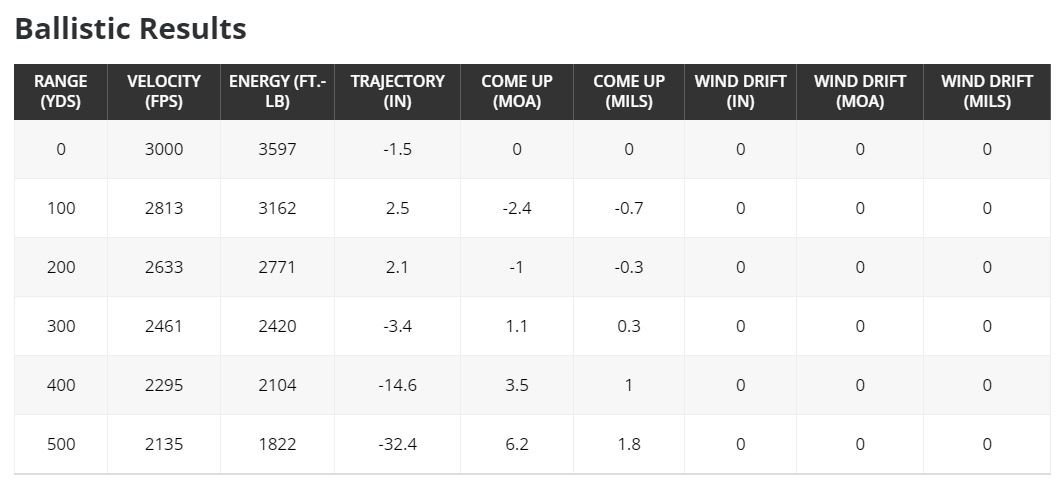
For example, if I wanted to find the best zero distance forthese 180-grain .300 Win. Mag. loads from Sig Sauer, I’d input a 180-grain bullet with a .507 BC, a .308-inch bullet diameter, a 3,000 fps muzzle velocity, and a 1:11 twist barrel.

Adjusting the zero distance to 250 yards would put me about 2.5 inches high at 100, two inches high at 200, and 3.4 inches low at 300.
That’s great if my max distance is 300 yards. If I want to shoot out to 400 yards without adjusting my scope, I might zero at 330. That would put me 4 inches high at 100, 5 inches high at 200, two inches low at 300, but only seven inches low at 400. That’s not as ideal for a 100- to 200-yard shot, but it’s still in the vital area on an elk, and I could shade a few inches low at those closer distances.
Again,youroptimal sight-in distance will vary depending on the distance you expect to take a shot. If you haven’t practiced at 400 yards and aren’t comfortable with pulling the trigger at that yardage, there’s no reason to sight in at 330 yards. But if you’re confident in taking a shot out to 300, and you’re hunting on a landscape where such a shot is possible, sighting in beyond the standard 100 yards is a good idea.
The Data
Without further ado, here are suggested sight-in distances for ten of the most popular cartridges capable of long-range shots. Many of these recommendations come courtesy ofTerminal Ballistic Research, which is a great resource for all things rifle ballistics. To see the specific bullet and load used in the calculation, click on each cartridge name.
I optimized many of these for shots from 0 to 350 yards, but you don’t have to. You might decide that you’d rather have less bullet rise at 150 or 200 yards and compensate more for bullet drop at longer distances. The point is to optimize your bullet’s flight path so you don’t have to dial a scope or use holdover marks at the ranges you’re most likely to take a shot.
| Cartridge | ||||||||
|---|---|---|---|---|---|---|---|---|
| .308 Win. | Yardage | 50 | 100 | 200 | 247 | 300 | 350 | 400 |
| Traj. (in) | 1.53 | 3.27 | 2.51 | 0 | -4.66 | -10.99 | 19.3 | |
| 300 Win. Mag. | Yardage | 50 | 100 | 200 | 260 | 300 | 350 | 400 |
| Traj. (in) | 1.12 | 2.70 | 2.50 | 0 | -2.75 | -7.49 | -13.78 | |
| .30-06 Sprg. | Yardage | 50 | 100 | 200 | 267 | 300 | 350 | 400 |
| Traj. (in) | 1.67 | 3.61 | 3.44 | 0 | -2.78 | -8.44 | -15.98 | |
| 6.5 Creedmoor | Yardage | 50 | 100 | 200 | 245 | 300 | 350 | 400 |
| Traj. (in) | 1.47 | 3.16 | 2.36 | 0 | -4.73 | -10.93 | -19.8 | |
| .270 Win. | Yardage | 50 | 100 | 200 | 270 | 300 | 350 | 400 |
| Traj. (in) | 1.50 | 3.36 | 3.32 | 0 | -2.33 | -7.52 | -14.43 | |
| 7mm Rem. Mag. | Yardage | 50 | 100 | 200 | 260 | 300 | 350 | 400 |
| Traj. (in) | 1.44 | 3.26 | 3.03 | 0 | -3.43 | -9.48 | -17.75 | |
| .243 Win. | Yardage | 50 | 100 | 200 | 275 | 300 | 350 | 400 |
| Traj. (in) | 1.24 | 3 | 3.18 | 0 | -1.78 | -6.51 | -12.95 | |
| 7mm-08 Rem. | Yardage | 50 | 100 | 200 | 252 | 300 | 350 | 400 |
| Traj. (in) | 1.3 | 2.9 | 2.4 | 0 | -3.7 | -9.2 | -16.4 | |
| .223 Rem | Yardage | 50 | 100 | 200 | 215 | 300 | 350 | 400 |
| Traj. (in) | 0.5 | 1.5 | 0.6 | 0 | -5.5 | -10.8 | -18.1 | |
| .22-250 Rem. | Yardage | 50 | 100 | 200 | 230 | 300 | 350 | 400 |
| Traj. (in) | 0.3 | 1.4 | 0.9 | 0 | -3.8 | -8.2 | -14.1 |
The Three-Inch “Rule"
The shooting range you use might not allow you to put a target at a precise distance between 200 and 300 yards. In that case, you can simply sight in the rifle at 100 yards at whatever distance above the point of aim the trajectory indicates.
You’ll notice that for many of these cartridges, that distance above your point of aim at 100 yards is about three inches. Hunters have long noted that sighting in most large, centerfire rifle cartridges three inches high at 100 yards will allow them to shoot out to 300 yards without any adjustment. If you’re not a mathy person and would rather not mess with ballistics apps, the three-inch rule is a decent shortcut for most common hunting cartridges.
But why go through all this trouble and thought? Why not just sight in a rifle at 100 yards and dial the scope for longer shots? For one thing, that forces you to trust your scope’s internal mechanism. That will work just fine most of the time, but having tested and reviewed dozens of scopes, I’d rather not introduce additional variables.
Plus, as Nathan Foster told me, consulting a drop table and dialing a scope can add precious seconds you can’t afford to waste. Foster is the founder of Terminal Ballistics Research and a hunting guide in New Zealand.
“If a client is sighted dead-on at 100, and we later see an animal across a gully, the animal will sometimes pick up our scent due to eddying winds within the time frame of the hunter mucking about getting down into position, reading a chart, and then dialing his scope,” Foster said. “The same problems can occur when trying to work out which holdover reticle to use if the client is using a holdover scope. In other words, the wind can move faster than the client.”
Believe it or not, a similar thing happened to me last week on a whitetail hunt. I was hunting a small property where most of the shots are within 100 yards, so my rifle was zeroed at that distance. I crested a small hill and saw a buck already staring at me from about 230 yards away. That's far enough that I knew I'd need to dial my scope a bit for the 6.5 Creedmoor cartridge, but I didn't have the exact numbers handy, and by the time I'd gotten into a shooting position, the buck had high-tailed it. If my rifle had already been zeroed at 245 yards, as per the table above, I would have stood a better chance at getting a shot off.
We all know that putting in a little extra work on the front end of a hunt can lead to more success on the back end. The same holds true with your rifle. Maximizing your point-blank range isn’t necessary for many hunters, but if you think you might take a shot beyond 150 yards, it’s definitely worth considering.
Stay in the loop withThe MeatEater Newsletter
Shop
Related

Firearms
AR-15 Workbench: How to Sight in an AR-Type Rifle
Firearms
Video: How to Sight in a Rifle