


If you asked most American hunters to name every kind of rifle action, they’d probably forget about the straight pull. While fairly common overseas–most famously on the Austro-Hungarian Mannlicher rifle–straight-pull bolt guns never really caught on here in the States.
The reasons for this are unclear (which is how journalists say “too complicated for me to figure out”), but at least two companies are trying to convince us Yankees to give the straight pull a chance. Savage introduced the American-made Impulse rifle a few years ago, and more recently, Beretta entered the world of hunting rifles with the BRX1.
Will the BRX1 become a mainstay of deer blinds and elk mountains? Or is it a flash-in-the-pan novelty destined for obscurity? Keep reading, and you can decide for yourself.


Specs and Features
- Barrel Length: 22"
- Barrel Thread: 5/8" x 24
- Overall Length: 43"
- Recoil Pad: Extralight®
- Threaded Barrel: 5/8" x 24
- Weight Unloaded: 7.3 lbs
- Available Calibers: 6.5 Creedmoor, .300 Win. Mag., .308 Win., .243 Win.
- Magazine: Removable, 5 Rounds
- Scope Mount: Yes, Picatinny rail
Advantages of a Straight Pull
Straight-pull rifles are exactly what they sound like: the user pulls back on the bolt to open the action and remove the spent casing, and then pushes the action forward to load the firearm.

The biggest selling point for this type of action is that it’s faster than your typical bolt gun. Because it cuts the number of movements in half, the shooter can (theoretically, at least) get off the same number of shots in a much shorter amount of time. Reducing the number of movements also allows the hunter to stay on target more easily than if they had to raise and lower a more traditional bolt-action rifle. While hunters always hope to avoid a followup shot, they’re often necessary. And when they are necessary, they’re almost always rushed. Being able to cycle the action quickly–even by just fractions of a second–might make all the difference in the field.
Because of this, straight-pull guns are also popular on pig hunts or driven hunts where multiple shots are taken in quick succession. Semi-autos fill this need for most American hunters, but for those who live in states where semi-autos are more difficult to own, a straight-pull might be the no-nonsense solution.
Straight-pull rifles are also a great option for left-handed hunters or hunters with lefties in the family. Because the bolt handle’s only job is to give the shooter a way to grip the action, it can be affixed on the left or the right and at different angles. The BRX1 I reviewed came shipped with the bolt in the left-handed position. In a few quick steps and without any tools, I was able to flip the bolt to the other side without any trouble whatsoever. If you really want to go crazy, you could even put the bolt opposite your strong hand to cycle the action without taking your trigger hand from the gun.

What’s more, because there is no upward motion of the bolt handle, some straight pull designs interfere less with the scope and allow for lower scope rings to be used. I still had to use medium-height rings with the BRX1 because the top picatinny rail is so long that it contacts the front bell of the scope. But the low position of the bolt handle still reduces interference with accessories like quick throw levers and scope leveling tools.
Disadvantages of a Straight Pull
A straight-pull rifle offers several potential advantages, but what about disadvantages?
Cost is the most obvious. Straight pulls tend to be more expensive than their bolt action counterparts thanks to the complexity of the design. More moving parts requires more research and development, higher build costs, and more precise machining. Even Savage, which made a name for itself building inexpensive firearms, sells their Impulse rifle for $1,399 MSRP. The BRX1 comes with a $1,599 MSRP, and the price goes up from there if you’re looking for a modern straight-pull from a different European company.
Cost isn’t the only potential downside. Engineers will tell you that the more complex a system is, the higher the likelihood of failure. Semi-autos get a bad rap in the field because hunters worry that they’ll jam at the moment of truth. Straight pulls come with a similar risk. Dirt, fouling, or an overpressured cartridge can lock up the mechanism, which would negate the straight pull's greatest strength.

Average Joe deer hunter will probably never experience this, and traditional bolt guns can malfunction, too. But there is some precedent for poorly designed straight-pull rifles failing in the field, as with Canada’s infamous Ross rifle used in World War I. That rifle’s troubles were due to more than its action, but it speaks to the potential finickiness of the straight-pull.
It is also theoretically possible to bash yourself in the face when you pull back on the bolt. The odds of this are low, but I can see it happening in the heat of a hunt, especially if the scope is mounted too far forward. If you hope to take advantage of those quick followup shots, just be sure to practice cycling the bolt without taking your head off the stock.
First Impressions: Weight, Trigger, Safety, Action
Those are the pros and cons of straight-pull rifles in general, but what about the BRX1 specifically? I’ve been shooting Beretta’s new offering for a few months now, and I have both good news and bad news to report.
I always eat my vegetables first, so we’ll start with the bad news. For starters, it’s heavy. Beretta advertises the unloaded weight of the 6.5 Creedmoor rifle as 7.3 pounds, but my scale showed 7.75 pounds. That matched up more closely with how the rifle feels in the hands, and with a Sig Sauer scope and scope rings, the entire rig is nearly 10 pounds with a full mag.

How much this matters to you depends on who you are. But for a medium-power cartridge like the 6.5 Creedmoor, I much prefer a lighter rifle. The .300 Win. Mag. model is listed at the same weight, and hunters would benefit from that extra recoil absorption. But straight pull rifles are supposed to be quick handling and quick shooting, and some of that benefit is lost if the rifle is difficult to shoot accurately off-hand. That’s a matter of personal opinion, and the model with the carbon fiber barrel shaves off a few ounces. But when comparing the BRX1 to other bolt guns (and even some other straight pull rifles), I think some hunters will be turned off by the weight.
The trigger came from the factory set just a hair above two pounds, and the trigger can also be set at 2.6 pounds and 3.3 pounds. That’s an appropriate range for most hunters, though the majority of adjustable triggers these days can be adjusted throughout the entire range rather than at two or three specific settings. The trigger must also be removed from the action to access the adjustment screws, which is less convenient than many other triggers that are externally adjustable. The trigger itself is good, but I could sometimes feel the slightest bit of creep prior to the break.
I know it sounds nitpicky to point out some of these things, and previous generations of hunters would (quite fairly) be blown away by the crispness of this factory trigger. But comparing it to other triggers at this price point, I gotta say, I was underwhelmed.


Moving from the not-so-great to the so-so, the safety mechanism is robust but takes some getting used to. It’s located on the rear of the action mechanism and features three positions–bolt locked/no trigger pull, bolt unlocked/no trigger pull, and bolt unlocked/trigger pull. I like that it’s ambidextrous, and the large button would be easy to manipulate with gloves. But it does take a good amount of force to operate, and it makes a grinding sound when it moves. To take it off “safe,” it also requires the user to push the button forward and then up to lock it in place. This makes it virtually impossible to accidentally bump the mechanism to the “fire” position, but it could be a hangup in the moment of truth.

The rifle is heavy, the trigger is ok, and the safety is a little wonky, but the BRX1 comes through where it counts–that is, in the action. It feels strange to cycle a bolt-action without having to unlock it first, but I found it to be smooth and reliable. The action locks up tight when closed, and I never had any trouble opening it after firing a round or pushing a new cartridge into the chamber. The action is not only reliable—it's really fun to use. Don't judge one of these rifles until you get one on the bench and put a few rounds downrange. If you didn't understand the appeal of a straight-pull before, you will once you do.
Caliber Conversion?
One of the biggest selling points of the BRX1 is that users can quickly and safely convert the rifle to fire different calibers by swapping the barrel and bolt head. This has become more common on hunting rifles in the last few years, but Beretta makes it even easier than other rifle makers. That’s because they offer caliber conversion kits that come with a new barrel, bolt head, and magazine (if needed)–right from the factory. The parts are all coded so users can be sure they’re using the correct components.
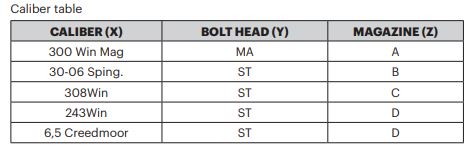
Conversion kits are $775 from Beretta, which is about half the cost of the original rifle. The kit includes a barrel that has already been fitted to the receiver, so the user can simply remove the barreled receiver from the stock and swap it out for the new one. All of the calibers offered use the same bolt head except for the .300 Win. Mag., and Beretta offers five-round magazines for all those same calibers.
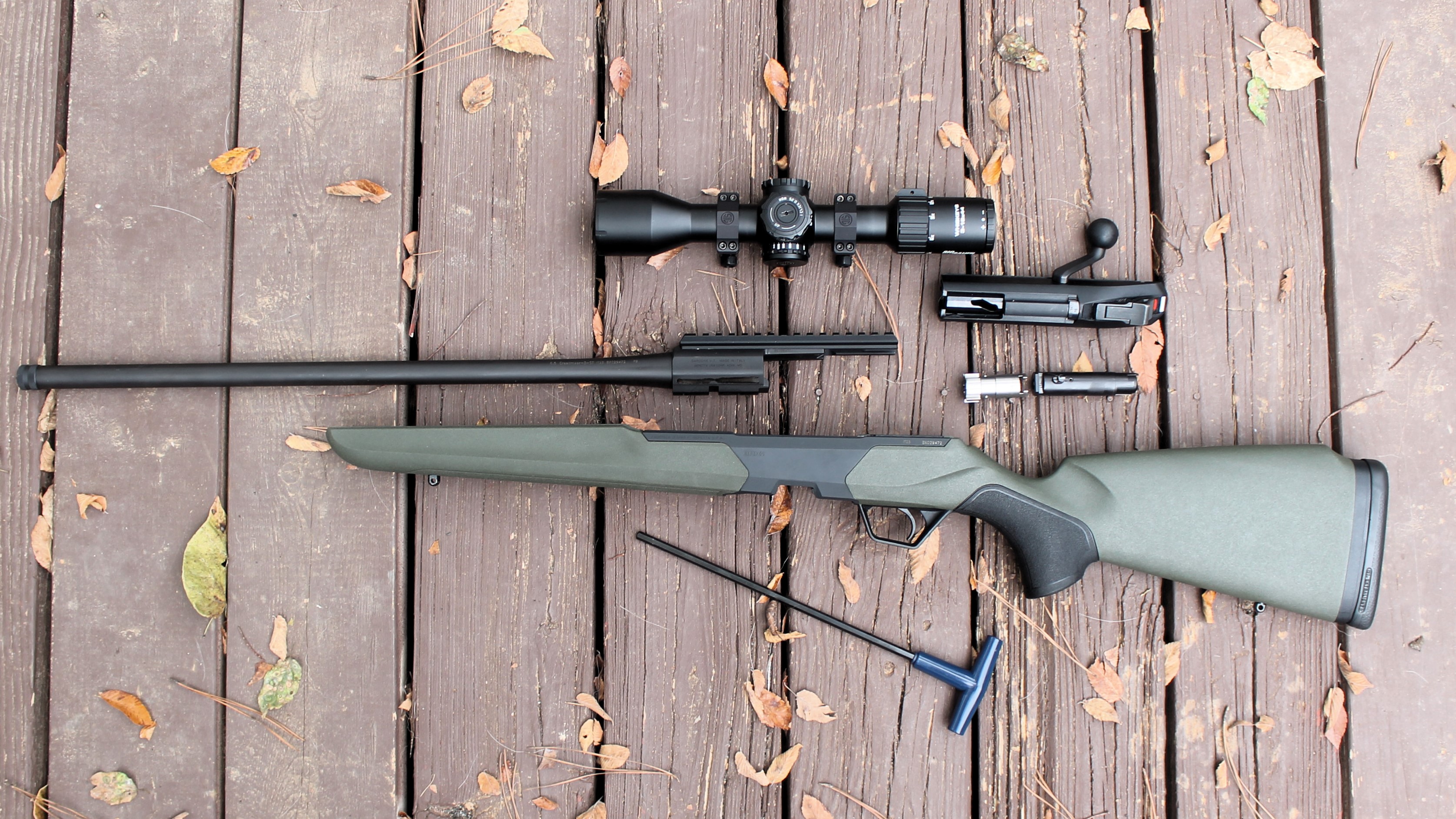
Some might argue that if you’re willing to spend the money on a new barreled receiver from the same company that made the original rifle, many bolt-action rifles allow for the same kind of “caliber conversion.” That’s true, but this system from Beretta removes all the guesswork and gives you everything you need to ensure your rifle is safe and effective. It might not be for everyone, but if you like the BRX1, Beretta’s system allows you to change from a .243 Win. deer gun to a .300 Win. Mag. elk rifle in a matter of just a few minutes.
At the Range
I’ve already covered most of what goes into the experience of shooting a rifle: the BRX1 is fairly heavy at nearly 10 pounds, the trigger is good but not great, and the action cycles smoothly without any hiccups. The only other thing to cover is accuracy, which you can check out in the graph below.
All groups shot from 100 yards using MDT bipod and bags. Velocity recorded with a Garmin Xero C1 Pro Chronograph.
| Ammo | 140g Open Tip Match | 140g Accubond | 130g Controlled Expansion Tip | |||
|---|---|---|---|---|---|---|
| Three-Shot | Five-Shot | Three-Shot | Five-Shot | Three-Shot | Five-Shot | |
| Small Group (in) | 0.75 | 1.2 | 0.5 | 1.0 | 0.7 | 1.65 |
| Average Group (in) | 0.89 | 1.48 | 0.71 | 1.15 | 0.89 | 1.75 |
| Average Velocity (fps) | 2669 | 2591 | 2725 |
The most significant thing I noticed during these tests is that the BRX1 is finicky about heat. I say that because the rifle would often shoot its first three shots within a respectable diameter, as you can see from the chart above. Then, as the barrel heated up, the fourth and fifth shots would stray from the center, which increased the average group sizes considerably.
Some say five-shot groups are the only way to test a rifle’s accuracy. For those folks, these aren’t great results. Others argue that three-shot groups are the best way to test the accuracy of a hunting rifle because you rarely if ever take more than three shots at one time in the field. If that’s you, the BRX1 is perfectly accurate.

I can understand where both camps are coming from, so I’ll leave this one for y’all to fight about in the comments. I’ve seen this kind of thing on other hunting rifles as well, so even though I would also prefer a rifle that can string together five good shots, it’s not uncommon for a hunting rig to be sensitive to heat.
My only other observation is that the rifle did seem to prefer the 140-grain Accubond loads pictured above, so if you purchase the BRX1 in 6.5 Creedmoor, that’s a good place to start.
Last Shot
At the end of the day, the BRX1 delivers on its promise, but I’m not sure it’s a promise many American hunters were asking to be made.
Beretta’s new offering is a robust, reliable straight-pull hunting rifle that offers good accuracy (with the caveats mentioned above) along with several interesting and useful features. At the same time, the straight pull’s biggest advantage–quicker followup shots–is diminished by the easy prevalence of semi-auto rifles, especially in the U.S. It doesn’t offer better accuracy than AR-10’s at this price point, and those rifles offer a significantly faster rate of fire and perfectly acceptable reliability. Even compared to a more traditional bolt gun, I’m not sure the BRX1 is that much faster, especially if you spend time practicing your followup shots.
If you’re tickled by a gun that breaks the norm and want the chance to rack a straight pull on your next hunt, I’m with you. It’s a cool gun. But don’t buy a BRX1 because you think it’ll make you that much more deadly in the field. Only you can make that happen, no matter what kind of action you’re using.
Stay in the loop with The MeatEater Newsletter
Shop
Related

Firearms
Is Wilson Combat’s New Rifle All Hype or the Real Deal? (Full Review)
Firearms
Full Review: Weatherby Model 307 MeatEater Edition Rifle

Firearms
The Ultimate Mountain Rifle? Tikka T3x Lite + MDT HNT26 Stock (Full Review)
The comments section requires Functionality cookies. Please enable Functionality cookies in Cookie Settings to view this content.