
This is the first segment of a three-part elk hunting story by FHF founder, Paul Lewis. You can read thesecondandthird instalmentshere.
The silence was the worst part. Not the sudden silence of elk themselves, but the silence right after the shot, that sudden crushing, anxiety-filled pit in my stomach. For the entire morning of September 21st, the river bottom I was hunting was a chaotic, screaming, bugling rut fest. Now, the big satellite bull, the one I had just wounded with a poorly placed arrow, had vanished into the head-high marsh grass. The herd had fallen quiet, melting away into the dark jungle of aspens and cottonwoods on the other side of the stubble field.
I stood there, my heart hammering against my ribs, a cold knot of regret tightening in my stomach. The "fifty-yard single-pin strategy," a technique I had only seen described online and had never actually practiced, suddenly felt like a profound self-betrayal.
I raised my binoculars, hands still shaking, and picked him up at eight hundred yards. Through the glass, I could see the fresh, red stain running down his right side, starting just below his withers. He was moving, bugling, and very much alive. The shame of a poorly placed shot was corrosive. The entire season, a lifetime of planning, and a sixteen-year wait for this specific tag now felt tainted by a single, high, limited-penetration mistake.
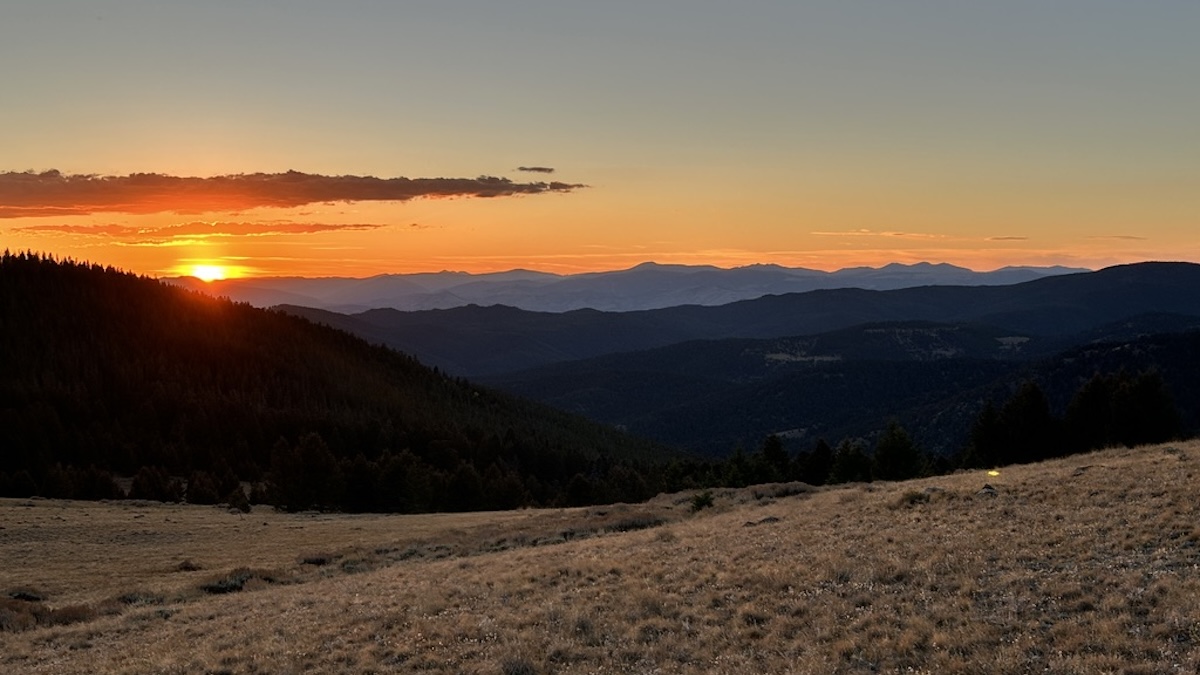
As a kid in the 1980s, my world was bounded by my Montana hometown and the old family homestead that sat halfway up the dirt road leading to a historic ghost town. I spent my summers wading in the cold waters of the creek that ran below our family cabin, catching small, wild brook trout, and exploring the granite boulders stacked like Legos in the hills above.
One of my most distinct memories of this place as a kid was drinking water directly out of a steel pipe my family had set up to collect the cold spring water seeping directly out of the mountain. As a child, I didn't grasp the unique history of this landscape; it was simply my playground. I didn't truly discover its pull until the summer of 2016, when I climbed a hill in our meadow to scatter my mother's ashes alongside my father's.
When I opened my email in mid-summer of 2025 to find I had drawn the coveted bull elk tag for a nearby unit, the weight of the past came rushing back. I hunted it before in 2009 but spent that entire season on the other side of the range, relying on leads from friends and never even considering the mountains behind our own property. The math of drawing this tag a second time was brutal; even with sixteen bonus points, my odds were barely three percent. The pressure that came with that number wasn't just about the search for a trophy; it was about honoring a multi-generational connection to this specific mountain range.
My family's roots here are literally etched into the earth. My grandfather, Wade V. Lewis Sr., a mining engineer, appropriated a claim for silver and lead in 1924. Twenty-five years later, he and two partners discovered radioactivity at the abandoned site, and when a visiting investor's wife found her chronic bursitis pain vanished after a few visits underground, word spread fast. What began as the Free Enterprise Uranium Mine, Montana's first, became the state's original radon health mine, a business my father ran for a time and my nephew Ryan still runs today.
On the other side of town, deeper into the mountains, lies the ghost town, a place of triumph and quiet tragedy. A Swiss immigrant named Peter Wys discovered silver here in 1868 and died mysteriously within a few years of the find. Norwegian entrepreneur Anton M. Holter acquired the claim in 1875 and developed the Holter Lode; by the late 1880s the town had boomed to 2,500 people.
Unlike the rowdy bachelor camps common to early Montana mining, this was a town for families with schools, churches, and the Fraternity Hall, built in 1893 and still standing today as part of Montana's smallest state park. It was a hard place to live; water was scarce and woodcutters stripped the surrounding hillsides bare to feed the stamp mills. The forest cemetery holds the quietest testament to that hardship: dozens of children's headstones, casualties of the brutal winter of 1888 and the diphtheria epidemic that followed. By 1931, the mines had gone silent and the rails were pulled up. Today, a handful of local families work to preserve what's left.

Our family property is not an old mining claim, as I'd always assumed. It was a homestead, carved out under the Forest Homestead Act of 1906. A Forest Service surveyor named Raymond Mauren walked our meadow in April of 1915, dragging his brass chains to map the boundaries out of what was then the Helena National Forest, and the land was patented to a man named George Walker the following spring. The small, one-room cabin on the property, now claimed by packrats, wasn't a miner's bunkhouse; it was Walker's home, likely built between 1913 and 1915. It's humbling to think this meadow once cleared by one man with a crosscut saw and a horse now serves as our sanctuary, where my parents' ashes rest in soil worked by hand over a century ago.
In the years leading up to drawing this tag, my wife Jen and I spent our summers running a rather large circuit of game cameras on the ridges above the property. We didn't do it with any real expectation of drawing the tag. We did it because we loved the land and wanted to know the wild neighbors we shared it with. It was about learning the terrain, discovering preferred trails, and understanding how the animals used this specific pocket of the mountains.
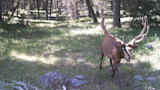
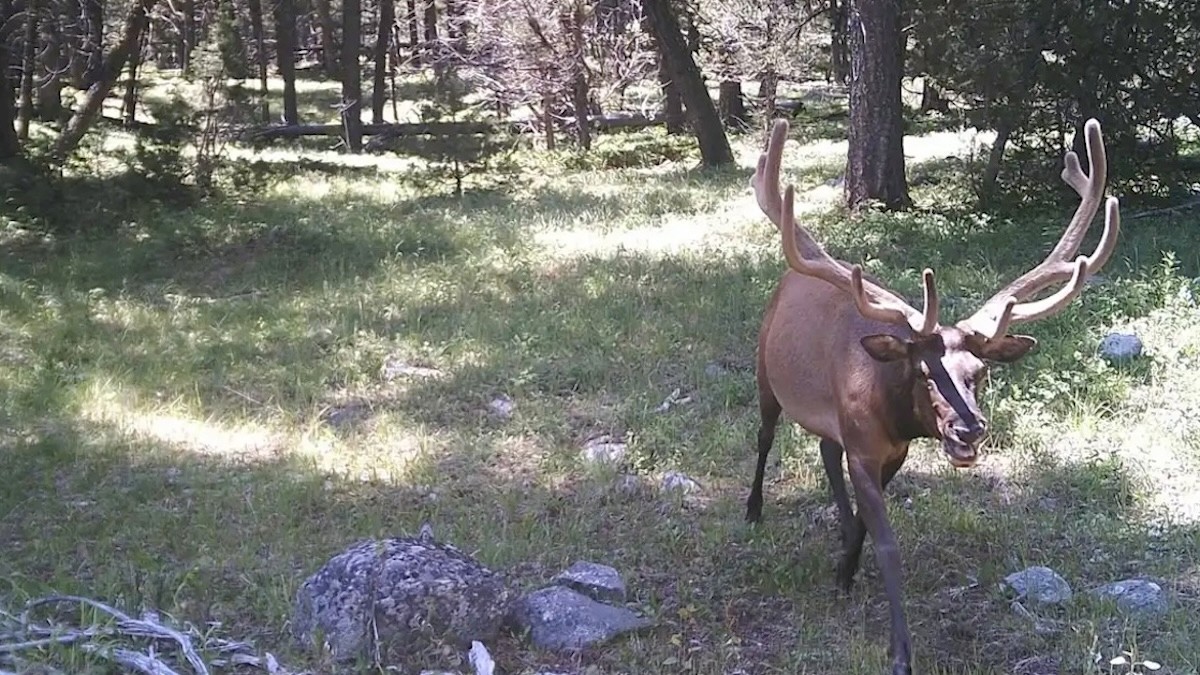
Through those cameras, we got to know the resident animals by name: Hank the Tank, a massive cinnamon-phase black bear; the non-shedding, hormone-addled "Cactus Bull"; Big Six, a large six-point with enormous whale tails; and a pair of six-point bulls we called Tall Guy and Wide Guy. Wide Guy was what I dream of when I think about bull elk: wide, symmetrical, and heavy, with long sweeping thirds and distinct, aggressively hooked brow tines. He was a digital ghost we watched grow season after season but had never seen in person, a theoretical target we never seriously expected to chase.

Over the years, those cameras taught us a critical lesson: our local elk almost always cleared out of our timber during the chaotic September rut, only filtering back into these drainages once the pressure of rifle season got underway. We tried to figure out their internal clocks, their preferred escape routes, and exactly where they were most likely to materialize. Those preseason images of Wide Guy kept me dreaming. He set the standard.
The unit in question is a lesson in the public-land paradox. It's managed as a premier trophy unit, yet anyone with a general tag can hunt spikes and cows for much of the season. On top of that, thousands of extra cow tags are distributed annually. Along with the hunters, this area has become a notorious playground for large groups of jeepers and UTV trail riders. You are never alone.
My season began in a smoky, orange haze on September 6th, delayed by a solemn trip to New Mexico for one last visit with my Uncle George, a lifelong hunter who passed away after a grueling battle with chronic illness. His parting words to me were that he'd be watching my hunt from wherever he was. Hunting and the outdoors had always been the biggest part of his life, and it was painful to watch him spend his last years stuck alone at home, relying only on old memories. It was a reminder that I wanted to make this season epic and earn more memories before I was too old to fully enjoy them.
My official first day of hunting was a scramble since I'd gotten back to Montana late the night before. By the second day, the reality of modern hunting pressure had set in, but I wasn't facing it alone. I'd found out late in the summer that two of my former law enforcement colleagues, Chris and Ed, had drawn the same coveted tag as a party. The three of us shared a long history as patrol cops and detectives. Chris and Ed with the Bozeman Police Department, myself with the Gallatin County Sheriff's Office. When you spend years working cases together, you develop a quiet shorthand, a dark humor, and a mutual understanding of human nature that carries over perfectly into the elk woods.
Ed is a gruff, salt-of-the-earth Montana native, raised in the hard-rock mining town of Butte, who'd give you the shirt off his back if he knew you needed it. He carries that proud Butte grit in everything he does. Ed and I had served on our local Special Response Team together, even working together as a marksman/observer team for a time. This is the kind of arrangement that builds a level of trust where your confidence relies entirely on the other man's eye and instinct.
Then there was Chris, a Louisiana transplant who hadn't just moved to Montana; he'd migrated here like a pilgrim chasing a calling, leaving the humid bayous and piney woods of the South for the rugged, uncompromising Montana lifestyle. Over the years he'd evolved into a meticulous, gear-savvy die-hard who lived for the physical challenge of the high country, and we'd always shared a mutual obsession with gear.

Our preseason scouting had kept us separate, they focused on the central area of the range while I stuck to the southern ridges around our family land. But our paths converged on September 7th. We met on our side-by-sides at the head of a long access road, only to find it already choked with other UTVs.
Further down the drainage, we passed a near-permanent hunting camp that had been there since at least the 4th of July, blatantly violating the fourteen-day camping limit. A twelve-foot wall of firewood and a circle of campers resembling a pioneer wagon train blocked access to the public basin behind. It was a stark reminder of the friction that builds when public resources grow scarce.
Eventually, my nephew Ryan gave me a tip and coordinated access to a piece of private river bottom. It was here, in the dense cottonwood groves and willow thickets, that the chaotic energy of the September rut climaxed.
Look out for part two next week.
Stay in the loop withThe MeatEater Newsletter
Shop

Related
Elk
31-Day Elk Hunt: Part 3, Coming Home
Elk
31-Day Elk Hunt: Part 2, Bad Luck and Good Buddies