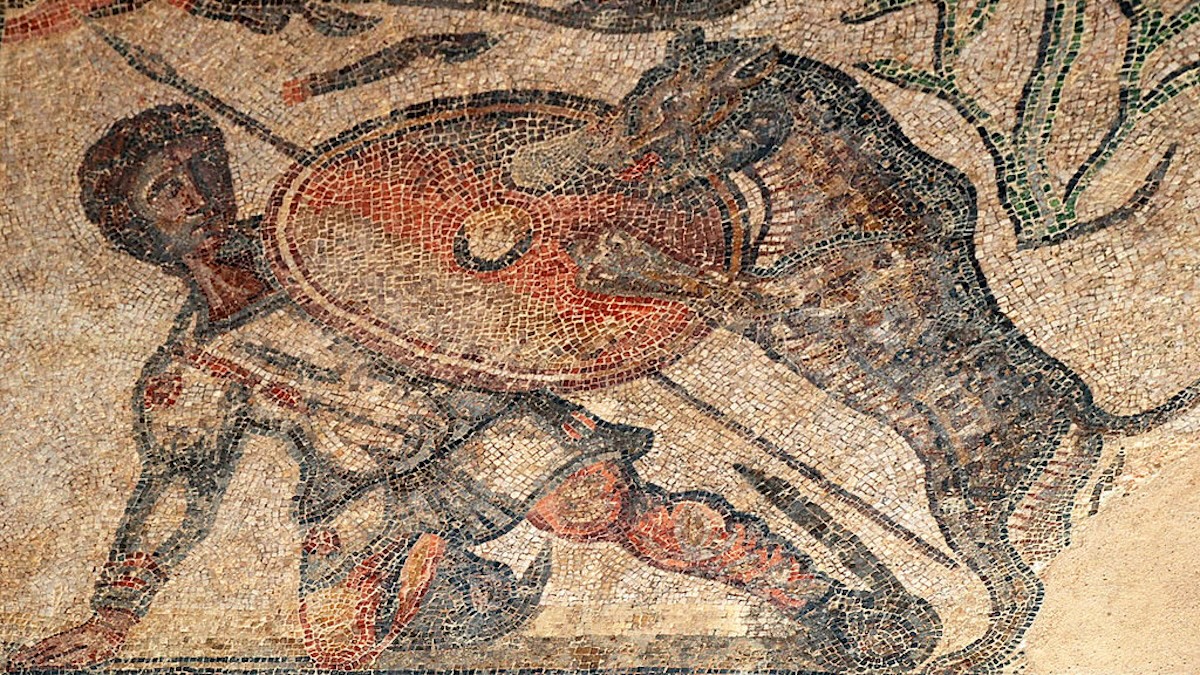

The echoes of Ancient Rome continue in our government, engineering, and the way we count Super Bowls. But Romans also sparked a less savory phenomenon: fake hunting.
Today, “canned” hunts for captive animals are regarded as violations of fair chase principles. But not so in ancient Rome, where staged “hunts” involving thousands of wild animals were common entertainment alongside chariot races and gladiator battles.
The ancient Romans were the dominant culture of the Mediterranean region for 1100 years, from 625 BC to 476 AD. At its peak, the empire ruled much of what is today northern Africa, Turkey, Germany, and Great Britain. Here in the United States, Roman influence can be seen in many common features of modern life, from the Constitution to the design of many of our bridges and sports arenas.
Roman culture was lopsided, with rich and powerful elites living lavish lifestyles propped up by lower classes and slaves. For distraction, the elites organized elaborate circuses in huge arenas for the masses. Russell Crowe’s “Gladiator” is fiction, but these coliseum events were all too real.
Large predators—lions, brown bears, tigers—were prodded to attack, kill, and eat criminals, Christians, and political enemies. But a special class of gladiatorial combat, called “venatios,” saw those animals killed for show.
Venatios pitted gladiators against all sorts of animals, including the predators mentioned above as well as hyenas, elephants, and giraffes. These slaughters could include 10,000 or more animals and extend over months. One piece of surviving mosaic art illustrates one prisoner getting his face bitten off by a leopard, which was evidently a crowd-pleaser.

Animals weren’t the only non-human life to suffer for the sake of Roman entertainment. In “Forest Journey, the Role of Trees in the Fate of Civilization,” John Perlin details how the Roman ax-men deforested Italy, surrounding nations, and even northern Africa, Lebanon, and Germany to fuel their empire. Without wood, the entire civilization teetered.
“To keep the Roman people from becoming too anxious over the declining economy and the constant specter of starvation, the rulers of Rome had to constantly find ways to entertain the population. The emperor Probus provided Rome with the greatest wild beast hunt that it had ever known,” Perlin writes.
“Since forests no longer grew near Rome, Probus ordered his legions to uproot giant trees and transport them to Rome. He then charged them with planting the trees in the Roman Circus which soon resembled a German forest, where thousands of wild animals—ostriches, stags. Ibexes and sheep—were let loose for the Romans to hunt and kill.”
All of this reflects poorly on human nature. The goal was not a quick kill, but a gory show. For example, Romans invented a specialized broadhead arrow with a wide flat blade. It was intended to behead ostriches so the birds would then run around, spraying blood from their severed necks. If this seems gruesome, consider that another popular entertainment of the day was burning people alive.
Outside the coliseums, Romans hunted for food and exercise, using nets, traps, and spears. Common prey included hares, boars, and dolphins. Professional teams of soldiers specialized in capturing bears and lions in pit traps, holding them in strong nets, and transporting them hundreds of miles to Rome for display.
Evidence of the Roman love of hunting can even be found in modern Great Britain. Some historians believe pheasants and fallow deer were imported by homesick Romans longing for a good hunt.
As with all great civilizations, Roman culture and society mixed the good with the bad. We can thank the Romans for many things, but conservationists can agree that their beliefs about the intrinsic value of wild animals wasn’t one of them.
Feature image via WikiCommons.
Stay in the loop with The MeatEater Newsletter
Shop
Related

Conservation News
When the Air Force Used Black Bears as Test Pilots


Wildlife Management
How Beavers Ended Up in South America

The comments section requires Functionality cookies. Please enable Functionality cookies in Cookie Settings to view this content.